In our house, we love looking at maps, just as much as the Brits love birdwatching. My favorite map is one I picked up on the Kings Road in London from one of those shops where people pay a lot of money for a not-so-useful-but-very-artistic gift to impress their friends, and then they ask the shop assistant to wrap it up for them in some expensive wrapping paper, in this case, the map. Three pounds for a piece of paper with an old European map printed on it, showing the state of Europe in 1897, from the perspective of the USA.
In 1897, Finland did not exist, nor did Poland. Ireland was not a divided country, while Romania was a third of its present size. Austria was Hungary and Hungary was Austria, while Germany and Turkey both claimed to be empires. Serbia and Bosnia were separate countries, as they are now after the killings and destruction that Yugoslavia underwent to get back to the state it was in over 100 years ago.

The Century Atlas Map of Europe, 1897
 100 years ago, no one knew where Macedonia was, but every one knew Constantinople. Now, you can choose the kind of Macedonia you want to go to (but not on a Greek map), whereas no one can go to Constantinople any more (you've got to go to Istanbul). Uskup was a relatively insignificant part of the Turkish empire. Now, with a slight change of name (Skopje), it's a relatively insignificant part of Europe. Greece was about as big as two Sicilies stuck one on top of each other, and it reached as far as Larissa. Crete was still considered part of the Turkish empire and it had no sure name - it was also labelled Candia. In 1897, Candia - or Crete, as I now know my beloved homeland - had only just managed to free itself from hanging off the dingle-dangles of the Turkish empire.
I stuck my purchase up on the kitchen wall when we returned home from our trip. My husband thought it inappropriate.
"This map only confuses me, Maria, I can't find my bearings." People believe in labels. He couldn't see the ones he expected on this old 1897 version of Europe. I bought him an updated map of the continent as we know it, produced in Greece, and labelled in the politically appropriate manner as such. He was delighted.
"Now we can take the old one down," he said.
I protested. "Let's keep it there for comparison reasons."
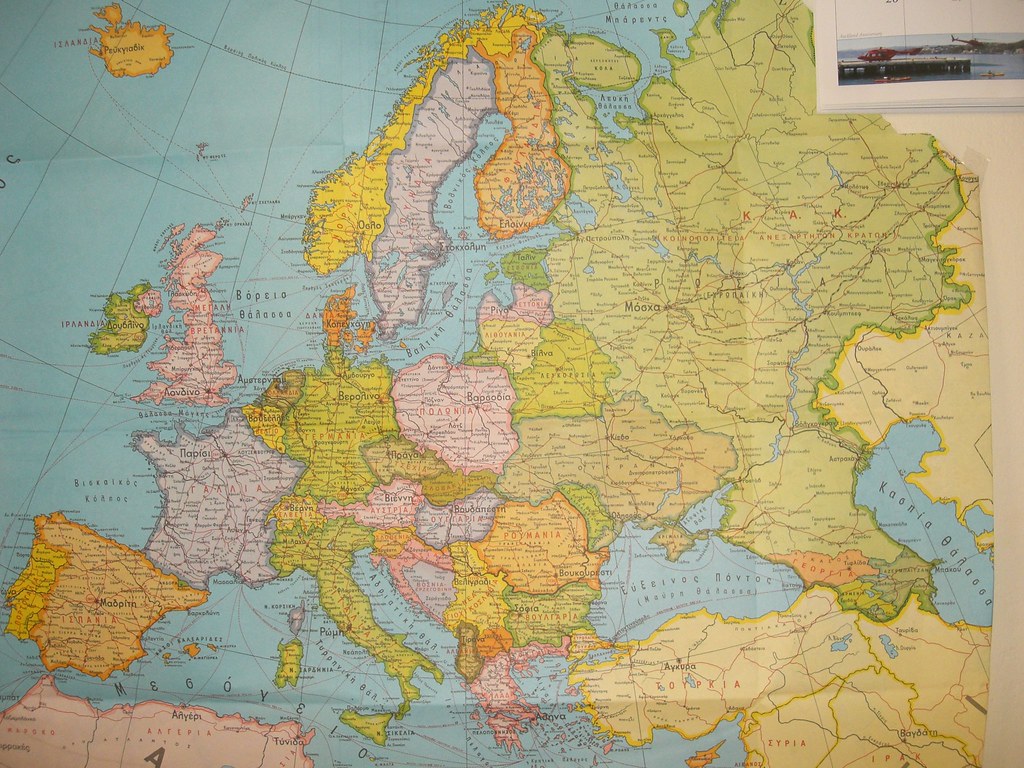
Modern Europe, 2006 (Greek edition by Loukopoulos Bros)
*** *** ***
"One look at this map and its obvious what they want to do."
"Who?" I asked. I eventually worked out who he meant by they. You will too.
"The gas pipeline presently runs from Russia, through the Ukraine, and onto some other European nations, eventually arriving in Greece.

The present gas pipeline (approximately)
"The Russians are sick and tired of playing games with bad debtors who hang off they's dingle-dangles, so they want to build another gas pipeline running through politically friendlier countries.

The future gas pipeline (approximately).
 "But they says that's not necessary, because they wants to build its own pipeline running from Kazakhstan, whose resources they uses, running through Turkey, which would then pass it on to Greece. Which all means, of course, that if we decide to use gas from they's new proposed pipeline, we'd be hanging off both they's and Turkey's dingle-dangles. And they hopes we're going to agree. Paparia!"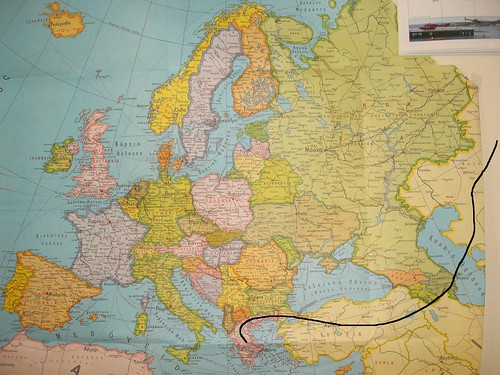
They would prefer it if Greece used this gas pipeline instead
*** *** ***
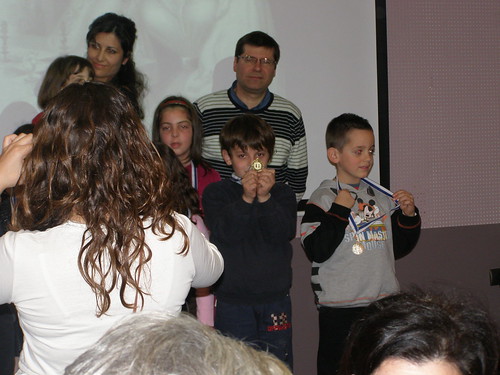
A charming middle-aged Englishman once told me on a double-decker bus in Londond that my kids are destined for the stage...
Take the Vasilopita cutting function for the Chess Academy of Chania that I attended last weekend with my children. The event was supposed to start at 6.30pm. I should have known this would have meant 'Greek time', in other words, at least 3/4 of an hour late. The only reason why we went was because my son had won third prize in an in-house tournament, and he was going to be awarded his medal on this night. The event was held at the reception area of a hotel. The admission price was 5 euro per person, sweets and drinks included, raffle tickets excluded (2 euro each). I couldn't work out why the event couldn't start on time: was it because of the strict adherence by Greeks to Greek time, or was it because all the politicians who were invited to give out the awards were adhering strictly to Greek time, hence our hanging off their dingle-dangles, in order to achieve the purpose we were there for?
The array of politicians was wide. I have never, ever, in my whole life, had the chance to see the people who run both my town and country from up so close. (And neither do I wish to have to do this again so quickly.) I was lucky (in that double sense) to be sitting near the door and could take in their individual entrances. I had my camera with me, but since none of these people had the Tsipras factor, it never occurred to me to take photos of these important gents as they arrived at this auspicious occasion, "η κοπή της Βασιλόπιτας", the cutting of the New Year's cake for the Chess Academy of Chania, an event held any time in January by all clubs and organisations, usually a social occasion to wish the members good luck. Many Members of Parliament were invited, but funnily enough, no priests, hinting that chess is a political rather than religious game.
 The first politico to arrive was from the old school of politicians, Mr Skoulakis (a fellow blogger, would you believe). He has the classic Cretan looks with a thick moustache; he looks very much like my dad. His serious but homely manner reminds one of Venizelos, the famous Cretan politician who became the Prime Minister of Greece. Skoulakis entered the room like a gentleman who didn't need any introductions, taking it for granted that everyone knew him, and they did, because he's been in politics longer than I have been alive.
 Next in was Mr Markoyiannakis. Why he's known better as Markoyiannis, without the Cretan name suffix -akis, as one would expect of a Cretan (have you ever noticed my own name?), might have something to do with his blond looks - he definitely doesn't look like my dad. He entered the room shiftily, his furtive gaze showing on his mafia-like fatsa as his eyes darted quickly from one side of the room to the other. He was flanked by two slight looking gentlemen who, despite their short stature, were probably undercover cops with pistols hidden in the right places to be brought out as needed. Mr Markoyiannakis never actually looked at anyone, just straight through them. The icing on the cake was when he excused himself for having to leave the event early. In his own words; "There are a lot of Vasilopites to cut this evening." Shucks man, that guy works so hard.
 Along comes Karagiozis in the form of Voloudakis. His eyes were large and bright, just like a college freshman's; he's new to the job. It's clearly obvious by the way he kept his hands raised waving to everyone; he looked as though he didn't know anyone in there in the first place. He waved as he entered with his eyes nearly popping out of their sockets, just like a Kewpie doll. He looked like my dad - the young version, of course, minus the moustache; let's face it, it's not so fashionable these days. He carried on like this until the end of his stay at the awards ceremony, exiting in exactly the same fashion as he entered, his hands flapping wildly.
 What kind of Vasilopita ceremony would it be if we didn't have Santa Claus himself making an appearance? Enter Mr Nikiforakis, Santa Claus minus the podge. He had a jolly look about him; he couldn't stop smiling and laughing. His humour was contagious - we ended up laughing with him too. He kept confusing the derivatives of the word 'skaki' (σκάκι), the Greek word for 'chess', with the word 'skase' (σκάσε), the Greek word for 'shut up'. This guy also looked like my dad (albeit after he had lost a lot of weight due to illness), and yes, he had a moustache. At one point he couldn't stop laughing when he corrected himself after saying 'skaSisitiki' (which meant "something to do with shutting up") when he should have said skaKisitiki (which means "something to do with chess"), which prompted my 8-year-old son to ask me: "Καλά, τρελός είναι αυτός ο άνθρωπος και γελάει τόσο πολύ;" (which basically translates to "Hey, why is that man laughing so much? Is he crazy?"). It is said that if you want the truth, you should ask a child.
What's that Greek saying about the roosters?
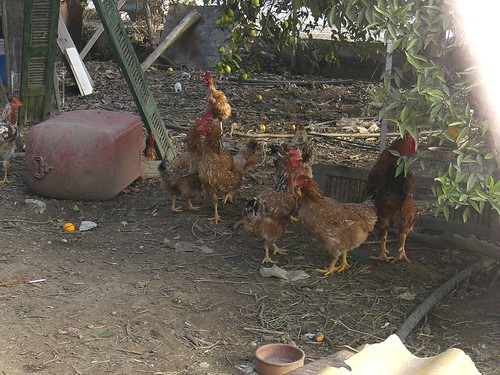
Οπου λαλούν πολλά κοκκόρια, αργεί να ξημερώσει.
"Wherever a lot of roosters crow, sunrise is delayed."
"Wherever a lot of roosters crow, sunrise is delayed."
The higher the chess award, the more VIP the politician was who handed it out, and the earlier in the evening it was presented. We got our award nearly two hours after we arrived. It was presented to my son by an insignificant local councillor. At this point, both my children had developed scratchy bums from sitting too long in a chair, and we had to leave. We couldn't wait for the κοπή της Βασιλόπιτας, the intended purpose of the evening, and neither could we hang around to find out if we were a lucky winner of a man's tie, a lady's pair of gloves, faux bijoux, a keyboard (without a computer), and some other prizes, kindly donated by local businesses.
Being a mother is very hard work - I've got at least a dozen more years of this keep-up-the-appearances business to go...
*** *** ***
"The Greek map," you ask me. "Shouldn't you have one of those hanging on the wall?"
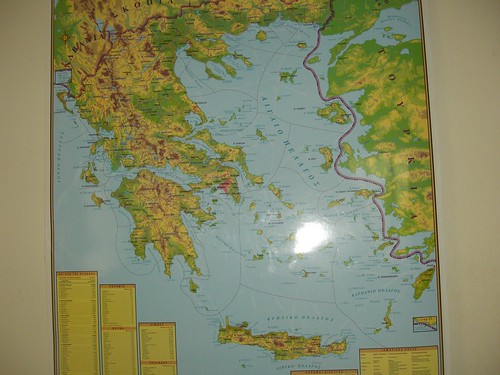
 Yes, don't worry, we've got one of those too. We live in Greece, remember?
And it's still a country.
By sheer luck.
Oh, the food. I almost forgot. Before I go, here's the recipe for dingle dangles. All food photos kindly donated by karvouna.
©All Rights Reserved/Organically cooked. No part of this blog may be reproduced and/or copied by any means without prior consent from Maria Verivaki.


Yesterday's answer: chunks of charcoal are in the big white sacks. They are produced at the end of summer, which is why there is alot available at this time, but it is mainly used for the BBQ, not to heat ourselves.
©All Rights Reserved/Organically cooked. No part of this blog may be reproduced and/or copied by any means without prior consent from Maria Verivaki.