Showing posts with label education. Show all posts

Friday, 19 December 2008

Sit-in

Here's a view of how a typical school sit-in is staged.


The children (in this case, the largest inner-city junior high school of the area, with students aged 13-15) lock up the school gates with chains and a padlock (which they've bought themselves; they are always gleaming their newness). They hang around the school gates, allowing students in, but keeping teachers out, even in the evening. When teachers are allowed in, it is for a purpose, like for instance, to pick up a document. The teachers hang around in the area, watching from the gates. Most often, they act as if there is nothing unusual about the situation, with laidback smiles on their faces. When the students eventually 'agree' to open up the school for lessons (hey, it's almost time for the school Christmas party, and who wants to be at school over the two-week holiday period?!), it is usually because they got bored. Despite not having lessons, children are expected to 'catch up' on whatever they weren't 'taught', as stipulated in the free Ministry of Education school textbooks that every Greek student receives at the beginning of each school year.

junior high school hania chania junior high school hania chania
(inner-city junior high school inHania; note the teacher who has just been 'allowed' to depart from the school, and the crowd of students guarding the main school entrance)
junior high school hania chania junior high school hania chania

Hania is a small picturesque town with mild winter weather. This newly renovated school is situated right next to the Agora, the central market, in a very historic area (you can see the minaret used to call out Moslem praying times during the Ottoman occupation of Hania - pre-1890 - in the background). The school does not reflect the miserable conditions found in most Greek schools as seen in larger centres, nor the misgivings of the Greek education system.

agora next to junior high school hania chania

And now, the $64 million question: what are the students staging sit-ins for? Sit-ins are a standard winter feature of Greek schools. There is never a reason; it's simply become a tradition. This year's started off with the shooting of Alexis, as if that was a good reason.

Monday, 8 December 2008

Post-weekend story: The influence of the Greek education system on biscuit making skills in young children

It's very easy to keep children entertained at home: give them a DVD player, a remote control, a stack of DVDs, and they'll stay in one place for a long period of time, zonking their brains out, turning into zombie zappers. Eventually when they want to talk to their parents, they aim the remote control at them. If they don't get their attention, they start screaming, or something similar to what we do when we can't get technology to work for us. Trying to wean children away from watching television at the weekend is a more difficult task, especially when they are very young, because they are simply not independent enough to act on their own devices and involve themselves in something creative without needing assistance from an adult. You can tell them to work by themselves on a project, but you have to be prepared to be more forgiving towards them when they accidentally damage or stain part of the house or furniture.

We have a lot of books lying around the house for the children to browse through and pick an activity they'd like to try. They've made volcanoes erupt (using vinegar and baking soda), they've made an aquarium (in a shoe box; the fish are hanging on strings) and they've made lap books (thanks to Paula, a home schooling teacher in the US, who likes to blog about food, which is how I discovered her) . But they still need help to do all these things, and even more so in the kitchen, where they're 'playing' with knives and heat. On a recent rainy weekend, my children asked me to let them make some biscuits that they saw in a DK activity book.

lapbook DK biscuit recipe

The instructions in the book were quite simple, and there was also a page full of different biscuit designs that they could try. They particularly liked the coloured biscuits, which of course they wouldn't be able to re-create since we don't keep this kind of confectionery in our house. I explained to them that I would help them to make the dough, but they could make all the biscuits. I disappeared from the kitchen (I felt like a homeless person) to let them work independently.

I heard an argument start between the children. Aristotle was annoyed that Chrstine wasn't lining up the finished biscuits in a similar pattern on the baking tray: Aristotle was angry because "she's not making a motivo." His view of the world is an ordered one where everything has to be done one step at a time, following some logical pattern. He wanted to see a motif on the baking tray. Needless to say, he is stuck on doing one activity before moving on to another activity: it is common knowledge that men can only do one task at a time, while women perform multi-tasking (something to do with women possessing a larger corpus callossum in the brain).

children making biscuits
(if you want to make the biscuits - the recipe is simple and the children had lots of fun making them - the recipe is given in the photo from the book)

Christine, in the meantime, was looking at the biscuit designs in the book and trying to copy them. She did her best, but was annoyed that she wasn't able to make her biscuits look exactly the same as the illustrations. "Why don't you make up some of your own designs?" I asked her. She stared at me blankly, as if she did not understand what I meant. Her brother, on the other hand, understood exactly what I meant; "That's not what the book says," he answered. If it's not in the book, it can't be done; if the teacher (in this case, the book) didn't say it should be done, then it shouldn't be done. It was very hard to convince the children that they could shape and top the biscuits any way they wanted.

Similarly with school homework, "δεν το είπε η κυρία" (den to ipe i kiria - the teacher didn't tell us to do that) is often what a Greek child will tell its parents if they suggest deviating in any way from the teacher's instructions. Going against the exact orders of the teacher, even if s/he expalined something incorrectly, is a sacrilege; the teacher is always right, even if s/he is wrong.

All over the world, the education system is the same: the most important things a child must learn at school are the three R's (Reading, w-Riting and a-Rithmetic), while anything creative gets second (or no) place. Science subjects are treated with reverence, but even they do not get the respect they are due, because if you can't think creatively, you can't really be a scientist, and there is so much to discover that is still unknown in the world, but children in Greece (and, I suspect, in most parts of the world) are learning what is already known, what is in the set textbooks of their education system and libraries, all in the aim of turning children into miniature self-important professors, despite the fact that in this world, we also need plumbers, laboratory technicians and rubbish collectors to make it go round.

Here's an example from my first-grade daughter's homework (yes, she really does have homework at age 6). Every day, the teacher (a lovely young woman with some teaching experience) gives the children a typed (or sometimes hand-written) sheet of language exercises. There is usually a letter-identifying exercise (eg "circle all the K's and k's"), a find-the-correct-spelling task (a given word must be found in a word cloud) and a picture exercise where children write down the word they see in the illustration.

Christine generally has no problem doing any of these activities. Upon seeing a paintbrush, she wrote pinelo (πινέλο), she recognised the cat - gata (γάτα) - and she recognised the bag: the general word for 'bag' in Greek is tsanta (τσάντα). But she didn't know how to spell 'tsanta'; the 'ts' and 'nt' letter combinations are difficult to recognise for a young child who has only recently started learning to read in Greek. I 'knew' that the teacher wasn't expecting Christine to write the word 'tsanta' on the line underneath the bag picture; I had previous experience of the same photocopied material (would you believe it, teachers aren't even writing their own student handouts?) from my son's homework, exactly one year ago.

"'Tsanta'. How do you write 'tsanta', Mum?" asked Christine.

On an informative note, the Greek language is not difficult to read once the letters and basic spelling rules are learnt, which is why, by Christmas, most first-grade Greek children can read practically any printed matter in the Greek language. (This can not happen for the English language where each letter or pair of letters does not have a standard pronunciation pattern: just think about how the words 'though', 'rough', 'through' and 'thought' are pronounced.) As a teacher myself, I don't believe in spoon-feeding children, not just my own. I tried to get her to think creatively so that she would do the exercise herself.

"Well, if you can't write the word 'tsanta', can you think of another word for 'tsanta'?"

Christine thought about it for a while. "'Sakidio?'" she offered. Σακίδιο is a kind of backpack, similar to a school bag.

children's greek homework

"OK," I replied, knowing that I should have made a more exclamatory remark like 'bravo!' or 'excellent!' to encourage her ability to think for herself; what held me back was that, once again, I 'knew' that this was not the answer that the teacher was expecting. I had seen all this before. Sure enough, the next day, the red ink (in this case, purple) was sprawled all over the bag icon: the 'correct' word was 'σάκα' (saka - an old-fashioned word for school bag, which no one uses nowadays, as it is reminiscent of 'satchel') and the teacher underlined the fact that the word 'sakidio' contains a combination of letters (the two vowels at the end) which 'have not yet been taught'. Why she couldn't just tick it as correct, and write 'saka' as a synonym rather than a correction, I do not wish to go into. It reminds me of teachers who can only go into a lesson carrying an answer book to the pupils' textbooks. What upsets me most is that she expected a six-year-old child to work through a homework sheet according to what had been taught in the class, without the child bringing in her own experiences.

I accidentally came across a brilliant mp3 - the only one I have ever heard, come to think of it. As I was perusing Jeremy's Wellington blog (where I was born), I noticed a side link in his favorite blogs that sounded vaguely familiar "Creativity Killer of Kids: our Education System." I had to check it out, and that's where I discovered Sir Ken Robinson. Please listen to his lecture; you may think he's trying to sound funny, but that's only because he is trying to attract your attention, as he has a serious point to make - I do this all the time with my adult students. He believes that creativity is as important as literacy in the education of children, and it should be given equal status; but the education systems of most countries of the world are "educating children out of creativity": they are teaching them not to make mistakes, and if you don't make mistakes, you will never be creative.

*** *** ***

"Mum, we've finished," the children called out from the kitchen. There was no more space on the baking tray, but there was some dough left in colours (yellow and chocolate).

"I'm going to make some biscuits, too," I told the children.

"Which pattern are you going to choose?" asked my son.

"None of those ones," I replied. "I'm going to make up a design of my own."

"How?" He was bewildered.

biscuits creative biscuits

"Just watch me," I said. I rolled each leftover bit of dough into two long strands and stacked them one on top of each other in alternate colours. Then I rolled the new dough combination altogether to get the strands to adhere to one another. Finally, I cut the sausage shape into slices: checkered biscuits.

"Wow," they both exclaimed.

"You don't have to make these ones," I warned them. "Think up something for yourself."

Sir Ken finishes off his lecture with the following statement: "We may not see our children's future, but they will, and our job is to make something of it." He also quotes another well-known writer who has this to say about the human being's actions against creativity: "If all insects disappeared from the Earth, in 50 years time, there would be no life; but if all people disappeared from Earth, in 50 years time life would flourish."

©All Rights Reserved/Organically cooked. No part of this blog may be reproduced and/or copied by any means without prior consent from Maria Verivaki.

Sunday, 7 December 2008

Proofreading

Apart from teaching English, part of my job entails proofreading Masters' theses written by non-Greek mainly Mediterranean and European students studying at the research institute where I work.

proofreading

This one had a lot of corrections to make on her work, not just in the English grammar...

In Greece, it is not acceptable to use the term "Macedonia" when meaning the country to the north of Greece, the Former Yugoslavian Republic of Macedonia, F.Y.R.O.M.; the name is a contentious issue on both sides of the border. In Greece, the word 'Skopia' is used, as this is the name under which the area was known (to be precise, Uskup) from at least the past century, according to a map of the world which was produced in 1896 in New York; there is also an 1861 map on Wikipedia that uses the word 'Uskup'. If you can read Greek, here's a story about what happened when a Greek and an Albanian of Skopian descent came together (use the google translator if you can't).

The correct way to refer to this country causes great embarrassment to me at the institute where I work, because we have a few students from there. How does one maintain an appropriate level of respect? Fyrom is not the name of a country, it is simply an acronym. There is no such thing a Fyromese - person or product. They don't call themselves Skopians, which the Greeks have been doing for years. Have you ever heard someone say: "Oh, you're from U-kay" (more likely, they'll say 'England', or 'Britain', or 'THE' UK), or "You're from Yousa" (they would probably say 'You're American'). When I asked them what I should call their country, one of them simply said 'Fyrom', but I think they've been prepped to say this from their home country, in deference to the fact that they have come to study in our territory, so they must respect our beliefs.

In any case, I fully sympathised with them when they became irate about their country being introduced as FYROM during an international sports event that took place in Thesaloniki, the capital of Macedonia as the Greeks know it. The Skopian participants refused to take part unless their country was named the Former Yugoslavian Republic of Macedonia, and not Fyrom. The Greek hosts did not oblige, so the sports group packed up and left home. Well, my compatriots wouldn't like it either, if someone called them Enzeders, either (instead of "New Zealanders").

Why hasn't Greece ever asked to change its name from Greece to Hellas? Not a single Hellene in the country calls themselves 'Greek' - they all say 'Ellinas' (for a man) or 'Ellinida' (for a woman). Is there a special reason why the Greeks haven't made an attempt to be recognised under a different name: 'Hellas' instead of 'Greece', in the same way that Siam became Thailand and Persia became Iran. Even cities have managed to pull this one off: Peking officially became Beijing, and Bombay officially became Mumbai. The name of this former Eastern bloc country has received so much attention by politicians that Greece cannot concentrate on solving its own real problems.

This cannot be a fair discussion if the other side's views are not taken into account. But the way I see the issue evolving in Greece is that "Macedonia is Greek, end of discussion."

©All Rights Reserved/Organically cooked. No part of this blog may be reproduced and/or copied by any means without prior consent from Maria Verivaki.

Answer to yesterday's quiz: the vegetable in question was kohlrabi.

Monday, 1 December 2008

Post-weekend story: The yo-yo

A little while ago, on St Demetrius Day, it was open house at our place. We clean up the house, we prepare a lot of food, and we wait for our guests to come. St Demetrius Day is my husband's saint's day, the day he celebrates his name. We never invite people to our house, but they never forget to come, either; friends' and family namedays are much easier to remember than birthdays, and for this reason, it is seen as an obligation of the guests to either visit or phone the celebrant and pass on their good wishes to his/her family.

So what does Organically Cooked prepare for her husband's nameday? You can imagine the fuss in my kitchen, the mayhem that must be taking place, as everything must be in order and only the best will do for this day. And being the venerable cook that I am on such an auspicious occasion, there is no leeway for erroneous actions. Hence your bewilderment at the sight of the boxed frozen food: pizza, kalitsounia, crepes and meatballs, along with some store-bought cakes and sweets. Allow me to explain myself.

frozen pastries from crete

A typical week in the life of Organically Cooked starts off with Monday morning: that's when the mayhem starts, without needing to prolong or re-create it in the kitchen at the weekend. On Monday morning (one of my two no-office-work days), I have to prepare Tuesday's meal (or both Monday and Tuesday's meal, if I hadn't prepared that the night before). After getting the kids up, preparing their breakfast and dropping them off at school (primary schools in Greece start by law at 8:10am), I buy our daily bread and milk needs. Our favorite bakery supplies the INKA supermarket chain in Hania with the full range of white and brown bread, rolls, burger buns, baguettes, olive bread, cheese bread, bacon bread, you name it, so it only follows that I go to the supermarket and not the local bakery to buy a 3-day supply of bread and milk. This allows me to pick up any other bits and pieces that we may have run out of: ham and cheese for the children's sandwiches, stamnagathi horta now that we have no more vlita in our garden, maybe a pot of yogurt, the odd paper napkin, whatever I remembered to write down on my list.


After unloading the shopping, I need to start cooking. Whatever is on the menu for that day, I need to make enough to last two days so that there will be some leftovers for another day later in the week when I'm working again. Let's not forget the evening meal: if it isn't dakos or bread, oil and tomato, then I need to prepare it: pancakes, kalitsounia, a pizza; there's a cyclical choice of something different every night, all of which does the rounds every week.

Any errands to run in town? Maybe some irrigation or olive-harvesting in the village, the main job at this time of year in the fields. We like to harvest our own table olives; they need to be cured using various treatments. And did my uncles promise me a pumpkin, or some farm-fresh eggs? I need to go pick those up too, otherwise I won't get asked if I need anything again. What about a washload of clothes? "You've got a washing machine for that," I hear someone say. Yes, I do, but we don't have a drier, and neither do we need one with all that Mediterranean sunshine we get. Any dishes to clean? We only use the dishwasher when the kitchen bench top gets out of control; perhaps this is what forces everyone to clean up after themselves...

washing with a view of souda bay autumn produce hania chania
(the washing has a view right up to Souda Bay; fresh village produce)

Time to pick up the children, after half-past three. Since I've had the day 'free', you may be wondering where the mayhem is. Six and seven year olds have no sense of responsibility concerning possessions: "Where did you leave your jacket?", "Did you forget your pencil case under your desk?", "What happened to your lunch bag?" By the time we get home, the countdown begins: we have approximately 70 minutes to have the main meal of the day and finish off any homework that wasn't completed at the afternoon session of the all-day school program (working parents use this state-provided service) before...

tennis lessons at palia ilektriki hania chania fencing club hania chania

...Number 1 joins his fencing club, while Number 2 plays tennis. Fencing starts at 5pm near the old town gymnasium close to our house. Number 2 has a tennis lesson for one hour in the middle of town; her club starts at 6pm. While I drop off Number 1, I go back home to Number 2. We leave the house at 5.45pm and weave through the inner city traffic to go to the town's stadium for the tennis lesson. Meanwhile, Number 1 finishes fencing at 6.30pm; I go back to pick him up, only to go back into town to pick up Number 2 at 7pm. We find a parking spot and Number 1 gets fertilised and irrigated with some water and a home-made snack. If I didn't bring food from home, I'd have to buy some puff pastry crap to feed them with. I drop him off at the chess club for a one-hour lesson at 7pm. In the meantime, I dash back to the stadium (chess and tennis are located in the same area) to pick up Number 2, who also has her snack in the car. As a way to pass the time before Number 1 finishes from chess club, we do some shopping together: there are two good fresh produce shops in the area, as well as a (not-so-good) supermarket, and the best organic supplies shop in Hania.

By the end of the after-school activities session, I've been walking and driving up and down town like a yo-yo. But it's not only me: every night of the week during the school year, the roads of Hania (and every other town in Greece) fill up with yo-yo-ing mother taxi drivers. Practically every single mother in this town (and every other town in Greece) has become a yo-yo at some point in her life, ferrying children from one activity to the other. In my house where there already is one taxi driver, it seems as though we are doubling up on energy, but there's a saying in Greece that should explain why this is happening: "the shoemaker's children are never shod".

chess club hania chania school bags

Some time after 8 o'clock, we're all in the car, on our way home. Then it's dinner, bathtime and the preparation of the next day's school meals: a packed lunch in a bento box.

lunch box
(After the nameday party, we were left with quite a few boxed sweets, a very popular 'present' to bring to a nameday, hence their inclusion in the children's lunch the next day: baby bananas, a mini-roll sandwich, dakos and chocolate eclair)

Then a quick ckeck of the contents of the children's school bags. The evening is almost over; there's not much energy or time left to do much else anyway. The next day, I'm on a 9 to 5 basis at work. I really only have time to prepare a meal and check the children's homework and bags. The next three days are either like a Monday or a Tuesday. That leaves the weekend to do whatever wasn't done during the week: mending my daughter's trousers which she tears at the knees on the basis of one per week, tidying up the house, ironing, gardening. Let's not forget that we like to eat a decent meat-based meal on Sunday, and we also had to cure the olives we picked from the village. Don't we all need some time to relax, too?

curing green olives for brine
(A telling photo: my kitchen balcony - the children use the orange table for activity work on sunny days. I was cracking green olives here all morning Saturday. The plastic sheeting and newspapers were stuck on the wall to prevent the oil stains from the crushed olives splattering the walls. The gas bottle connects with our kitchen through a hole in the wall; mainland Greece has gas pipes, but not insular Greece. The crockery - the two large tubs, the tray and the overturned pot under the tray - are all from New Zealand, remnants from my mother's kitchen. The mallet belongs to my mother-in-law, but it looks as though I have already inherited it.)

It wasn't my intention to put simple snacks on the dining table on my husband's nameday, but that's all I felt I could cope with, given the daily routine we now follow with the children's schedules. St Demetrius fell on a Sunday this year, which means that the next day is also the start of new mayhem. Life is too short to worry about minor matters. At least tomorrow, there'll be a home-cooked meal, with the start of another round of the weekly mayhem.

Χρόνια Πολλά, Δημήτρη, και του χρόνου!
(Many Happy Returns, Dimitri, and to next year!)

©All Rights Reserved/Organically cooked. No part of this blog may be reproduced and/or copied by any means without prior consent from Maria Verivaki.

Wednesday, 8 October 2008

ABC Wednesday: L for language school

It's ABC Wednesday again, and L is language school.


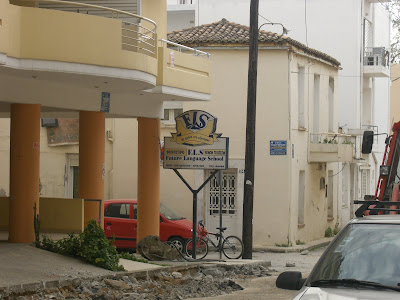
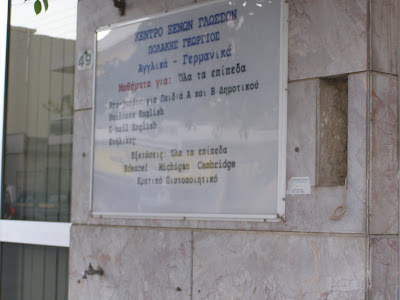
Language schools (in Greek, we call them frontistirio) in Hania, and the whole of Crete (I may as well add the whole of Greece) are like the corner shop in a neighbourhood; in some places, there is one on each street. Chiefly English, as well as French, German, Italian and Spanish (but not Chinese or Russian which I view as far more economically 'important' languages) are taught there. Children start English lessons at state school in the third year of primary school. This is also the year that they start English lessons in a private (ie you pay a monthly fee) language institute which operates in the afternoon. This kind of after-hours school is completely optional of course, but there is no Greek child that does not attend a language institute at primary school age; everybody goes to them, whether they come out of them with foreign language skills or not. If the child attends an optional all-day school program (a kind of child-minding service for working parents), there may be English lessons in that too, apart from the morning school program's regular lessons. If they are weak in some areas, their parents may hire a private language tutor to teach them in a one-to-one basis. Does it all sound too much? Maybe it is, but it shows how much focus there is in Greece in second-language acquisition, primarily English.


The principal of my children's school recently said: "Children get over five hours a week of English lessons every week, and come out of the school system not being able to understand a word of it." I disagree with this statement. In Hania, there are ample opportunities to hear and speak English, and all seasonal summer jobs require some foreign language skills. You cannot avoid hearing English every day of the week if you live and work in the tourist areas, and it is second nature to most people in Hania to be able to direct a tourist to some focal point in the town. Outside the tourist areas, many children may not be learning the English language as ardently as the average child in Hania (I should know, as an English teacher and EDEXCEL examiner), but in Hania, all children learn English, and most do come out with the bare basics in communication skills.

When I came to Greece, I had already gained my ESL-teaching qualifications in New Zealand. I had heard that there were ample opportunities for well-qualified English teachers, which was what I found when I arrived in Athens. I landed a well-paid job working in one from half past two in the afternoon till half past ten int he evening every weekday. The first week I worked there, I felt strange teaching until so late at night, especially because I had become accustomed to going to bed at the time I was still at work. The second week, I forced myself not to go to bed immediately after I came home from work, so that I could sleep in in the morning, so that I could pretend that when I did actually leave the house for work, it was still morning, even though it was actually afternoon. The third week, I realised that I would always hate working in the evenings, no matter what time I woke up or went to bed.

By working in this kind of system, I was supporting the para-education system of Greece, the one that does the work that the state education system should do, but for various reasons (disorganisation, a relaxed attitude, employing the wrong people, state indifference, etc) it is not being done. It is not only English lessons that are being given in the private 'user-pays' institutes; it is also extra tuition for all the subjects taught at school: history, Ancient Greek, Modern Greek, composition writing, chemistry, biology, physics, mathematics, computer lessons, and a whole host of other 'hobby'-type lessons such as sports, dance, music, etc. Politicians have been known to make moves to improve the education system, all the while sending their own offspring to the most elitist private paying educational establishments.

I have been working in this kind of educational institute for 17 years. This is the first year that I have decided not to return to such work. At present, through my own choice, I am unemployed. My children are nearly of the age when they will be deemed to have started lessons at a private English language institute. They already understand more than they can speak in English. I do not wish to support the Greek para-education system, but I still need to
teach them to read and write in English, because, let's face it, they need that skill, as everyone the world over needs it.

Thursday, 8 May 2008

School


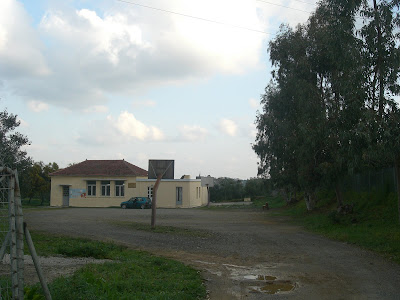
Remember the days of the old school yard? My children certainly will. Their kindergarten is housed in an airy building which feels more like a cosy house, with up to 20 students in a class group. The playground area is large, and the teachers are very caring. The location of the school is in a quiet village district, about 8 kilometres away form the main town, and is surrounded by olive groves and orange fields. Some of the lessons in this kindergarten take place outdoors; the school yard is surrounded by eucalyptus and olive trees. The children learn about nature through the five senses: seeing, hearing, smelling and touching it. If the teachers feel like it, the y sometimes stage cooking lessons for them using local produce.

The original building with the tiled roof was once the local primary (elementary) school. Changes in the education system and a reduction in the rural population forced the primary school to re-locate, while the building became a kindergarten. The room on the right, the kitchen and dining area, was added once the school became an all-day kindergarten, catering for the needs of working parents.

Monday, 7 April 2008

Villa Koundourou


Villa Koundourou was the house of a rich businessman (Mr Koundourou) who lived in Hania. He had the house built for himself and his family at a time when most people lived in roughly built stone houses in the surrounding villages. There would have been very very few houses in the centre at the time. He was lucky to have had the best pick of location - it is right next to the sea (right-hand side of the photo) behind the old port, which suggests that he might have used it as a summer house. There are a few other houses of this style on the same street (they are known as 'neo-classical' buildings, and are protected against demolition), but none are in the same condition as Villa Koundourou; they are used both as houses and offices. Their value exceeds the the lifetime income of many of the town's residents.

When he died, he left the house to the local council, who have refurbished it. It is now used for art, music and theatre classes, as well as housing occasional exhibitions.

The pick-up truck outside the villa is a symbol of Cretan agriculture. A parent is probably waiting to pick up their child after an art class. This photo was taken on a Saturday morning. The beautiful old port is right behind this villa, about a ten-minute walk.

Tuesday, 1 April 2008

Pine trees


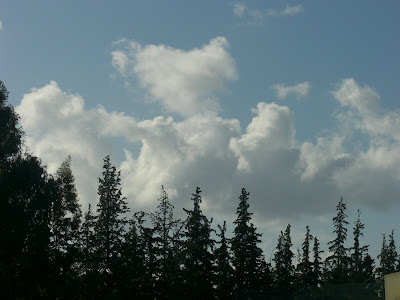
I work at the Mediterranean Agronomic Institute of Chania (note the spelling: it's pronounced 'Hania', the result of archaic transliteration processes), a research centre midway between the town centre and the ferry port (not the famous old port with the cafes). I teach English to Master's students investigating subjects of agricultural or economic significance in the Mediterranean. Very few of them are Greek; they actually come from all over the Mediterranean and English is the main language used at the centre - Greek is used by the staff to each other. The campus is surrounded by beautiful pine trees. This is what it looked like on a cloudy day last week near the tennis courts, which are directly in front of the trees.