Showing posts with label building. Show all posts

Saturday, 28 March 2009

Buildings

koum kapi hania chania

The last month in Hania has been very cold and dreary, although the sea is always an uplifting sight.

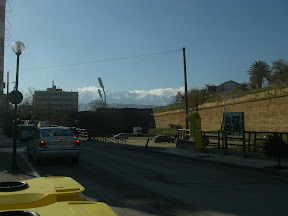
This photo shows the antithesis of the architecture we often come across in Hania. The two buildings on the corner of the road, standing across from each other, were probably both built around the same time. But the fate of each one has taken a different turn.

A wide range of buildings stand side-by-side in Hania, each one representing a different time period. Click on the photo to see the notes.

Saturday, 29 November 2008

Exhibition

Hania has one of the highest rates of road accident deaths in the country, which must make us the worst drivers in the whole of Europe, since Greece once again tops the lists in that respect.

car crash exhibition hania chania hospital

It's all very well to say that the roads are at fault, but since we know that, we should be more careful when we drive.

car crash exhibition hania chania hospital

Recently, an exhibition was held outside the general hospital of Hania to highlight this fact. Cars involved in road fatalities were positioned centrally, at the entrance to the hospital, and each one had a sign saying how the accident happened, and why the driver was at fault.

car crash exhibition hania chania hospital

This one was caused by the driver of the car. The sign says:

"He was out all night...
He was drinking...
His co-driver was a few more bottles of beer...
He set out in a foggy journey..."

I don't know which driver(s) was killed, but that's not that the point.

Tuesday, 11 November 2008

Palia Ilektriki

Hania has a few sports facilities spaced around the town, some of which include: the track and field stadium in the centre,

stadium hania chania

the new gymnasium near the sea,

kleisto gymnastorio nea hora hania chania

and an old gymnasium on the outskirts of town, known as Palia Ilektriki, because it was built on a site where the state electricity company was formerly located (which is why the whole area has a shabby look to it).

palia ilektriki gym hania chania

One of my daughter's tennis lessons took place at Palia Ilektriki. While she was busy, I had to figure out what to do to keep my son occupied. There was what looked like a cafe across the road from the gym, which I noticed was closed. No surprise, as it was a Wednesday afternoon, when shops are closed and the town isn't so busy. Tables and chairs were still set outside it, even though the weather is cooling down now.

cafe gogoni street hania chania

We went there to rest on one of the chairs so my son could finish his homework. No one moved us away, which I was quite thankful about, especially when I saw the sign on one of the windows of the cafe: "No entry to under-18s". We weren't entering it anyway, but I wonder if they would allow under-18s to enter if accompanied by an adult. Probably a poker house...

Sunday, 9 November 2008

The old wall

western side of wall hania chania

I often talk about the old town, the old port, the old wall of Hania, but I've never really shown you a photo of what the old wall actually looks like. The town centre was once enclosed within a square wall, surrounded by a moat. Some parts of the wall survive more or less intact, other parts are left in crumbling ruins, while the moat, which was never actually used as it was intended, has often been used as a car park, a football pitch, or a rubbish dump.


(The eastern side, which houses an open-air theatre; the western side, looking from the top of the wall down onto the moat, also bordered by the hill where the town was built)

western side of wall hania chania
(restoring the wall)

Work started about a year ago to restore the wall to its former glory. Houses that were built on the foundations of the wall, including an old hotel, were torn down to make way for its restoration. The wall represents tangible evidence of the history of the town. It was built in the 16th century by the Venetians who conquered Crete.

Answer to yesterday's quiz: donkey dung.

Friday, 26 September 2008

SkyWatch Friday: The lighthouse of Hania


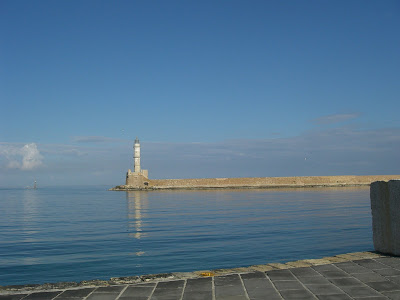
The most famous image of the old port of Hania (which is a now the centre of summertime night life) is that of the lighthouse. It could be considered a timeless view if it weren't for the fact that the lighthouse recently underwent extensive repairs, which clearly date it, as its appearance has changed. It was built by the Venetians about 700 years ago and restored by the Egyptians in the 1800s. Its recent restoration was deemed necessary as it was in dire need of restrengthening. It lights up the harbour every evening, and is considered one of the most romantic focal points in the town of Hania. Here it stands across the backdrop of the blue Mediterranean sky. Autumn is setting in, as the clouds attest.

Monday, 11 August 2008

Odd shots Monday: the train station


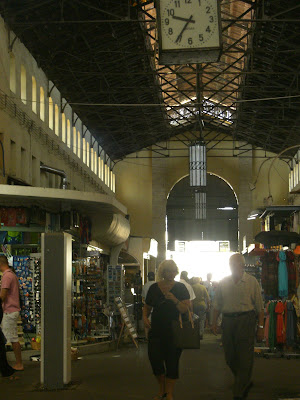
You may be wondering what's so odd about this shot: it looks like a normal train station, doesn't it? Just when you least expected it, Hania has its own Kings Cross.

Weary travellers holding their bags, a ticket vending machine, boutique-style stores for that last minute shopping before you board your train, the ticking clock reminding you that the train is due to depart, out-dated decor from art deco times...

(But it's not a train station; it's the Agora in Hania.)

Thursday, 7 August 2008

Kalamaki Beach

kalamaki 1974

You might think I have a penchant for beaches. Maybe it's because I'm spending a lot of time there as of late, but there is only one beach for me, and that's Kalamaki Beach, which I first visited in 1974 on a family holiday back to my parents' homeland. I then saw it again in 1991, when I returned on what I thought was going to be another short holiday to Greece. At the time, I wouldn't have believed anyone if they told me that, in less than a decade, I would end up living 3 kilometres away from this beach.

CIMG4482

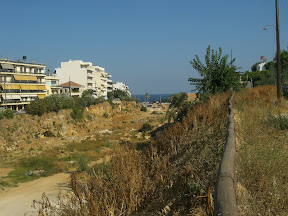
After 34 years, the area has changed drastically. The traffic that plies the road must have increased 1000-fold. The mountains can hardly be seen for the apartment blocks - everyone wants to live by the sea. The number of trees has been increased, while the whole coast has seen an accelerated rate of development in the tourism sector. The large white hotel complex was opened up only two years ago. The breakwater barrier and the electricity post above it are the only two things that seem to have remained constant.

kalamaki beach 20008

You can read the full version of the story of my 1974 trip at Organically Cooked.

Monday, 4 August 2008

Odd shots Monday: forever locked


The town of Hania was once filled with stately homes, all porting heavy iron gates and doors, a sign of importance, a signal to keep clear, and that all intruders would be dealt with accordingly. Now, all that's left of this stately iron gate is the rust and the crumbling stonework. This gate looks as though it hasn't been opened up for a long time, by the state of the overrun garden in front of it.

It's not the only gate that seems to be in a perpetual state of being locked; quite a few other gates and doors on this central street are in the same state, reminding us of a glamorous prosperous past. I tried to find a door or gate as grand as this one in the same area (where there are many of these types of doors), that looked as though it was being used, but to no avail; most of the usable ones are not very photogenic. At least no one will be bothered by the recycling bin that has been placed in front of this old gate, as it doesn't look as if anyone will be passing through it on a regular basis.

Wednesday, 30 July 2008

ABC Wednesday: B for Barn and Bridge

It's ABC Wednesday again, and B is for barn and bridge.

barn fournes hania chania

Abe posted about barns a while back. The ones he photographed looked old and disused. This barn looks rather old too; it was built by German soldiers in the village of Fournes (where we own fields with oranges and olives), to be used as offices and a storeroom during the occupation of Crete by the Nazis. Its present use is by the local community as a processing plant for olive oil. We pass it every time we go into the village to our orange groves; as you can see in the following photo, the barn is surrounded by orange and olive trees.

barn in amongst olive and orange groves fournes hania chania

The Nazi regime lasted only four years, but the occupants thought they would be here longer. The barn was not the only important structure they built which had great strategic significance. A river runs just below the hills in the village of Fournes, with its source being a stretch of high mountains (Lefka Ori) in the middle of the western province of Hania.


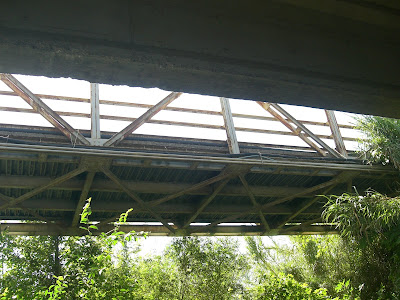
The German soldiers also built a wooden bridge to the left of the road from the barn, which opened up better access to the remote (and Nazi-resistant) mountain villages. The bridge is now disused, as a more modern roadway has been built right beside it to replace it. It makes a good place to watch the river passing by furiously in the winter.

Wednesday, 23 July 2008

ABC Wednesday: A for Asylum


Another round of ABC Wednesday has started, and this week, it's being hosted on its very own website, ABC Wednesday, created by Denise and her team.

This week's letter is - of course - A, and the word is asylum.

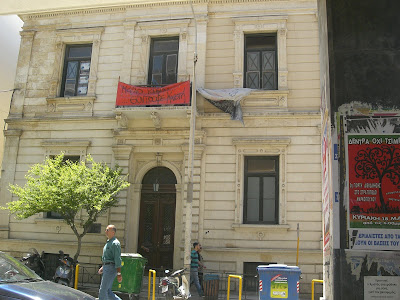
This is one of the old buildings that reminds the residents of Hania of its former more glorious period, the years between the world wars, even though it now looks like a dumpster. The plaque on the building simply states the owner's name and that he donated it to the University of Crete. He must have been an important person in the community. People become important in Greece usually because they are connected with money or politics. To build a house like this one means the former owner was wealthy and/or possibly involved in politics (the two still go hand-in-hand in Greece).

Riches don't always bring happiness, and this is probably the reason why the former owner of the house passed it on to the state in his will. The state had no money to spare (as usual) to maintain it by repairing what needed to be fixed, so the house was left to stagnate in a state of ruin. The University of Crete was expanding and took over the building, as was the original owner's wishes.

There's only one catch with university properties. University areas are protected by asylum: the police can't enter them under any circumstances, according to an archaic Greek law created no doubt for the benefit of the advancement of science and knowledge. This is why not a single university building in the whole country has remained unscathed by attacks from hooligans, vandals, drug dealers, squatters and all other kinds of vagrants. The building in question has been occupied by student activists for the last two years, its present use probably not envisioned by the former owner.

This building is found on the main shopping road in Hania, diagonally across from the Agora, which coincidentally also begins with 'A'.

Thursday, 17 July 2008

Agious Apostolous: the old military training site


Yesterday's post
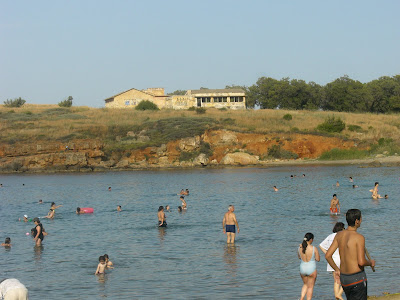
showed an old photograph, taken more than 45 years ago, of my mother standing on some rocks facing a military training site. These buildings are still standing, albeit in a state of ruinous decline. Had they been privately owned, there would now be a cafe-bar or a hotel in this area. Since they are state-owned, they've been left to rot, nobody showing interest to maintain them as a historical site, not even as an investment. Every day from May until September, the place is crawling with people looking for some refreshing shade. The people are locals, Greeks from other areas, and Northern Europeans. Why were the installations left in ruins? And why haven't they been torn down so that we don't have to watch their gradual erosion? I wonder what the authorities could say about this situation.

Wednesday, 16 July 2008

ABC Wednesday: Zambia

(Phivos Nicolaides featured this post on his blog.)


It's ABC Wednesday again, and the second round of the alphabet has come to a close with Z today, which stands for Zambia.

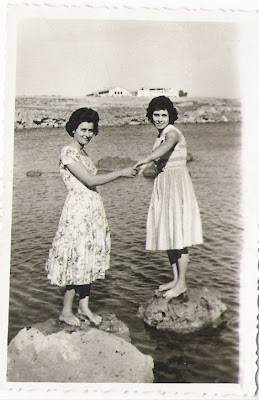
Zambia (on the left) was the name of my mother. She's standing here with a friend at Agious Apostolous beach, where her grandchildren (unfortunately, she didn't get to meet them) now go for swimming lessons. The buildings in the background were once used as a military training centre, but are now disused, left in a state of ruin. My mother left Crete when she was 30 years of age. As an olive picker from a poor family, the island offered no prospects for her in the 1960s, so she emigrated to New Zealand, where she lived the next 30 years of her life. It was a very prosperous life, albeit a very short one.

Zambia is an unusual name. It's common in the villages around where she was born (Kambous, Keramia, Hania, Crete), and in a few other pockets of the island, but is hardly known in other parts of Greece. There is another similar woman's name in Rhodes (Tzambika, where churches are dedicated to St Tzambika), but I'm not sure if it is of the same origin. An archaeologist friend of mine told me that the name has Venetian origins; this means that my mother's ancestors have been living in this town since before it was occupied by the Ottoman army, ie before 1500. My mother's history is an integral part of the history of the town she was born in.

It's the custom to name children after their grandparents, but I clearly remember my mother telling me that she didn't like her own name (because it was so reminiscent of Greek peasantry), so I gave my daughter her other grandmother's name (Christine). I didn't want my children getting teased over their names, like Talula Does the Hula from Hawaii does, or maybe Superman in New Zealand does whenever he walks into the room: "Is it a bird? Is it a plane? No, it's Superman!" I suppose it's better than the original name his parents had planned for him: imagine if Superman did eventually get called 4Real: "Are you for real?" everyone would be asking him. Some parents have no foresight; they are oblivious to the fact that they have
screwed up their child's life before the child itself can have a chance to do it for himself.

The photograph of my mother was taken in the early 1960s.

Η Ζaμπiα (αριστερά) ήταν το όνομα της μητέρας μου. Εδώ βρίσκεται μαζί με μια φίλη της στην παραλία στους Αγίους Αποστόλους, όπου τα εγγόνια της (δυστυχώς, δεν τα γνώρισε), τώρα πάνε για μαθήματα κολύμβησης. Τα κτίρια στο παρασκήνιο κάποτε χρησιμοποιήθηκαν ως στρατιωτικό κέντρο εκπαίδευσης, αλλά σήμερα είναι εγκαταλελειμμένα. Η μητέρα μου άφησε την Κρήτη όταν ήταν 30 ετών. Ελαιομαζώχτρα από φτωχή οικογένεια, το νησί δεν πρόσφέρε προοπτικές στη δεκαετία του 1960, οπότε μετανάστεψε στη Νέα Ζηλανδία, όπου έζησε τα επόμενα 30 χρόνια της ζωής της. Ήταν μια πολύ ευημερούσα ζωή, έστω και αν ήταν πολύ σύντομη.

Το όνομα Ζaμπiα είναι ένα ασυνήθιστο όνομα. Είναι κοινό σε χωριά γύρω από όπου γεννήθηκε (Κάμποι, Κεραμιά, Χανιά, Κρήτη), και σε μερικές άλλες τσέπες του νησιού, αλλά είναι ελάχιστα γνωστή σε άλλα μέρη της Ελλάδας. Υπάρχει άλλο παρόμοιο όνομα της Παναγίας στη Ρόδο (Τζαμπίκα), όπου εκκλησίες είναι αφιερωμένες στον Αγια, αλλά δεν είμαι σίγουρη αν είναι της ίδιας καταγωγής. Μια αρχαιολόγος φίλοι μου μού είπε ότι το όνομα έχει βενετσιάνικη προελεύση. Αυτό σημαίνει ότι οι πρόγονοι της μητέρας μου ζούσαν σε αυτή την πόλη για πολλά χρόνια, δεδομένου ότι μετά τους Βενετσιάνους τα Χανιά είχαν καταληφθεί από τον οθωμανικό στρατό. Της μητέρας μου η ιστορία είναι αναπόσπαστο μέρος της ιστορίας της πόλης που γεννήθηκε.

Είναι το έθιμο να κατονομαστούν τα παιδιά με τα όνομα των παππούδων, αλλά θυμάμαι τη μάνα μου να μου λέει ότι δεν ήθελε το δικό της όνομα (διότι της θύμιζε φτώχεια και χωριά), ώστε να δώσω στην κόρη μου το όνομα της άλλης γιαγιάς (Χριστίνη) . Δεν ήθελα τα παιδιά μου να τα κοροιδεύουν για τα ονόματά τους, όπως υποπτεύομαι για τον Superman στη Νέα Ζηλανδία, όταν μπαίνει μέσα σε μια αίθουσα: "Πρόκειται για πουλί; Είναι ένα αεροπλάνο; Οχι, είναι ο Σούπερμαν!" Υποθέτω πως είναι καλύτερο από το αρχικό όνομά που είχαν προγραμματίσει η γονείς του γι 'αυτόν: φανταστείτε αν η Ταλούλα η ο Superman λεγόταν 4Real: "Είστε πραγματικός;" όλοι θα τον ρωτούσαν. Ορισμένοι γονείς δεν έχουν καμία πρόβλεψη! Αγνοούν το γεγονός ότι έχουν καταστρέψει την ζωή του παιδιού τους πριν μπορέσει το ίδιο παιδί να βρει την ευκαιρία να το κάνει για τον εαυτό του.

Η φωτογραφία της μητέρας μου είχε ληφθεί στις αρχές της δεκαετίας του 1960.

Thursday, 3 July 2008

Motorbikes


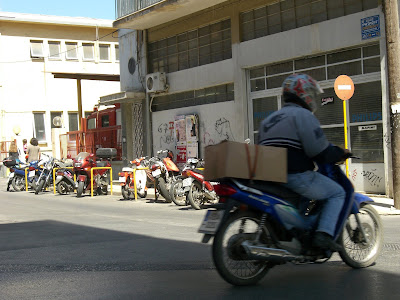
Admittedly, it's not the prettiest part of town, near the central fire station. The mode of transport depicted is one of the most frequent causes of deaths among young Greek males, usually through a combination of the following reasons: not wearing a helmet, speeding, bad road conditions, joyriding, being knocked over while driving legally. In the last seven years of my life, I have lost relatives and friends' sons through potentially avoidable motorbike accidents: my cousin was wearing a helmet but didn't strap it under his chin, the son of a colleague of my husband's bent down to pick up his ringing cellphone, and drove into the back of a lorry, a friend's son fell into a ditch on a stretch of road that had been dug up for pipe-laying; these three cases are the most memorable.

At least this guy is wearing a crash helmet. He looks like a delivery agent.

Friday, 27 June 2008

SkyWatch Friday: Castle in the sky


The minaret used to be called the leaning tower of Hania, because it was in such a bad state of disrepair that it needed to be repaired or demolished. It was literally leaning to one side in a rather built-up area where the houses have been built so closely together; if it had fallen, it wold've been difficult to get the rubble out, let alone repair it. This kind of building can't be demolished; it is under protection orders, but it's allowed to fall down of its own accord. Its daily presence in Hania involves a significant part of the history of the town, which was once ruled by the Ottoman Turks who presided in the area for four centuries.

Right now, the minaret in Splantzia looks like it could be mistaken for a castle spire - maybe Rapunzel's going to throw her golden hair over the balcony...

Thursday, 12 June 2008

Forgotten garden


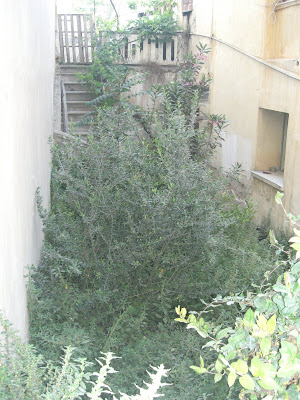
It's the kind of place no one would think of looking. Walking past it on the street, slightly sunken from the level of the road, it is barely worth turning one's eyes to, a mess of tangled pointless greenery, sandwiched between the two walls of the neighbouring houses. It must have been useful to someone in days gone by; the wooden ladder wouldn't have been built if the garden was never going to be used. Someone must have had high hopes for this patch of earth in past times. There's a grapevine plant growing unchecked at the top, while the whole patch is practically overtaken by a wild olive tree. The weeds are thriving, maintaining a no man's land of the site.

Monday, 2 June 2008

Something old, something new...

houses splantzia
Here's a colourful example of the old houses behind the old port area of Hania. Some are luckier than others, but that's just a natural part of the wear and tear process. The red one has been completely renovated and is now an architect's office.

These houses are very similar to the ones that were built by former Greek residents of Alexandria in Egypt, at a time when there was a Greek colony there. One of my wonderful students at MAICh told me that he was amazed at their similarity. The travelling Greeks always took their culture with them.

Sunday, 1 June 2008

Nana's rooms

nana rooms
Another example of the multi-faceted uses of neoclassical houses in Hania. You can barely see the sign on the top balcony - it shows the name of this 'pension'-style hotel; the English bed and breakfast. But that's only the two top floors of the building. The bottom floor is a residential property - I've been inside it quite a few times. It's got high painted ceilings and it's decorated in an old-world style by a very proud owner. The owner also tends a large garden very lovingly. No one would think this town villa is located on a busy road leading into the main centre only a few metres away from the municipal gardens.

Saturday, 31 May 2008

The former Italian embassy

italian embassy

This unassuming edifice once housed the Italian embassy in Hania, which was formerly ruled under the Venetians. It is located in the centre of town, right across from the municipal gardens, and can be viewed by the public by appointment only. I've never seen it open; a sign remains affixed on the inner wall next to the door with a few details relating to its former glory. Since Crete became part of Greece in 1913, the Italian embassy became obsolete, with all embassies relocating to Athens.

Thursday, 29 May 2008

Volvo P220

volvo
I really don't know how this Volvo P220 manages to look brand spanking new - it dates back to 1968, so it's 40 years old. It has a 2008 road tax sticker, the body work is original, the interior is in perfect condition; the owner must be very proud of it. Only the license plate looks a little beaten up. It was parked right outside the Agora; I'm amazed the owner actually drives it into the town, which has recently filled up with reckless drivers.

Wednesday, 28 May 2008

ABC Wednesday: Street sweeper

street sweeper
It's ABC Wednesday again, and S is for street sweeper.

I admire the patience of this immigrant to my town, taking on the job of sweeping the main street right in front of the Agora clean for the benefit of the locals and tourists alike. He didn't bat an eyelid when he saw me photographing him; he just proudly carried on with his work. Notice how he's tied a few blue bin liners behind him; he's just doing his job.