Showing posts with label orange. Show all posts

Thursday, 28 August 2008

Colours:orange

In August, the colour orange is strongly represented in Fournes, a village in Hania, located in a wider area well-known in Greece for orange production.

orange fournes

The summer sun anoints everything animate and inanimate, encasing it all in a shade akin to the golden globes found hanging on the dusty trees. Its shades are found in the terracotta urns that lie abandoned in the gardens of the old brick-orange houses, the chickens under the orange trees, the fallen citrus crop that nobody bothered to pick, the weeds that dry up in the scorching heat. Even the pick up trucks, the packing crates and irrigation pipes cannot evade the hue that Fournes is most famous for. The sun parches the ground, scorches the trees and burns the life out of the fallen crops. Yet without it, there would be no crops and rural life would cease.

orange fournes orange fournes orange fournes orange fournes

(This work has been inspired from Calliope's series on Spectral Studies.)

Wednesday, 30 July 2008

ABC Wednesday: B for Barn and Bridge

It's ABC Wednesday again, and B is for barn and bridge.

barn fournes hania chania

Abe posted about barns a while back. The ones he photographed looked old and disused. This barn looks rather old too; it was built by German soldiers in the village of Fournes (where we own fields with oranges and olives), to be used as offices and a storeroom during the occupation of Crete by the Nazis. Its present use is by the local community as a processing plant for olive oil. We pass it every time we go into the village to our orange groves; as you can see in the following photo, the barn is surrounded by orange and olive trees.

barn in amongst olive and orange groves fournes hania chania

The Nazi regime lasted only four years, but the occupants thought they would be here longer. The barn was not the only important structure they built which had great strategic significance. A river runs just below the hills in the village of Fournes, with its source being a stretch of high mountains (Lefka Ori) in the middle of the western province of Hania.


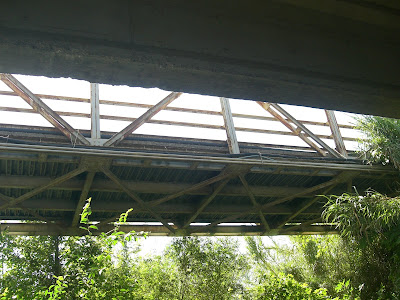
The German soldiers also built a wooden bridge to the left of the road from the barn, which opened up better access to the remote (and Nazi-resistant) mountain villages. The bridge is now disused, as a more modern roadway has been built right beside it to replace it. It makes a good place to watch the river passing by furiously in the winter.

Thursday, 24 July 2008

Zucchini baseball

When you can no longer stand the look of zucchini on your dining room table or kitchen bench top, and the wholesaler offers you a low price on your orange production, there's always this solution.

(The courgette escaped our notice. It is perfect for animal feed, but not much else.)

Saturday, 17 May 2008

Irrigation methods


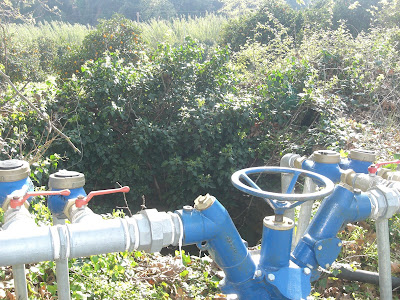
These irrigation taps have been built beside a well that used to be used to irrigate the fields in years gone by. No one seems to be aware of any danger of falling in the well, since it's been left open and unfenced. It causes me great strife to bring my children to our fields in the village; I want to teach them to love their land, but I have to keep telling them to watch out for all the dangers that it carries.

Wednesday, 30 April 2008

ABC Wednesday: Orange groves and olive fields


It's ABC WEDNESDAY today, and O is for orange, and it's also for olive.

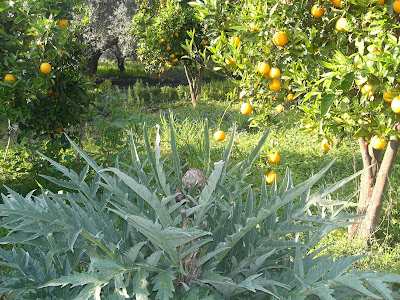
The orange trees in this field are our very own! We have 500 orange trees spread across half a dozen fields in Fournes, Hania, Crete. The olive trees in the distance (with the black nets below them covering the ground) aren't in our field (but we have been known to make good use of them every now and then). The artichoke plant is in front of the cement fence we recently built to section off our property from a country path running through it.