Showing posts with label ABC. Show all posts

Wednesday, 6 August 2008

ABC Wednesday: C for Carriage


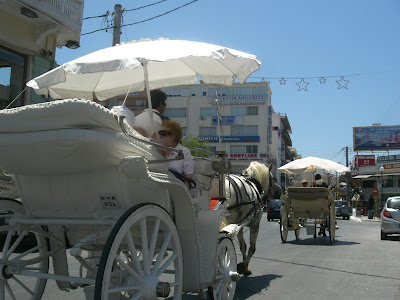
It's ABC Wednesday again, and C is for cart or carriage, in the lovely town of Hania which is usually written as Chania.

Everyone loves going for a ride in one of these old-fashioned carriages. These ones are heading towards the old harbour; as relics of older times, they suit the mood of the lovely port lined with the many little cafe bars. They are used mainly by tourists (at 20 euro for a short ride, the price is a bit steep), and they are also hired for weddings. The town is too small and the roads are too narrow for open-top tourist buses, but these are prettier and will stay in your memory for much longer.

If you're wondering what the Christmas lights are doing in the picture (another 'C' word) on a warm summer's day, don't worry: we don't light them until Christmas time; it's just easier to leave them hanging there rather than taking them down and putting them up every year...

Although the name of the town of Hania is most often written with a 'C' ('Chania'), the 'C' is never pronounced. To pronounce the name of the city correctly when you see it written as 'Chania', pretend it's not there, and say 'Hania' instead. That's why I call my blog 'One day in Hania'.

Wednesday, 23 July 2008

ABC Wednesday: A for Asylum


Another round of ABC Wednesday has started, and this week, it's being hosted on its very own website, ABC Wednesday, created by Denise and her team.

This week's letter is - of course - A, and the word is asylum.

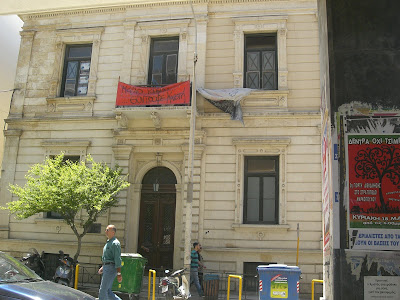
This is one of the old buildings that reminds the residents of Hania of its former more glorious period, the years between the world wars, even though it now looks like a dumpster. The plaque on the building simply states the owner's name and that he donated it to the University of Crete. He must have been an important person in the community. People become important in Greece usually because they are connected with money or politics. To build a house like this one means the former owner was wealthy and/or possibly involved in politics (the two still go hand-in-hand in Greece).

Riches don't always bring happiness, and this is probably the reason why the former owner of the house passed it on to the state in his will. The state had no money to spare (as usual) to maintain it by repairing what needed to be fixed, so the house was left to stagnate in a state of ruin. The University of Crete was expanding and took over the building, as was the original owner's wishes.

There's only one catch with university properties. University areas are protected by asylum: the police can't enter them under any circumstances, according to an archaic Greek law created no doubt for the benefit of the advancement of science and knowledge. This is why not a single university building in the whole country has remained unscathed by attacks from hooligans, vandals, drug dealers, squatters and all other kinds of vagrants. The building in question has been occupied by student activists for the last two years, its present use probably not envisioned by the former owner.

This building is found on the main shopping road in Hania, diagonally across from the Agora, which coincidentally also begins with 'A'.

Wednesday, 16 July 2008

ABC Wednesday: Zambia

(Phivos Nicolaides featured this post on his blog.)


It's ABC Wednesday again, and the second round of the alphabet has come to a close with Z today, which stands for Zambia.

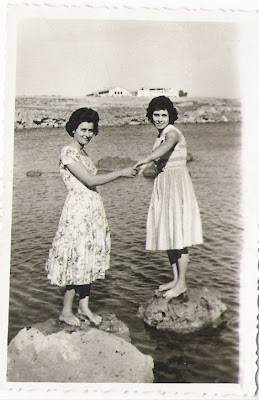
Zambia (on the left) was the name of my mother. She's standing here with a friend at Agious Apostolous beach, where her grandchildren (unfortunately, she didn't get to meet them) now go for swimming lessons. The buildings in the background were once used as a military training centre, but are now disused, left in a state of ruin. My mother left Crete when she was 30 years of age. As an olive picker from a poor family, the island offered no prospects for her in the 1960s, so she emigrated to New Zealand, where she lived the next 30 years of her life. It was a very prosperous life, albeit a very short one.

Zambia is an unusual name. It's common in the villages around where she was born (Kambous, Keramia, Hania, Crete), and in a few other pockets of the island, but is hardly known in other parts of Greece. There is another similar woman's name in Rhodes (Tzambika, where churches are dedicated to St Tzambika), but I'm not sure if it is of the same origin. An archaeologist friend of mine told me that the name has Venetian origins; this means that my mother's ancestors have been living in this town since before it was occupied by the Ottoman army, ie before 1500. My mother's history is an integral part of the history of the town she was born in.

It's the custom to name children after their grandparents, but I clearly remember my mother telling me that she didn't like her own name (because it was so reminiscent of Greek peasantry), so I gave my daughter her other grandmother's name (Christine). I didn't want my children getting teased over their names, like Talula Does the Hula from Hawaii does, or maybe Superman in New Zealand does whenever he walks into the room: "Is it a bird? Is it a plane? No, it's Superman!" I suppose it's better than the original name his parents had planned for him: imagine if Superman did eventually get called 4Real: "Are you for real?" everyone would be asking him. Some parents have no foresight; they are oblivious to the fact that they have
screwed up their child's life before the child itself can have a chance to do it for himself.

The photograph of my mother was taken in the early 1960s.

Η Ζaμπiα (αριστερά) ήταν το όνομα της μητέρας μου. Εδώ βρίσκεται μαζί με μια φίλη της στην παραλία στους Αγίους Αποστόλους, όπου τα εγγόνια της (δυστυχώς, δεν τα γνώρισε), τώρα πάνε για μαθήματα κολύμβησης. Τα κτίρια στο παρασκήνιο κάποτε χρησιμοποιήθηκαν ως στρατιωτικό κέντρο εκπαίδευσης, αλλά σήμερα είναι εγκαταλελειμμένα. Η μητέρα μου άφησε την Κρήτη όταν ήταν 30 ετών. Ελαιομαζώχτρα από φτωχή οικογένεια, το νησί δεν πρόσφέρε προοπτικές στη δεκαετία του 1960, οπότε μετανάστεψε στη Νέα Ζηλανδία, όπου έζησε τα επόμενα 30 χρόνια της ζωής της. Ήταν μια πολύ ευημερούσα ζωή, έστω και αν ήταν πολύ σύντομη.

Το όνομα Ζaμπiα είναι ένα ασυνήθιστο όνομα. Είναι κοινό σε χωριά γύρω από όπου γεννήθηκε (Κάμποι, Κεραμιά, Χανιά, Κρήτη), και σε μερικές άλλες τσέπες του νησιού, αλλά είναι ελάχιστα γνωστή σε άλλα μέρη της Ελλάδας. Υπάρχει άλλο παρόμοιο όνομα της Παναγίας στη Ρόδο (Τζαμπίκα), όπου εκκλησίες είναι αφιερωμένες στον Αγια, αλλά δεν είμαι σίγουρη αν είναι της ίδιας καταγωγής. Μια αρχαιολόγος φίλοι μου μού είπε ότι το όνομα έχει βενετσιάνικη προελεύση. Αυτό σημαίνει ότι οι πρόγονοι της μητέρας μου ζούσαν σε αυτή την πόλη για πολλά χρόνια, δεδομένου ότι μετά τους Βενετσιάνους τα Χανιά είχαν καταληφθεί από τον οθωμανικό στρατό. Της μητέρας μου η ιστορία είναι αναπόσπαστο μέρος της ιστορίας της πόλης που γεννήθηκε.

Είναι το έθιμο να κατονομαστούν τα παιδιά με τα όνομα των παππούδων, αλλά θυμάμαι τη μάνα μου να μου λέει ότι δεν ήθελε το δικό της όνομα (διότι της θύμιζε φτώχεια και χωριά), ώστε να δώσω στην κόρη μου το όνομα της άλλης γιαγιάς (Χριστίνη) . Δεν ήθελα τα παιδιά μου να τα κοροιδεύουν για τα ονόματά τους, όπως υποπτεύομαι για τον Superman στη Νέα Ζηλανδία, όταν μπαίνει μέσα σε μια αίθουσα: "Πρόκειται για πουλί; Είναι ένα αεροπλάνο; Οχι, είναι ο Σούπερμαν!" Υποθέτω πως είναι καλύτερο από το αρχικό όνομά που είχαν προγραμματίσει η γονείς του γι 'αυτόν: φανταστείτε αν η Ταλούλα η ο Superman λεγόταν 4Real: "Είστε πραγματικός;" όλοι θα τον ρωτούσαν. Ορισμένοι γονείς δεν έχουν καμία πρόβλεψη! Αγνοούν το γεγονός ότι έχουν καταστρέψει την ζωή του παιδιού τους πριν μπορέσει το ίδιο παιδί να βρει την ευκαιρία να το κάνει για τον εαυτό του.

Η φωτογραφία της μητέρας μου είχε ληφθεί στις αρχές της δεκαετίας του 1960.

Wednesday, 2 July 2008

ABC Wednesday: Xylophone

It's ABC Wednesday again and X is for xylophone, which stands for 'xylo' (say KSEELO) meaning wood and 'phone' meaning sound.


Press the play button to hear the music of the xylophone (which happens to be made of metal tubes, and not wood), located at the children's public library of Hania, in the municipal gardens.

Wednesday, 25 June 2008

ABC Wednesday: Weather

blue sky
It's ABC Wednesday again, and W is for weather.

We all want to live in a place where the weather is pleasant, the kind of weather that is appealing to the eye, and allows us to get on with our daily lives without hindering our activities too much. Sometimes it's too much to ask for good weather all the time; yet, in Hania, this is pretty much the norm. Good weather all year round isn't actually as pleasant as it sounds. When it's too cold, your body feels it; when it's too hot, your brain feels it.

Some skywatchers that I've met through Mr Wigley's blog take the most spectacular photos. Have you seen Abe's cornfield sundance? Or Bobbie's yellow-orange sunset? And Lillie's grey blanket with a fiery sun under it? We don't get these kinds of skies in Hania. The colour of our sky has a very uplifting peace-keeping feeling, a shade of clear blue that could easily pass for the sea. Our blue skies beckon the tourists to come in droves in the summer, while the locals try to steal as many moments away from work as possible, praising its relaxation effects. Angry looking clouds rarely make their appearance in this town.

I'm still waiting to see a colourful sky like the ones I've seen in other skywatchers' blogs, but I hope I'm safe and sound in my house, and don't need to be running errands or doing chores (so I can snap photos at my leisure).

Wednesday, 18 June 2008

ABC Wednesday: Vauxhall Victor vintage vehicle

vauxhall triumph
It's ABC Wednesday again, and V is for Vauxhall Victor.

This one in particular doesn't seem to have moved in a long long time. Although the car's not roadworthy, it obviously means something special to the owner, as he (I doubt it's a woman) is keeping it parked in his driveway, and doesn't seem to want to part with it. It is clearly an FB model which means it dates back to at least 1964 - that car is over 40 years old.

I think my father's first car - from what I can remember - was a Vauxhall.

Wednesday, 11 June 2008

ABC Wednesday: Umbrellas

CIMG1616

It's ABC Wednesday again and U is for umbrella. Here's another summer shot of a Cretan beach.

Umbrellas are more called for in the summer than in the winter here in Hania, a town which gets 300 days of sunshine. This is true more so in Paleohora than any other place in Western Crete.

Despite the fact that the whole of Crete is one long never-ending beach, the best place for a holiday in my family's opinion is Paleohora on the south coast of the province of Hania. The pancake hill above the beach is actually the site of a former fortress now in ruins, appropriately called Fortezza, which was once a lookout for pirates and invaders. Paleohora is tucked neatly away from the main centre by a beautiful but windy route; in the winter when it snows in Hania, the road becomes inaccessible.

Paleohora is also a town that never sleeps: in the winter, the greenhouses work overtime, supplying the whole country with hothouse tomatoes and other vegetables, while in the summer, it becomes the hottest place to be, literally and metaphorically: its location and landscape can raise temperatures up to 45 degrees Celsius, which is what happened last year during the heatwaves.

The best export from
this slow-paced town are the people (as I said before, the tomatoes are full of chemical fertilisers). I should know, because I used to work there in my youth; I spent three years teaching English to its youngsters. And now, one of those little girls has grown up and become my son's computer teacher!!!

Wednesday, 4 June 2008

ABC Wednesday: Taxis


It's ABC Wednesday again, and T is for taxi.

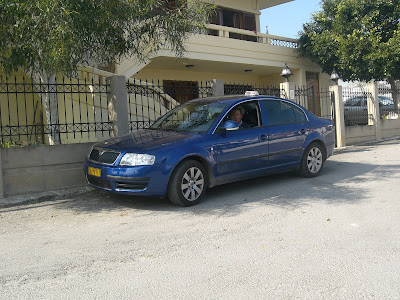
In Hania, we have two different colours of taxi cab. Taxis whose base is outside the town of Hania (ie, they are registered in a village) are grey, while taxis registered in Hania are blue.

The new rules governing cabs now state that a newly bought town taxi must be painted blue all over. The one in the photo has a white roof, because it was bought before the new rule came out.


And here's my husband sporting his (new) taxi, parked outside our house.

Wednesday, 28 May 2008

ABC Wednesday: Street sweeper

street sweeper
It's ABC Wednesday again, and S is for street sweeper.

I admire the patience of this immigrant to my town, taking on the job of sweeping the main street right in front of the Agora clean for the benefit of the locals and tourists alike. He didn't bat an eyelid when he saw me photographing him; he just proudly carried on with his work. Notice how he's tied a few blue bin liners behind him; he's just doing his job.

Wednesday, 21 May 2008

ABC Wednesday: Three doors


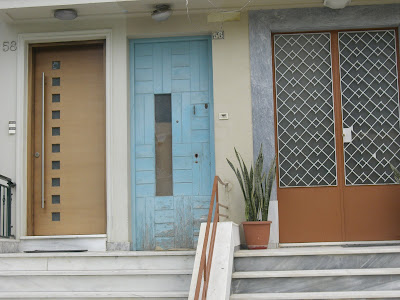
It's ABC Wednesday again, and R is for repulsive.

These three doors appear side-by-side on a central city street apartment block. They never seem very welcoming; the first two even resemble elevator doors. If you ever passed by when they were open, what would you expect to see through them?

Wednesday, 14 May 2008

ABC Wednesday: The municipal gardens


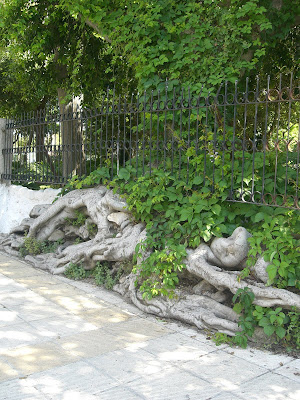
It's ABC Wednesday, and Q is for quirky, as is this tree.

This tree trunk has been exposed to form part of the concrete fence of the municipal gardens of Hania. The gnarled roots are draped with a climbing plant and they look magnificent.

The park is found in the town centre. It houses an open-air cinema and live chess in the summer, there is a lake with a few ducks, and there's also one of the most modern children's parks in the whole town, attached to the children's public library, which we use right throughout the winter. A few animals are also kept there in cages, but this part of the park is being phased out. In the middle of the park, there is large indoor-outdoor cafe, a regular haunt for locals on a Sunday morning where you often see them reading a Sunday newspaper. One of the walls enclosing the park (across the road from the stadium) also contains a clock tower.

The park has special significance for me because my parents owned an apartment close to the park. When my father sat out on the 2metre-by-4metre balcony, he was very thankful that he didn't have to stare into another person's apartment. His view was of the little road right in front of the apartment block's main entrance, which led straight to the park's main entrance, only a few metres to the left of where this photo was taken.

Wednesday, 7 May 2008

ABC Wednesday: Prison


It's ABC WEDNESDAY, and p is for prison.

Islands are perfect places on which to build prisons. Even if a prisoner escapes, they can't go far. Just 4km away from my house (I pass this place every day on my drive to the children's schools), we have a minimum security agricultural prison, catering for prisoners convicted for minor offences. Each day they spend in there (without causing trouble) counts for two sentence days. They live inside the compound, but every day they can be seen clearing the fields, tending sheep, raising vegetables, growing flowers, and doing all manner of outdoor work.

I don't know if this is true, but a friend of mine told me recently that some of the prisoners held there also commit minor offences while they are actually serving their sentence in this minimum security agricultural complex because they don't want to leave at the end of their time; the prison provides them with work, food and accomodation, something they won't find easily once they leave the compound.

I didn't take a photo of the front entrance of the prison, because I would have looked too conspicuous, but I can tell you it looks really pretty. The main office looks like a country cottage, and in front of it, there are flower beds full of roses. A new maximum security prison is also being built 4km away from this site. That place looks quite ugly, if you ask me (watchtowers, high walls, barbed wire).

Wednesday, 30 April 2008

ABC Wednesday: Orange groves and olive fields


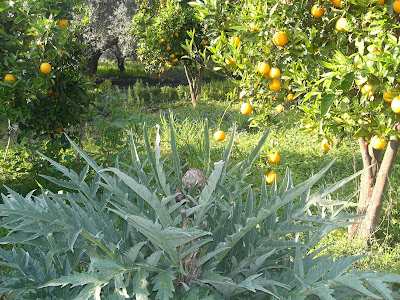
It's ABC WEDNESDAY today, and O is for orange, and it's also for olive.

The orange trees in this field are our very own! We have 500 orange trees spread across half a dozen fields in Fournes, Hania, Crete. The olive trees in the distance (with the black nets below them covering the ground) aren't in our field (but we have been known to make good use of them every now and then). The artichoke plant is in front of the cement fence we recently built to section off our property from a country path running through it.

Wednesday, 23 April 2008

ABC Wednesday: The High St


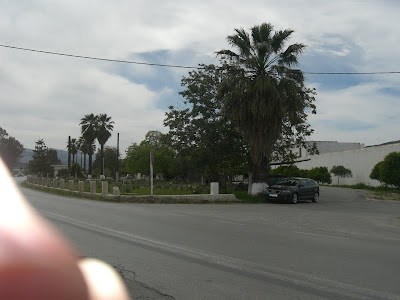
It's ABC WEDNESDAY again, and N is for NATTY (meaning: stylish)

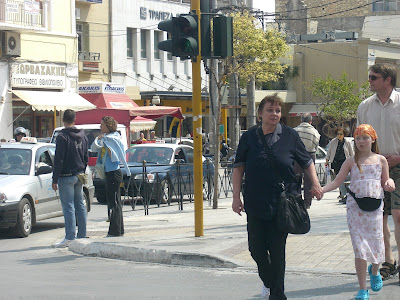
Here's a view of the main road in Hania (the famous Agora is on the right, right next to the trees). The natty old port is found behind the Agora. This photograph was taken yesterday at midday, while I was having a natty ice-cream with a natty little laughing olive tree on the top-floor of a natty cafe called CLOCK, on a day when the fecking weather report forecast cool temperatures between 20-24 degrees Celsius - the temperature went up to 37 degrees Celsius. We felt like potatoes roasting in the oven.

(More about what I got up to with the little laughing olive tree tomorrow...)

Wednesday, 16 April 2008

ABC Wednesday: St Nicholas in Splantzia


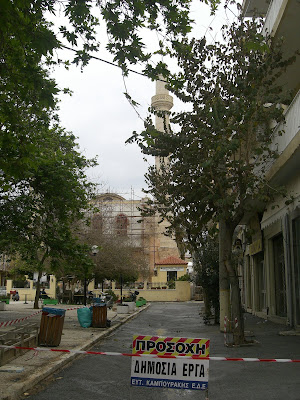
It's ABC Wednesday again and M is for minaret.

On first sight, this photo doesn't look very spectacular - the sign reads (translated from the Greek) "BEWARE - MUNICIPAL WORKS - (name of construction group)." In the background there is St Nicholas church in the Splantzia district, whose dome is being repaired, but what on earth is a mosque's minaret doing on top of the church?

This was once the site of a church built by the Venetians, dedicated to St Rokkos; along come the Turks, turning it into a mosque. When the Greeks finally took over the running of the island, they left the minaret as it was, standing above a church dedicated to St Nicholas. To the left of the church (but not visible in the photograph) stands a house which was once owned by a Jewish family. The main square on the left has always been a meeting point for the locals of the area, filled with tables and chairs for having a coffee or just relaxing. It's a pity these works have stopped the locals from enjoying each others' company in a central location away from their cramped apartments and tiny box houses in the narrow streets of this inner-city suburb right behind the eastern side of the old harbour.

It is no wonder, with such a rich multi-cultural heritage, that the district of Splantzia in Hania, considered a poor people's suburb, is still as multi-cultural as ever. It is one of the few places in Hania where you will hear more foreign languages spoken rather than Greek, the language of the Greek nation. The people who live there are mainly economic migrants from Eastern Europe and North Africa, and there are shops owned by foreigners, mainly for the benefit of foreigners, including a second-hand shop, something still considered quite a novelty in a traditional, trendy summer resort town like Hania, on the island of Crete, in Southern Greece.

The minaret was almost ready to fall down; in fact, it was leaning to one side, clearly screaming out to the council that it was a danger to public safety. At one point, people started calling it the leaning tower of Hania. Eventually, though, the message got through, and the council restored the minaret by strengthening its structure; it is deemed of too significant historical importance to be allowed to fall into ruins.