The beautiful Byzantine church of St Nicholas in Kiriakoselia, a village in the Apokoronas region, retains a small very well kept cemetery within its yards. The village itself has almost been wiped off the map, but the graves are still lovingly tended by the families whose ancestors are buried here. The actual church was built in the middle of the 10th centruy, and is one of the most intact remnants of this time period in Greece.
The most notable part of this particular family tomb is the photographs of the older generation, wearing the trdaditional Cretan costume. The fact that these people were photographed shows their important status in the society of the time.
Greek tombs are never very elaborate. They usually state only the names and dates of the deceased and contain a small closed box where photos, candles and incense can be placed, as well as oil for lighting a lamp in memory of the dead. The handles on this tomb are there simply to make it easier to lift the marble to add another member of the family when it is their turn...
The old minaret adjacent to St Nikolaos church is a perfect reminder of the way the East met the West in the town I made my home, Chania, Crete, Greece. The photographs I post all help to tell a part of a longer story that focuses on the town and its citizens, whether they are living there now, or have made their home in other parts of the world. As a newer resident, by writing about the town in this way, I am trying to put some order into the chaos that I seem to be confronted with.
Showing posts with label church. Show all posts
Monday, 11 May 2009
Tuesday, 18 November 2008
Florist
Tuesday, 21 October 2008
Old man at St Luke's
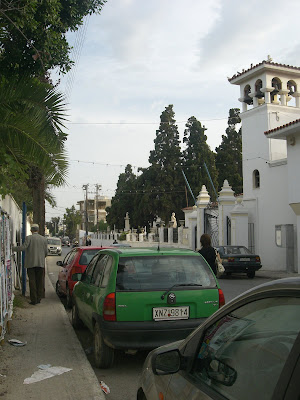
Agios Loukas (St Luke) church houses the town's inner city cemetery. It is located on a street that approaches the town from the west. But that's not why I took the photo. I wanted to talk to you about the old man walking on the pavement. He leaves his house somewhere further down the road, and taps his way up the corner of the road just a few more steps ahead of him. Then he turns back down the same road he came up on, and walks back home. He does this two times a day, every day.
Whenever I walk along this road, I feel very happy to see him. He uses familiar landmarks that he has mapped out in his mind, like the lamp posts, electricity poles, the texture of the walls and gates that he passes, among other things. I got to know him a long time ago when I noticed he was tapping his stick on a car that had been parked on the footpath.
"Do you need any help?" I asked him.
"Oh, no, thanks, I'm fine," he answered. "It's just this car that's been parked here for a long time, and it's blocking my access to the rest of the road."
"Would you like me to help you maneuver your way round it?" I asked helpfully.
"No, thanks, no, I don't walk anywhere else except this stretch of road if it's clear of cars. I'm completely blind," he told me.
I'm still seeing him take his daily walk here, and I think that's a good sign. It means he hasn't moved home to St Luke's yet.
Saturday, 4 October 2008
Saturday, 20 September 2008
Thursday, 18 September 2008
Galatas square
Wednesday, 17 September 2008
ABC Wednesday: I for Icon
It's ABC Wednesday again, and I is for icon.
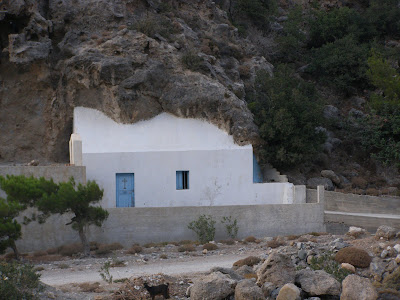
I had the pleasure of enjoying fish and chips today – fish and chips, Greek style, that is. Mama was with me. True, it wasn’t my mama, but this mama was the same age that my own mama would have been, were she still alive today. She would also have been wearing a stocking to tighten her swollen arm filled with fluid after her lymph glands were snipped following breast cancer. Mama would have enjoyed the ride out to the fish taverna, which took us past a little church built on the side of a rock, the sacred cite dedicated to the birthday of St John the Baptist, celebrated on the 23rd of June, a place I had visited with her during the brief period we spent together in Crete.
She would have asked me to stop – as I did – so that she could go into the church, make the sign of the cross and light a candle before the icons which depict Jesus, his Mother and various saints of the Greek Orthodox Church.
Then she would have taken her grandchildren into the church to do the same. She’d probably have washed her hands and face at the fountain with the cool running water and walked around the cave telling the children that everyone has a guardian angel looking out for them.
She probably wouldn’t have wanted to walk down the underpass just next to the cave, which leads to the coolest bluest lagoon I've ever seen, the perfect place for a secluded swim away from the crowds; it's not the right kind of place for sufferers of osteoporosis.
She would probably have rested on one of the stone benches outside the church in the cool damp air of the cave, away from the harsh bright sunlight and the high levels of humidity, which would probably have done her more good anyway.
As we drive by the Kasteli shipyards, she might have looked out at the fishermen's boats and told to the children to watch out for pirates.
“We’re having fish today!” she would announce as we seat ourselves at the taverna, with probably a hint of irony in her voice as memories of the fish and chip shop would flood back to us.
We’d talk about it as if it were yesterday that we were serving our regular customers in the shop – you never forget those ones – and wonder what all the friends and relatives we left behind are doing now in Aotearoa.
After we eat our meal, she’d ask for the bill. I’d offer to pay, and she’d say, “No dear, let me get it this time.” And I’d say, “OK, thanks, mama,” just like I did today.
I had the pleasure of enjoying fish and chips today – fish and chips, Greek style, that is. Mama was with me. True, it wasn’t my mama, but this mama was the same age that my own mama would have been, were she still alive today. She would also have been wearing a stocking to tighten her swollen arm filled with fluid after her lymph glands were snipped following breast cancer. Mama would have enjoyed the ride out to the fish taverna, which took us past a little church built on the side of a rock, the sacred cite dedicated to the birthday of St John the Baptist, celebrated on the 23rd of June, a place I had visited with her during the brief period we spent together in Crete.
She would have asked me to stop – as I did – so that she could go into the church, make the sign of the cross and light a candle before the icons which depict Jesus, his Mother and various saints of the Greek Orthodox Church.
Then she would have taken her grandchildren into the church to do the same. She’d probably have washed her hands and face at the fountain with the cool running water and walked around the cave telling the children that everyone has a guardian angel looking out for them.
She probably wouldn’t have wanted to walk down the underpass just next to the cave, which leads to the coolest bluest lagoon I've ever seen, the perfect place for a secluded swim away from the crowds; it's not the right kind of place for sufferers of osteoporosis.
She would probably have rested on one of the stone benches outside the church in the cool damp air of the cave, away from the harsh bright sunlight and the high levels of humidity, which would probably have done her more good anyway.
As we drive by the Kasteli shipyards, she might have looked out at the fishermen's boats and told to the children to watch out for pirates.
“We’re having fish today!” she would announce as we seat ourselves at the taverna, with probably a hint of irony in her voice as memories of the fish and chip shop would flood back to us.
We’d talk about it as if it were yesterday that we were serving our regular customers in the shop – you never forget those ones – and wonder what all the friends and relatives we left behind are doing now in Aotearoa.
After we eat our meal, she’d ask for the bill. I’d offer to pay, and she’d say, “No dear, let me get it this time.” And I’d say, “OK, thanks, mama,” just like I did today.
Friday, 27 June 2008
SkyWatch Friday: Castle in the sky
The minaret used to be called the leaning tower of Hania, because it was in such a bad state of disrepair that it needed to be repaired or demolished. It was literally leaning to one side in a rather built-up area where the houses have been built so closely together; if it had fallen, it wold've been difficult to get the rubble out, let alone repair it. This kind of building can't be demolished; it is under protection orders, but it's allowed to fall down of its own accord. Its daily presence in Hania involves a significant part of the history of the town, which was once ruled by the Ottoman Turks who presided in the area for four centuries.
Right now, the minaret in Splantzia looks like it could be mistaken for a castle spire - maybe Rapunzel's going to throw her golden hair over the balcony...
Saturday, 26 April 2008
Good Friday
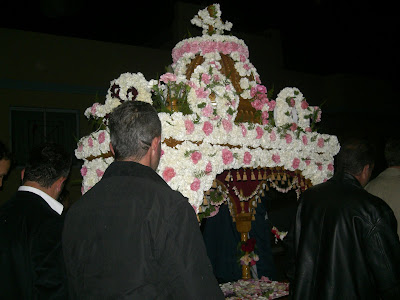
According to the Greek Orthodox calendar, yesterday was Good Friday (we celebrate Easter Sunday tomorrow). Good Friday is celebrated with a solemn procession of Christ's tomb, a wooden structure decorated with flowers and an icon of Christ on the cross. Everyone following the mourning procession holds a yellow candle as they follow the shrouded funeral bier that is carried through the town's or village's streets to the local church. Every major city and tiny town in Greece has their own procession; I attended the service with my family in the village of Galatas, close to where I live.
Galatas has a long standing connection with Wellington, New Zealand, my hometown. It is also the village from where my mother left Greece to migrate permanently to New Zealand.
Wednesday, 16 April 2008
ABC Wednesday: St Nicholas in Splantzia
It's ABC Wednesday again and M is for minaret.
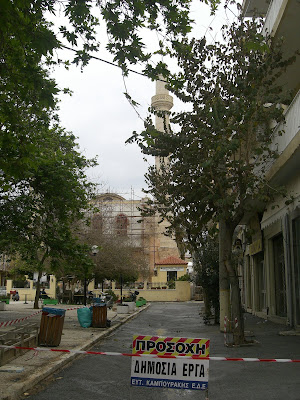
On first sight, this photo doesn't look very spectacular - the sign reads (translated from the Greek) "BEWARE - MUNICIPAL WORKS - (name of construction group)." In the background there is St Nicholas church in the Splantzia district, whose dome is being repaired, but what on earth is a mosque's minaret doing on top of the church?
This was once the site of a church built by the Venetians, dedicated to St Rokkos; along come the Turks, turning it into a mosque. When the Greeks finally took over the running of the island, they left the minaret as it was, standing above a church dedicated to St Nicholas. To the left of the church (but not visible in the photograph) stands a house which was once owned by a Jewish family. The main square on the left has always been a meeting point for the locals of the area, filled with tables and chairs for having a coffee or just relaxing. It's a pity these works have stopped the locals from enjoying each others' company in a central location away from their cramped apartments and tiny box houses in the narrow streets of this inner-city suburb right behind the eastern side of the old harbour.
It is no wonder, with such a rich multi-cultural heritage, that the district of Splantzia in Hania, considered a poor people's suburb, is still as multi-cultural as ever. It is one of the few places in Hania where you will hear more foreign languages spoken rather than Greek, the language of the Greek nation. The people who live there are mainly economic migrants from Eastern Europe and North Africa, and there are shops owned by foreigners, mainly for the benefit of foreigners, including a second-hand shop, something still considered quite a novelty in a traditional, trendy summer resort town like Hania, on the island of Crete, in Southern Greece.
The minaret was almost ready to fall down; in fact, it was leaning to one side, clearly screaming out to the council that it was a danger to public safety. At one point, people started calling it the leaning tower of Hania. Eventually, though, the message got through, and the council restored the minaret by strengthening its structure; it is deemed of too significant historical importance to be allowed to fall into ruins.
Subscribe to:
Posts (Atom)