Showing posts with label food. Show all posts

Wednesday, 13 May 2009

Menu board

Konaki Restaurant by the old harbour was sporting this mantinada:

"What you are going to eat, my friend,
In the company of the Lyre,
Staka and Wedding pilaf rice
Which is the Greek Viagra."

(Please excuse me for the out of focus photo)

Sunday, 19 April 2009

Happy Easter!


Why are my red eggs speckled? A speckled hen must have laid them. The koulourakia (Greek Easter biscuits) are going like hot cakes, and this year...

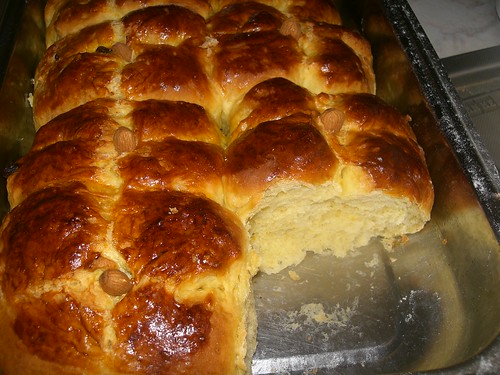
hot cross bun tsoureki

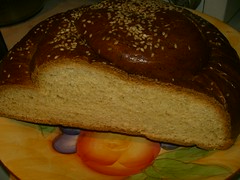
... I used my tsoureki (Greek Easter tea bread) recipe in conjunction with Aussie Peter's idea of mixing the hot cross bun shape with the traditional Greek Easter bread; the result revived nostalgic feelings for my down under origins.

Χριστός Ανέστη!

Thursday, 25 December 2008

The Christmas symbol of Greece

Christmas is associated with the decoration of a tree all over the world, thanks to Queen Victoria and her prosperous England. This tradition has been imported into the culture of most countries, possibly replacing the more meaningful customs of the country that are associated with this time of year. Greece has a vry different Christmas symbol of its own.

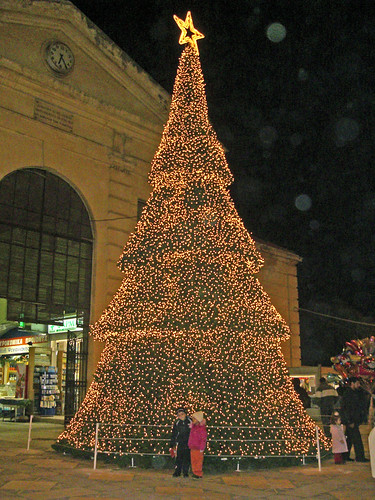
christmas tree hania chania
The Christmas tree in Hania, in front of the Agora

One of the most meaningful traditional Christmas symbols of Greece is the ship. Greece has been a seafaring nation since ancient times, still boasting one of the largest fleets in present day maritime economics. The history of shipping is filled with unpleasant stories of ships being lost at sea due to adverse weather conditions, especially in the wintertime. Perhaps the Greek Christmas symbol has remained relatively unknown to the rest of the world because Greece is a summer tourism destination. If you came to Greece int he winter, you may think a boat has been decorated with Christmas lights as a kinky alternative to the globalised tree symbol...

christmas boat rethimno christmas boat
The Christmas boat symbol in Rethimno, another town located on coastal Western Crete, one hour away from Hania

At Christmastime, Greek people used to (and still do) decorate a toy-sized boat, lit up by an oil lamp burning away throughout the Christmas period (the Christmas holidays officially end in Greece on Epiphany, the 6th of January), as a shrine to the sailors in the family during the cold dark stormy days. Children carried a decorated ship as they went around the village singing the traditional Greek Christmas carols (which sadly have also been replaced by the majority with the Greek translation of Jingle Bells).

christmas boat hania chania
The ship, a symbol of Greek Christmastime

The ship is still used throughout Greece as a Christmastime symbol. It appears in the main squares of most towns, as well as shop windows and private homes and gardens. Hania maintains this tradition with an electrically-lit up boat in the main town square close to the taxi stand. Of all the Christmas decorations in the town (we're just as light-polluting as any other small town in the world), for me, this is the most beautiful.

*** *** ***

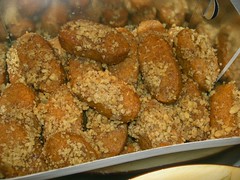
While we lived in New Zealand, my mother used to make kourambiedes, those shortcrust half-moon biscuits covered in icing sugar; we ate them all year round. I only discovered that they were traditionally served in Greece during the Christmas period (you can't even purchase them at any other time of the year), along with melomakarona (a honey dipped log biscuit topped with chopped nuts), when I ended up living here. She made at least 100 pieces per batch and we were instructed not to eat them, as they were to be served to any guest that came to our house, for whatever reason. When we had visitors, out popped the silver serving tray with a demi-tasse of Greek coffee, a dessert plate containing a melomakarono and a kourambie, along with a glass of water.

There are many recipes on the internet for kourambiedes. I make mine according to Anne Yiannoulis, as she describes in her Greek Calendar Cookbook, a book I've enjoyed using so much, that I was thrilled to hear that it is going to be re-issued some time in the near future by Lycabettus Press.

kourambiedes kourambiedes kourambiedes

Another traditional sweet of Greece at Christmastime, apart from melomakarona (mine are from Spitiko in Hania), is the Christmas tsoureki (mine is made by the Xiotakis pastry company).

melomakarona christmas tsoureki hristopsomo

During these severely troubled times in my country and around the world,
I can only hope that the Christmas Season will bring some peace in everyone's lives.

poinsettia
Last year's poinsettia survived its second Christmas

Wishing you all a Merry Christmas
with all the joy and happiness
associated with this time of year

©All Rights Reserved/Organically cooked. No part of this blog may be reproduced and/or copied by any means without prior consent from Maria Verivaki.

Monday, 15 December 2008

Post-weekend story: Dimitra's story

I finally got round to visiting them on my way to pick some olives from Fournes, a short detour from my route. They would appreciate my dropping off the photos of their granddaughter's wedding. They will not be expecting to see the bride and groom so soon, so this will be seem such a treat. Long-distance journeys are never easy; the telephone makes one feel that they are never far away. In any case, a photograph is bound to be on its snail-mail way soon.

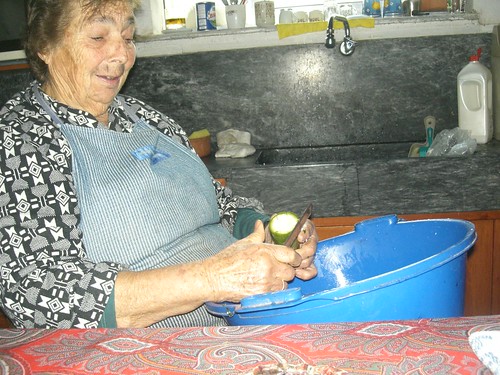
dimitra

"Why, hello there! Look who remembered us, Mihali!" my aunt greeted me as I entered the house. The front door is never locked, I simply pushed it and it swung open.

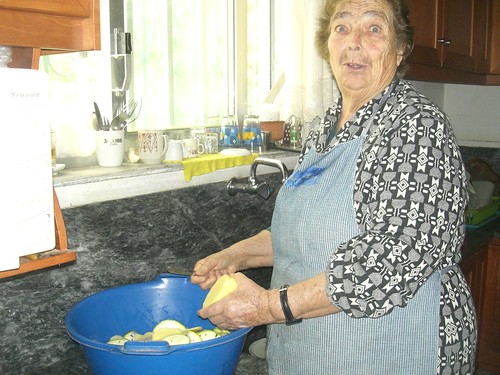
"Happy nameday, Thia!" I replied. I saw her standing in her usual position, over the sink, slicing courgettes. Even though there are no children or grandchildren living in her vicinity, she's still cooking up a storm in her kitchen, a whole tin of food, enough for a family of six. I wondered how many vegetables that woman must have cleaned, pared and chopped in her lifetime of 79 years.

"Na hairese ton andra sou!" she replied. She always remembers my husband's nameday, but can never get round to calling us on the day, as she is too busy accepting phone calls for her nameday on St Demetrius'.

Thio was nowhere to be seen; he had probably wandered off to the kafeneio to pass the morning, away from his wife's space. "The same to you and Thio!" I reciprocated, only just remembering the correct wish for the occasion of a nameday. My brain never seemed to be able to cope with categorising the appropriate expressions for each occassion. Most of the time, I keep my mouth shut just in case I make a faux pas, and say something unlikely, such as 'Hronia polla' at a funeral, or some other highly inappropriate occassion for such a wish.

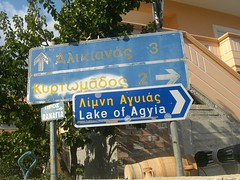
"You know how much I love it when you come over!" Yes, I did know, feeling guilty that I did not visit more often. Whenever I pass the sign pointing in the direction of the village, I tell myself that I must remember to turn onto their road on my return journey from the olive grove, by which time it always seems too late to spend time in another person's kitchen when I could be in my own.

(Ayia Lake is now a protected area; pouraki is a similar sweet to baklava, made locally.)

"Shall I make you a cup of coffee, sweetie? What about a pouraki?" Even when I'm not hungry, I know that the food I will be eating in this house will not be available to me again until my next visit. Eat what you can now, Thia's said to me on many an occasion, because you don't know when you'll be able to find it again.

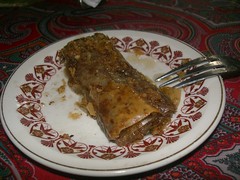
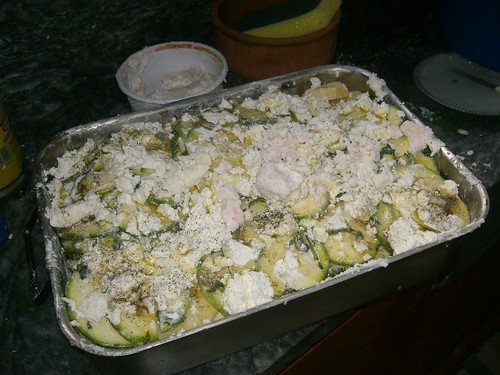
"Yes, please," I replied, awaiting with eagerness that little sweet roll filled with nuts from the surrounding trees, seeped in aromatic honey syrup. "That's a big tin of boureki you're making, isn't it, Thia?" I can't see any potato in the tin; she didn't add any potato to her moussaka, either. Once Thio was diagnosed as diabetic, Thia had to adjust her recipes to accomodate him. Not that potato would make much of a difference to Thio's sugar levels; it's all in the mind.


"This'll be enough for two days. But it's not just for us, you know," she explained. "I'm going to your uncle's house and we'll have our lunch there." More guilty feelings; another person I hadn't seen in a long long time. Thio Perikli is her older brother. What am I waiting for?

"How's he doing?" I asked, a question I prefer to avoid, because the answer is never very good.

"Life's a chore for them, they've aged, we've all aged, but they haven't aged well. Athina's practically blind, and all she does is sit around the house now, she never gets out. And her husband's not any better, thinks he can feel death knocking on the door." They both had recently voicedtheir concerns of losing each other.

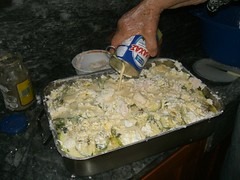
She rummaged around the bowl of courgette slices as though she was searching for something. "Ah, here it is," she said, pulling out a huge pristine white potato from under the mint-dotted courgettes. "I had to hide it until Thio left the house. What the eye don't see, the mind don't know." The oldest trick in the book. "He's just gone to the kafeneio to pick up some bread. The baker's coming round today. Not that we eat much ourselves - it's not too good for Thio's diabetes - but we buy some out of habit, like we did in the old days," she sighed, still standing at the sink with her hands full of vegetables.

boureki

She began layering the vegetables and mizithra into the baking tin. "We used to make our own bread in the village, me, Marika - may the Lord forgive her - and your yiayia," she continued. "We would buy flour with yiayia's pension, after pappou was killed in the war, and if we didn't have enough money we would trade some eggs, or whatever else we grew in excess. In those days, we used ten okades of flour, which isn't ten kilos, but much much more, and we always made ten huge loaves of bread to last a whole week for the six of us."

She opened the oven door. "Don't you top your boureki with filo pastry?" I asked her.

"Oh, I'm past rolling out pastry, dear, that's for the young like you to do." Not that I could be bothered doing it myself; I just throw my boureki into the oven as it is, bare; the cheese burns slightly as the pie cooks, creating the illusion that there is a sheet of pastry topping it. "Besides, if you thio sees it, he'll start another rant about his diabetes levels."

It was a heroic gesture for her to visit her brother and his wife daily. "I don't really want to go to your uncle's house. They always seem so depressed, you know, and this reverberates onto me. It lowers my morale and raises my blood pressure, so I always leave their house feeling ill. They don't realise how much this takes a toll on me; I've still got your thio to look after." She had that worried look on her face, the fear of the unknown, mixed with the knowledge that, whatever it was that she would discover, it would not be something good.

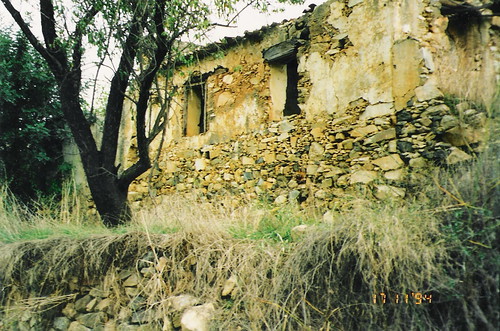
drakiana
(the original family home in the village of Drakiana)

"Sometimes I feel as if I've gone back in time, and we're eating altogether in the house with your yiayia." Her blue eyes always twinkle when she recalls the past. Her father was killed on the first day of the Battle of Crete, but her stories never seem to recall those days of misery. "When the midday meal was cooked, your yiayia would tell us to come to the table so that we could eat together. We never ever started eating until all of us were home. It was a rule that she enforced strictly. She never wanted anyone to feel that he'd missed out on the first pick. It was usually Manoli who was missing from the house, so Marika or Niko would go out and look for him. He was the youngest, so he was always out playing with the other orphans in the neighbourhood." I had never thought of my father as a young boy, carelessly playing in the mud streets, being called home by his older siblings. What games did he play in those post-war days?

tsouri
(a toy fashioned from wire, called a tsouri; from John Donat's KPHTH - CRETE 1960)

Thia now sat on a chair and began cutting up all the vegetable scraps into tiny cubes for the chickens and rabbits Thio kept in the sohoro near their house. "We may have been orphans, but we weren't like the other orphaned children in the village. We always ate off plates. I usually helped my mother in the kitchen, and Marika would lay the table, and we each had our own plate," she continued, "not like in Elenara's house. She was widowed too, but there were ten of them in the family, eleven counting herself, so there was never enough food in her house. She'd plonk a hot cauldron full of food in the middle of the table, and all the children would rush to it, like they'd never seen food before, and fish whatever they could out of the pot with their hands. We were much more civilised, we ate like royalty compared to them." She smiled with a satisfied look on her face.

kirtomado hania chania

"I was lucky, because when I got married, I came into another good family, and we all lived well there too. I was only seventeen, but everyone loved me, and I loved them too, you know. I would go with my mother-in-law to the fields and we would gather horta together. If I was given a taliro (five drachmas) for each bag of horta that I gathered, I'd be the richest woman in the world." She had finished chopping the vegetables, and now sat with the palms of her hands on her knees, tucked away under an enormous blue apron.

animal feed

"There was never a sad moment in those days, not like now, when all you hear about is doom and gloom..."

©All Rights Reserved/Organically cooked. No part of this blog may be reproduced and/or copied by any means without prior consent from Maria Verivaki.

Saturday, 13 December 2008

Home-made dinner

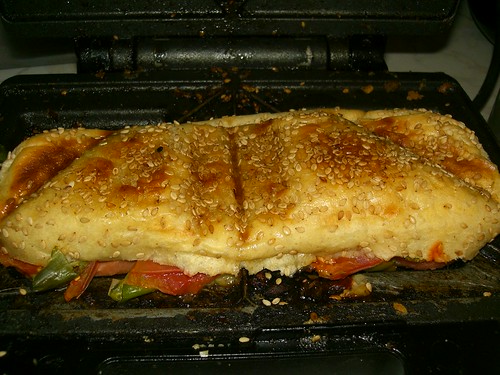
cabbie's dinner

Today's photo doesn't really look like much: a toasted bread roll, filled with a slice of ham and cheese, with some garden-fresh tomato and green peppers, which the grower will enjoy when he drives his taxi this evening in the town. Much healthier choice than a greasy souvlaki.

Wednesday, 10 December 2008

Olives in brine

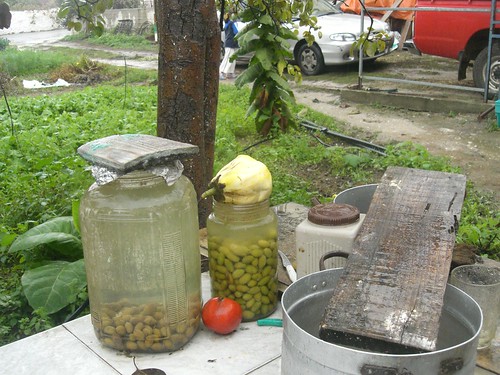
olives in brine

A village scene on a very wet day; olives in brine. The jars are missing their lids, so my uncles placed an aged (albino) eggplant on top of one and a piece of (rotting) wood on the other to keep away insects and dust.

The mayhem is continuing, now that there is no control anywhere. I don't have a licence to use my husband's hunting rifles, but I have the water pressure unit ready on hand to protect what I can.

Answers to yesterday's quiz:
The fashion store is operated by Chinese businesspeople - wherever we see red lanterns hanging outside a store all over Greece, this is a sign that cheap clothes are being sold here by Chinese people.
On the left-hand side is a TAVERNA, while the green door has a sign on it for the Greek Language Society; it is also the premises of a "philological preparatory school" which helps high school students in their exams.

Monday, 8 December 2008

Post-weekend story: The influence of the Greek education system on biscuit making skills in young children

It's very easy to keep children entertained at home: give them a DVD player, a remote control, a stack of DVDs, and they'll stay in one place for a long period of time, zonking their brains out, turning into zombie zappers. Eventually when they want to talk to their parents, they aim the remote control at them. If they don't get their attention, they start screaming, or something similar to what we do when we can't get technology to work for us. Trying to wean children away from watching television at the weekend is a more difficult task, especially when they are very young, because they are simply not independent enough to act on their own devices and involve themselves in something creative without needing assistance from an adult. You can tell them to work by themselves on a project, but you have to be prepared to be more forgiving towards them when they accidentally damage or stain part of the house or furniture.

We have a lot of books lying around the house for the children to browse through and pick an activity they'd like to try. They've made volcanoes erupt (using vinegar and baking soda), they've made an aquarium (in a shoe box; the fish are hanging on strings) and they've made lap books (thanks to Paula, a home schooling teacher in the US, who likes to blog about food, which is how I discovered her) . But they still need help to do all these things, and even more so in the kitchen, where they're 'playing' with knives and heat. On a recent rainy weekend, my children asked me to let them make some biscuits that they saw in a DK activity book.

lapbook DK biscuit recipe

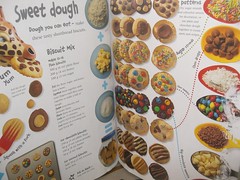
The instructions in the book were quite simple, and there was also a page full of different biscuit designs that they could try. They particularly liked the coloured biscuits, which of course they wouldn't be able to re-create since we don't keep this kind of confectionery in our house. I explained to them that I would help them to make the dough, but they could make all the biscuits. I disappeared from the kitchen (I felt like a homeless person) to let them work independently.

I heard an argument start between the children. Aristotle was annoyed that Chrstine wasn't lining up the finished biscuits in a similar pattern on the baking tray: Aristotle was angry because "she's not making a motivo." His view of the world is an ordered one where everything has to be done one step at a time, following some logical pattern. He wanted to see a motif on the baking tray. Needless to say, he is stuck on doing one activity before moving on to another activity: it is common knowledge that men can only do one task at a time, while women perform multi-tasking (something to do with women possessing a larger corpus callossum in the brain).

children making biscuits
(if you want to make the biscuits - the recipe is simple and the children had lots of fun making them - the recipe is given in the photo from the book)

Christine, in the meantime, was looking at the biscuit designs in the book and trying to copy them. She did her best, but was annoyed that she wasn't able to make her biscuits look exactly the same as the illustrations. "Why don't you make up some of your own designs?" I asked her. She stared at me blankly, as if she did not understand what I meant. Her brother, on the other hand, understood exactly what I meant; "That's not what the book says," he answered. If it's not in the book, it can't be done; if the teacher (in this case, the book) didn't say it should be done, then it shouldn't be done. It was very hard to convince the children that they could shape and top the biscuits any way they wanted.

Similarly with school homework, "δεν το είπε η κυρία" (den to ipe i kiria - the teacher didn't tell us to do that) is often what a Greek child will tell its parents if they suggest deviating in any way from the teacher's instructions. Going against the exact orders of the teacher, even if s/he expalined something incorrectly, is a sacrilege; the teacher is always right, even if s/he is wrong.

All over the world, the education system is the same: the most important things a child must learn at school are the three R's (Reading, w-Riting and a-Rithmetic), while anything creative gets second (or no) place. Science subjects are treated with reverence, but even they do not get the respect they are due, because if you can't think creatively, you can't really be a scientist, and there is so much to discover that is still unknown in the world, but children in Greece (and, I suspect, in most parts of the world) are learning what is already known, what is in the set textbooks of their education system and libraries, all in the aim of turning children into miniature self-important professors, despite the fact that in this world, we also need plumbers, laboratory technicians and rubbish collectors to make it go round.

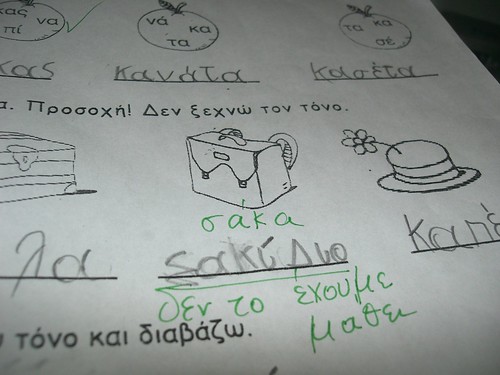
Here's an example from my first-grade daughter's homework (yes, she really does have homework at age 6). Every day, the teacher (a lovely young woman with some teaching experience) gives the children a typed (or sometimes hand-written) sheet of language exercises. There is usually a letter-identifying exercise (eg "circle all the K's and k's"), a find-the-correct-spelling task (a given word must be found in a word cloud) and a picture exercise where children write down the word they see in the illustration.

Christine generally has no problem doing any of these activities. Upon seeing a paintbrush, she wrote pinelo (πινέλο), she recognised the cat - gata (γάτα) - and she recognised the bag: the general word for 'bag' in Greek is tsanta (τσάντα). But she didn't know how to spell 'tsanta'; the 'ts' and 'nt' letter combinations are difficult to recognise for a young child who has only recently started learning to read in Greek. I 'knew' that the teacher wasn't expecting Christine to write the word 'tsanta' on the line underneath the bag picture; I had previous experience of the same photocopied material (would you believe it, teachers aren't even writing their own student handouts?) from my son's homework, exactly one year ago.

"'Tsanta'. How do you write 'tsanta', Mum?" asked Christine.

On an informative note, the Greek language is not difficult to read once the letters and basic spelling rules are learnt, which is why, by Christmas, most first-grade Greek children can read practically any printed matter in the Greek language. (This can not happen for the English language where each letter or pair of letters does not have a standard pronunciation pattern: just think about how the words 'though', 'rough', 'through' and 'thought' are pronounced.) As a teacher myself, I don't believe in spoon-feeding children, not just my own. I tried to get her to think creatively so that she would do the exercise herself.

"Well, if you can't write the word 'tsanta', can you think of another word for 'tsanta'?"

Christine thought about it for a while. "'Sakidio?'" she offered. Σακίδιο is a kind of backpack, similar to a school bag.

children's greek homework

"OK," I replied, knowing that I should have made a more exclamatory remark like 'bravo!' or 'excellent!' to encourage her ability to think for herself; what held me back was that, once again, I 'knew' that this was not the answer that the teacher was expecting. I had seen all this before. Sure enough, the next day, the red ink (in this case, purple) was sprawled all over the bag icon: the 'correct' word was 'σάκα' (saka - an old-fashioned word for school bag, which no one uses nowadays, as it is reminiscent of 'satchel') and the teacher underlined the fact that the word 'sakidio' contains a combination of letters (the two vowels at the end) which 'have not yet been taught'. Why she couldn't just tick it as correct, and write 'saka' as a synonym rather than a correction, I do not wish to go into. It reminds me of teachers who can only go into a lesson carrying an answer book to the pupils' textbooks. What upsets me most is that she expected a six-year-old child to work through a homework sheet according to what had been taught in the class, without the child bringing in her own experiences.

I accidentally came across a brilliant mp3 - the only one I have ever heard, come to think of it. As I was perusing Jeremy's Wellington blog (where I was born), I noticed a side link in his favorite blogs that sounded vaguely familiar "Creativity Killer of Kids: our Education System." I had to check it out, and that's where I discovered Sir Ken Robinson. Please listen to his lecture; you may think he's trying to sound funny, but that's only because he is trying to attract your attention, as he has a serious point to make - I do this all the time with my adult students. He believes that creativity is as important as literacy in the education of children, and it should be given equal status; but the education systems of most countries of the world are "educating children out of creativity": they are teaching them not to make mistakes, and if you don't make mistakes, you will never be creative.

*** *** ***

"Mum, we've finished," the children called out from the kitchen. There was no more space on the baking tray, but there was some dough left in colours (yellow and chocolate).

"I'm going to make some biscuits, too," I told the children.

"Which pattern are you going to choose?" asked my son.

"None of those ones," I replied. "I'm going to make up a design of my own."

"How?" He was bewildered.

biscuits creative biscuits

"Just watch me," I said. I rolled each leftover bit of dough into two long strands and stacked them one on top of each other in alternate colours. Then I rolled the new dough combination altogether to get the strands to adhere to one another. Finally, I cut the sausage shape into slices: checkered biscuits.

"Wow," they both exclaimed.

"You don't have to make these ones," I warned them. "Think up something for yourself."

Sir Ken finishes off his lecture with the following statement: "We may not see our children's future, but they will, and our job is to make something of it." He also quotes another well-known writer who has this to say about the human being's actions against creativity: "If all insects disappeared from the Earth, in 50 years time, there would be no life; but if all people disappeared from Earth, in 50 years time life would flourish."

©All Rights Reserved/Organically cooked. No part of this blog may be reproduced and/or copied by any means without prior consent from Maria Verivaki.

Saturday, 6 December 2008

Aliens: guess what?

kohlrabi

This vegetable looks like an alien.
Do you know what it is?

Answer tomorrow.

Sunday, 23 November 2008

Winter stock up: guess what?

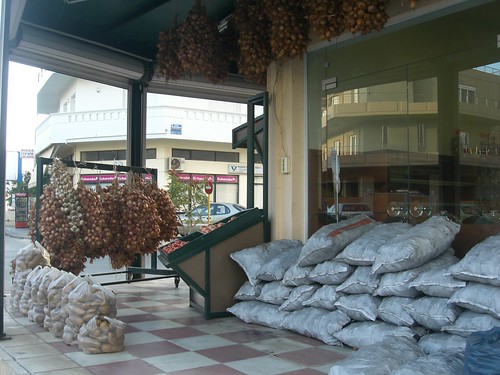
winter stock up hania chania

A well stocked store in Hania: onions, garlic, potatos and ???
What's in the sacks?
Answer tomorrow.

Thursday, 13 November 2008

Autumn hues

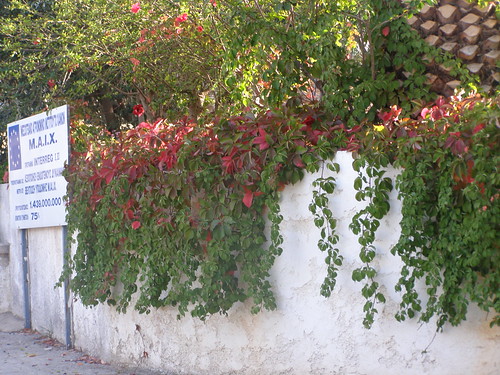
signs of autumn

Autumn colours are considered one of the most spectacular artists' palettes. In my town, however, the mesmerising autumn hues are not played out very well; most of our trees are evergreens. Most of the time, summer turns to autumn without a trace, since the weather is still quite warm.

This is the only plant in the whole town - found in various places: my home, the town centre, most of the villages, and even my workplace, where the photo was taken - that remind us that winter is nearing.

For more spectacular shots of autumn, take a look here and here.

Monday, 3 November 2008

Post-weekend story: The wild west

The image of Athens that springs to mind in most people's heads is that of a tightly packed sprawling treeless city full of apartment blocks that bear a resemblance to the notion of inhabitable accommodation, with the pride and centrepiece being the Acropolis. The image is generally correct, but this did not resemble my first introduction to the city that the Scottish like to think compares to their very own Edinburgh (and why a sun-starved city like Edinburgh should, only the Scots can tell us - it's all Greek to me). As a Greek born abroad, I had very little idea what there was in Athens beyond the Parthenon. The leafy northern suburbs (like Kifissia) and the southern coastal suburbs (like Palio Faliro) were and still are unknown to me, despite having lived in Athens for nearly four years. I went to the wild west, into an area that remains relatively unknown to most of the tourists and locals alike; you don't go west of Athens unless you need to.

When I first arrived in Greece, my very first introduction to Athens was spent in an area that was very far removed from the images of the Athens that I thought I was coming to, a mental image acquired from the tourist brochures at the travel agencies, the travel books in the Wellington public library, and the postcards we were occasionally sent from our relatives. Everyone there lived in single story dwellings, there were quite a few parks and many open spaces surrounding the houses, and the Acropolis was regarded as one of the most useless rocky hills on a prime spot of land in central Athens. The area was close to the sea, hence the name given to the region: Παραλία Ασπροπύργου (Paralia Aspropirgou: the Aspropirgos coast).


Aspropirgos is located 17 kilometres west of the centre of Athens. Many members of my mother's family moved to this area from the village of Κάμποι (Kambi) in the 1960s, in search of work and better opportunities; generally speaking, they were aiming for a chance to improve their lives. In the poverty of the post-war era, with the demise of village and rural life, everyone was leaving the agricultural regions and moving into the urban environment. But in Paralia Aspropirgou, urbanisation never seemed to catch on at the rate that it had in the centre of Athens. The area only recently acquired footpaths and tarmac on the road, while the main form of grocery shopping is still the neighbourhood παντοπολείο (pantopolio). Everyone knows each other; they are often related to one another in some form, be it as a sibling, best man, godparent or the same village origins. Many people from Crete settled in this area, creating enclaves of Cretan communities, in the same way that immigrants to the New World did in America and Australasia.

My aunt was one of those 'migrants' who settled in Aspropirgos with her young family after her husband was 'excused' from his duties as a policeman (due to the curse of the bottle). There were many job opportunities available in the area, all within walking distance of the first dwellings in the area: makeshift roughshod container style houses, onto which rooms were added one by one, until they were big enough top house all the occupants. They usually contain two bedrooms, and resemble brick and mortar shacks. The area was classified as residential only recently; since then, pavements and tarmac were laid on the roads, which were also given street names. Eventually, Thia bought her own home, very similar to the one she rented when she first came out to the area. It still remains a simple house, although it has been modernised to the point where she has air conditioning in the summer and radiators in the winter. Her tiny garden contains an olive, a lemon and a walnut tree, all of which she planted herself.

paralia aspropirgou
(the footpath, tarmac and street names are relatively recent additions to Paralia Aspropirgou)

"When we moved up with Leonidas-God-rest-his-soul, I realised that we would never move back down to Crete. Because of the jobs. Because we had no work there. It was very tiring travelling to Crete and back during the olive season, so I sold the olive grove I had been given as part of my dowry. What use was it to us? We had jobs here, and our lives were based here. I bought my own home with the money from the sale, and helped my daughters into theirs."

So what kind of jobs did everyone do around here? Factories. Hundreds of factories. Light industry, heavy industry, shipbuilding yards, gas works, electricity plants, metal works, oil refineries, cement works. The different suburbs of Paralia Aspropirgou weren't named after a church, in the classical Greek manner; they were all named after the works close to it.

Ask a cabbie to go west of Athens beyond Egaleo and watch the reaction on his face.
"Where ya goin' to, kiria mou?" asked the taxi driver.
"Paralia Aspropirgou," I replied. His face scrunched up; Paralia Aspropirgou isn't the most popular destination for cab drivers - there's no guarantee of a return fare. It's like World's End, the point of no return.
"Know ya way round there?" he looked at me suspiciously.
"Sort of, you can drop me off at Halips."
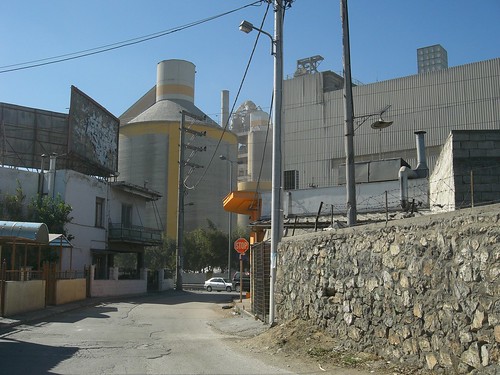
halips paralia aspropirgou athens
(Halips factory, as seen from the entrance to the suburb of Paralia Aspropirgou)

Halips (ΧΑΛΥΨ) is the now defunct cement works across the road from what looks like a narrow insignificant side street on one of the filthiest motorways in Europe, the very road that one must take to go from central Athens to Corinth. Looking at it from the motorway, it is difficult to imagine that there is sense of home and hearth behind the putrid dust storms that Halips left behind well after it closed down. Not a single house can be seen from the main road, only industrial plants. It looks like Hell, a wasteland of metal, concrete and glass, right next to the coast, a site probably chosen for the ease with which waste could be dumped without anyone needing to find out (toxicity tests started being conducted well after the environmental damage had turned the area into Athens' biggest sewer). Nothing shines here on the main road. If you saw the metal works in the Lord of the Rings films, you can conjure up the right picture in your mind. The windows are permanently covered with a thick film of dust, which doesn't get thicker because it is so dry, nothing can stick onto it any longer. It blows around continuously, entering the houses, settling on the ground, piling up in corners.
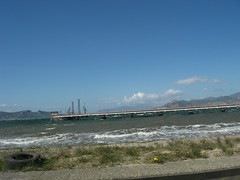
nafpiyia aspropirgou athens nafpiyia aspropirgou athens
(when you don't have a choice, you may indeed decide to go for a dip here; don't worry about the mass of ships ramming into you - this is a ship cemetery, they're not going anywhere)

On my first night there, I woke up in the middle of the night feeling somewhat disoriented, as is common when you stay in an unfamiliar place for the first time. From the window of the kitchen-cum-dining room where I slept, I saw a fire that seemed to be burning on the top of a chimney. I startled my aunt.

"Thia, wake up! Something's burning!" I pointed to the window. She turned to look at me, with a surprised look on her face, then looked back out the window without saying anything.

"What's that fire there?" I realised that she had seen this flame before.
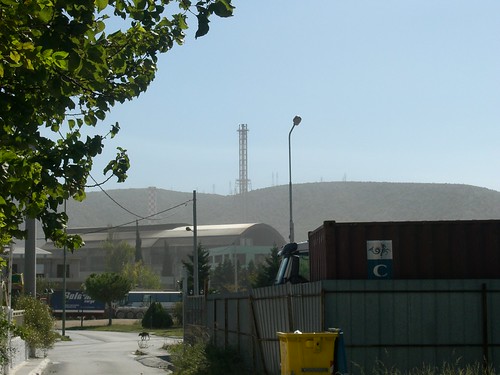
oil refinery paralia aspropirgou athens
(look closely; you'll see the Olympic flame, too)

"Oh, that's the Olympic flame," she replied, and returned to her bed. "Διυλιστήρια (thilistiria - oil refineries)," she added. "Nothing to worry about."

I received a few more shocks over the next few days of living in Paralia Aspropirgou. One of the most shocking for me was that nobody could direct me as to how to get to Athens. No one knew how to go to the Acropolis. I finally found out from someone who had been living in Paralia Aspropirgou for a long time, and worked in Athens.

halips paralia aspropirgou athens
(the original Halips bus stop was at the point where the iconostasis is now; don't kid yourself about why the bus stop was moved a few metres away just below the recently built overpass )

"Cross the road and stand outside Halips. All the blue and white buses that pass this road terminate in central Athens (except one which clearly says PIREAS on its ticker tape). Buy your ticket at a kiosk before you board the bus and validate it once you get on. On a Sunday, getting into Athens takes a quarter of an hour from here, since there's less traffic."

It sounded surprisingly easy. "Why couldn't anyone else have given me this information?" I asked her.

"Oh, don't ask anyone anything here. They don't know, really they don't know anything. In any case, they do their shopping in Elefsina, which is only a few kilometres from Aspropirgos. It's much more convenient than entering central Athens. They'll just get lost, believe me, they'll never be able to return home if you let them loose there."
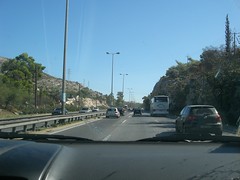
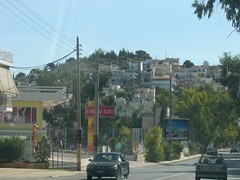
part of iera odos athens iera odos athens
(various views of Iera Odos; heading westwards, once you pass the signpost for the old monastery, the road loses its tree-lined scenery and takes on a deserted ghostly appearance)
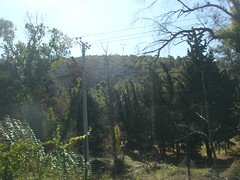
iera odos athens iera odos athens

Elefsina, 5 kilometres westwards of Aspropirgos, is where the site of the ancient sacred mysteries perfomed in the goddess Demeter's honour are located. The site was highly significant in the ancient world, with members of her sect being sworn to secrecy about the ceremonies held there. The road from Eleusis (as it was then called) to Athens was known as Ιερά Οδός (Iera Odos), the Holy Road. It is still bears that name - Iera Odos offers some of the most pleasurable shopping opportunities in Western Athens - one big long stretch of road with few turns and bends, leading straight to the Parthenon, although this will not be so obvious any longer, what with the reshaping of the city of Athens once the urban sprawl began to spread out of control. There was a time when the Acropolis could be seen right along Iera Odos, although this has changed too, since the construction of tall buildings, obscuring the view of the hill where the Parthenon stands. My father remembers seeing it as he walked to work at the Pitsos appliance factory in Egaleo. It is more visible once you pass the site of the Agricultural University of Athens, which coincidentally is located in the most polluted area of the city, the western suburbs.

*** *** ***

So what did Little Crete have to offer in terms of edibles? I recently overnighted at my aunt's house, before meeting up with a friend who I had never met before in my life.
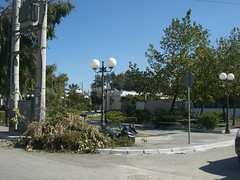
paralia aspropirgou CIMG4944
(typical views in the area of Paralia Aspropirgou)

"So what brings you to Athens, dear?" asked my aunt.
"I'm going to meet up with a friend who I've never met before," I answered.
"Oh.. well.. you know what you're doing, you always did." We left it at that.
"Are you hungry?" she asked me. I had left my own home in Hania at 7pm, and it was now half an hour before midnight.
"No, not really, Thia."
"I've got some leftover rabbit from today's lunch," she tempted me, an offer I couldn't really refuse. "I've cooked it with pasta, and there's just one more serving of it."

rabbit and spaghetti

Thia comes once or twice a year to Hania and stays with her brothers. When she returns to Athens, she takes whatever she can in terms of fresh produce back with her. Cretan products are not always difficult to source in Elefsina - her main shopping area - but they are not always available when she does her weekly shop. Her brothers give her freshly slaughtered rabbits and chickens, farm fresh eggs, potatoes and whatever is in the garden at the time of her visit. There are also some Cretan supplies stores in Elefsina. A very small laiki street market runs weekly in the area, mainly used by old people and those that do not own a car. Most people drive to the large well-stocked supermarkets in Elefsina to do their shopping.

"I almost forgot, Thia, I bought you some aubergines and peppers." She was most thankful; we discussed different recipes I cook to use up the eggplant surplus in our garden.

It was time to go to bed. Thia doesn't usually stay up so late. She did it for me. As it was a warm night, we left the window open in the bedroom. It was eerily quiet in the neighbourhood, save for a humming sound. This sound did not stop, in the same way that the Olympic flame never blows out in the Aspropirgos refineries. It was the sound of the humming machinery that was working 24/7 in the surrounding area, a slow buzz that did not so much interrupt the silence, as much as pervade the air. Every other sound was like an over-write on the silent humming, like the lyrics to the refrain of muzak playing in a supermarket, an artifical world where nothing seems to change. Paralia Aspropirgos had not changed much at all, despite my first visit to the area being seventeen years ago.

In the morning, Thia insisted that I have breakfast with her. She brought out some φρυγανιές (friganies - dry toast squares), feta cheese made in Hania by a local cheesemaker ("ask your uncles where they buy it from," she informed me), and a bowl of cured olives from the olive tree on her property, served with a cup of hot τούρκικο (tourkiko - Greek coffee, named after its origins).

cretan breakfast in athens

"Do you like it here, Thia?" What a question; she's been living here over thirty years.

"Of course, I do, dear, it's much better to be living in a little shabby house that I can call my own, rather than the best apartment in central Athens. If I didn't live here, I'd have gone back to Crete. I could never live in a box. And it really isn't that bad here; I know everybody and we all look out for each other. At night, all the lights from the factories sparkle like a Christmas tree. It's really quite beautiful."

If you could just keep your eyes away from the main road, Paralia Aspropirgos doesn't seem such a bad solution to the Greek housing and employment problem.

©All Rights Reserved/Organically cooked. No part of this blog may be reproduced and/or copied by any means without prior consent from Maria Verivaki.

Sunday, 2 November 2008

Camera critters: the great escape


Some time in mid-September, I was in Fournes irrigating our orange trees, a task now being accomplished automatically by nature itself. The field snails had woken up from their summer slumber as the irrigation taps were being turned on. There were hundreds of them walking about; I counted 100 snails in my plastic bag when I turned them into a boiling pot of water (really, they are delicious if you know how to treat and cook them).

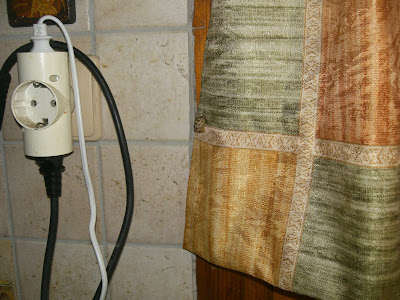
We don't usually eat the small ones. Maybe this one didn't catch my attention; it escaped from the bag and climbed up the kitchen curtain. There it curled up and hibernated until I saw it only a few days ago.

"Don't worry", I comforted it, "you're not ready for the cauldron, not just yet anyway", I said to it as I threw it into the garden.

Monday, 27 October 2008

Post-weekend story: Double identity

Recently, I had the odd task of having to prepare my children's school meals 160 nautical miles away from home. Really weird, but that was the agreement between me and my husband if I wanted to go to the big smoke and meet up with a friend. The food had to be able to remain relatively fresh; all I'd have to do when I came back home would be to put it into my children's schoolbags within the same hour that I arrived. What kind of healthy prepared street-cafe food can you buy for your children's Monday lunchboxes on a Sunday, when you're flying back home 160 nautical miles away at 5.30 the next morning?

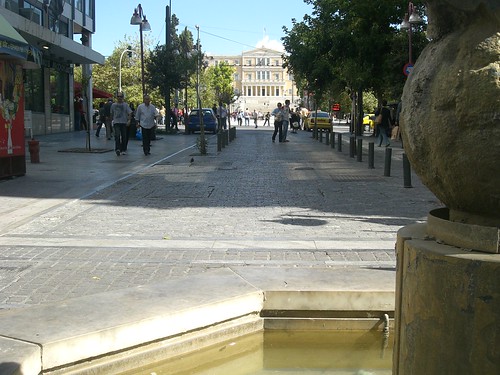
sintagma athens
(Sintagma Square in the distance)

I had arranged to meet up with my friend in the middle of Athens. Σύνταγμα - Sintagma (Constitution Square) - was teeming with people that day, even though it was a Sunday and all the commercial shops on Ermou St were closed. The day was sunny, warm and breezy, a perfect day for a Sunday βόλτα (volta - stroll), which most of the town's residents were doing. There were pigeons flying all over place on the pavement, people were taking photos of Parliament's guards in their sentry boxes, the McDonalds on the corner was full of youthful faces enjoying their happy meals and a whole range of foreign languages could be heard all over the place, interrupted occasionally by the Greek language. I had some time to spare before the appointed meeting to search for what I could buy from around the area that could travel safely, not go off or become stale, stay intact without getting mushy in my backpack, and more importantly, resemble a nutritiously rich meal that could constitute a child's school meal.

plaka athens
(laidback atmosphere in Plaka)

The side streets of Sintagma Square leading to the Acropolis abound with mini-markets, cafes and παντοπολεία - pantopolia - literally a 'sell-everything' shop. In terms of edibles, the one I chanced on sold croissants, potato chips, sweets, sodas, fragile φρυγανιές (crumbly rusks that look like miniature toasts) as well as tinned goods. About the only healthy item in it was fruit, which was out of the question: bananas will go black with the merest touch, while the other all-time classic morning-break fruit, the apple, bruises easily, and may need peeling if you don't know what its pesticide content is.

CIMG5026
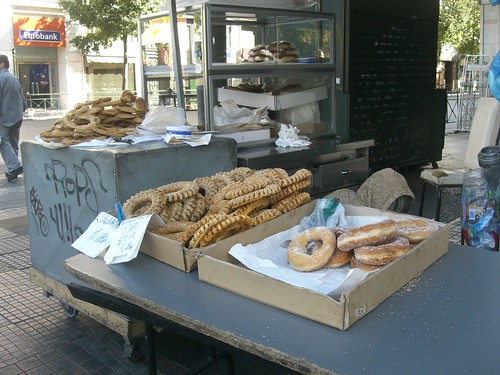
(the bagel lady at Sintagma)

I was beginning to feel I had lost the battle for a healthy mid-morning school snack when I spotted a lady selling the classic Greek bagel - κουλούρι, koulouri - at a stand on the corner of the road on Μητροπόλεως (mitropoleos - Cathedral) and Φιλελλήνων (filelinon - Philhellenic) Streets. Bagels are quite durable; in any case, they don't lose their taste, nor do they become stale in 24 hours. A perfect choice; I bought two plain soft bagels, two hand-shaped hard ones and a tomato-and-feta filled soft bagel, ditching plans to buy the full range, which also included chocolate-filled ones. Koulouria are usually eaten on their own, but if you manage to avoid the temptation of munching into them on the street, they go great with a piece of cheese, a few olives and a glass of wine, which I didn't have handy on me at the time, the reason why I didn't deal with my own bagel choice (the filled one, naturally) till I got back to Hania.

Monday's school lunch wasn't tricky at all. The cafes in the area served luscious looking sandwiches and πίτες (pites - pies) of all types: cheese, sausage, sweet cream, spinach, hotdog, mince, you name it. My only caveat was that they would be subjected to all sorts of bruising, temperatures and humidity levels in my bag, so I decided not to buy anything from the road, except for my own lunch (before I was treated to a sumptuous dinner by my friend. I could easily buy my children something similar for their lunch from the airport cafeterias, which served this kind of food.

I had almost forgotten to have lunch that day (such a rare occurrence in my life), I was so excited, not just about meeting my friend, but because I had managed to achieve so much in one day. I had seen a few relatives in Aspropirgos (a dingy Western suburb in the Greater Athens area), walked through the neighbourhood I had lived in for two years before settling in Hania permanently (Egaleo, another neighbourhood of Western Athens), and enjoyed the luxury of the organised Athenian mass transportation system, via the suburban blue buses and the Athenian underground.

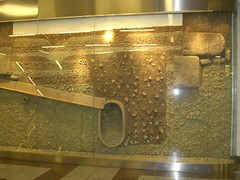
athens underground athens underground
(pottery shards and the ground layers found when the underground was being constructed)

It is a fact that Athens has not improved its dreary image since I was last living there, but that is simply not true about the means of transport: the underground in Athens is clean, modern, awesome, even beautiful. Walking into the underground world of Athens is like entering a museum full of ancient antiquities: in some parts of it, when the lighting is set in such a way that it highlights a particular monument on display in the foyers, you might even get the feeling that Hades is lurking somewhere in the twilight, ready to turn you into a pillar of salt if you dare to turn around and look, like he did to Eurydice when Orpheus wanted to check that Hades had kept his word about his lover's return. Most of the treasures found in the foundations of the underground during its construction were eventually turned into a museum display piece.

athens underground
(Some of the Parthenon marbles Elgin stole; these ones are the fakes, on display at the Acropolis metro station)

A long time had passed since I last went to see the Acropolis. Of course, the whole area has changed since I was last there, but my instinct led me in the right direction during my short interlude in the area. I got out of the metro at the Acropolis stop, located right next to the brand new Acropolis Museum, a strategic environmentally-friendly station, enabling people to have more efficient access to an important landmark, without the need to bring their own car to an already over-congested area (top marks to the town planners). The hot autumn sun made up my mind for me: the Acropolis also looks good at lower ground level, and I don't need to work up a sweat by walking up the hill to get to see it close up. (Believe me, I've been much closer to it than anyone can get to it in modern times.) It was at this point that I remembered I was feeling hungry and thirsty. Right across the Acropolis metro station were a few strategically positioned cafes and snack bars. Everest was located on a highly visible corner near a row of crafts and souvenir shops.

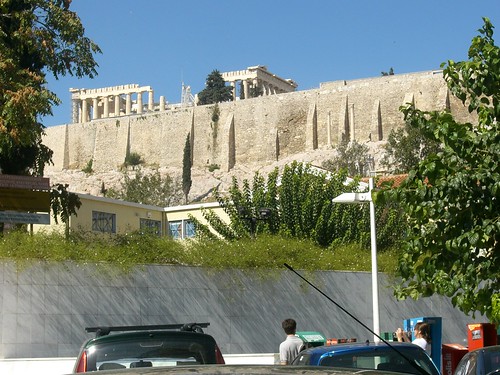
acropolis athens
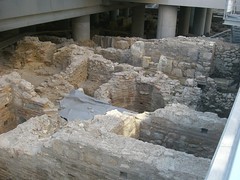
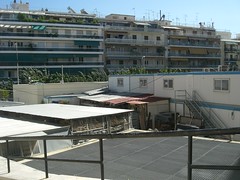
(above - the Acropolis of Athens; below - the foundations of the Acropolis museum among excavated ruins; a view of the apartment blocks facing the Acropolis - dingy as they look, they enjoy one of the most amazing views in the world )
acropolis museum acropolis museum

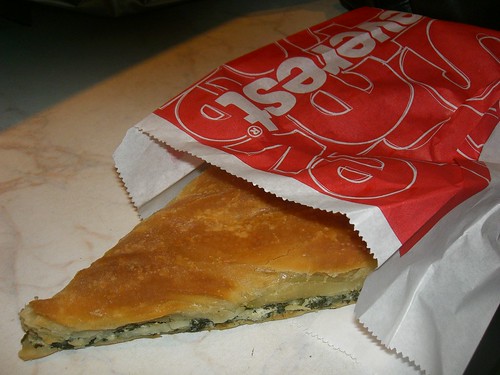
Everest is a chain store selling snack food and refreshments right throughout the country. Its food is prepared in the way most chain stores run; it is very centralised. At one of a few places in some industrial areas of the country (like Aspropirgos in Athens, where I overnighted with relatives before my Sunday adventure in the centre of Athens), people are busy preparing food in different ways for different businesses, most likely using processed ingredients: a fast-food chain may sell profiterole desserts in octagonal plastic tubs (like Everest), while another fast food chain might want chocolate mousse served in smooth round plastic bowls (like Goody's). Another chain may order spinach pie made with thick pastry (like Everest), while another chain may prefer to serve a spiral spinach pie made with thin filo pastry (like Greogry's). The food is prepared according to each customer's specifications, after which it is stored appropriately, and trucked or shipped to the branches of these fast food outlets, be they close to the production plant or a remote island.

The advertising of each company may claim that their food is 'fresh', but this is all relative. A product that is stored under artificially controlled conditions to keep its appearance, shape and smell 'fresh' cannot be compared to the same product that was made and eaten on the same day in someone's kitchen, which will not be subjected to any kind of unnatural treatment in order to prevent it from spoilage. My Everest spanakopita cost me 1.95 euro and it was very satisfying; having said that, I must admit that I am a spanakopita fanatic, and it is usually the only thing I buy from a snack food outlet when I need to have a meal on the run. I ignore the ringing bells in my head sounding out warnings against fast food; we do this irregularly, and only when we need to. I even went into a McDonalds while I was at Sintagma; the coffee was OK, the toilets excellent.

Spanakopita was the kind of thing I had in mind for my children's school lunch. I decided to buy them each a piece of Everest spanakopita at the airport, another place where you can find 24/7 fast food chains en masse, each one claiming to serve you the healthiest food made with the freshest ingredients possible, served warm after a short zap in a microwave oven.

CIMG5060

When I arrived at Athens airport, I checked out each food outlet and wondered what kind of money people make in Athens in order to be able to afford to eat here: hot drinks cost well over 2 euro a cup, while sandwiches and pastry-encased cheese, spinach, sausage, chocolate or cream cost at least 3 euro a piece. A family of four with a long delay between flights would need to spend at least 20 euro to eat here. In Hania, we spend about 40 euro for a modest but well-cooked fresh taverna family meal. I was in shock, and it was not just the cost of living that knocked me out: Everest was selling exactly the same spanakopita that I ate in central Athens for 3 euro and 30 cents at the airport; that's 1 euro and 35 cents more than in the other branch.

I was in two minds about what to do. In any case, there is an Everest outlet at Hania airport (which I was hoping would be open), so I decided to buy my children's meals when I arrived in Hania instead. That way they would also be 'fresher'. I hopped off the aeroplane at 6.30am and walked through to the arrivals foyer. Everest was open there too: same spanakopita, same price as at Athens airport. It was too early in the morning to argue, but I've kept the receipts: one price at one outlet, a different one at another. Where I was born, we would call this a bloody rip-off. I bought two pieces of Everest spanakopita (individually wrapped, thank you), and took a cab, which, coincidentally, cost me twice as much as what it cost me in Athens to be driven the same number of kilometres. Where is the country heading to? I ask myself.

©All Rights Reserved/Organically cooked. No part of this blog may be reproduced and/or copied by any means without prior consent from Maria Verivaki.