Showing posts with label garden. Show all posts

Thursday, 5 February 2009

Aliens in the kitchen

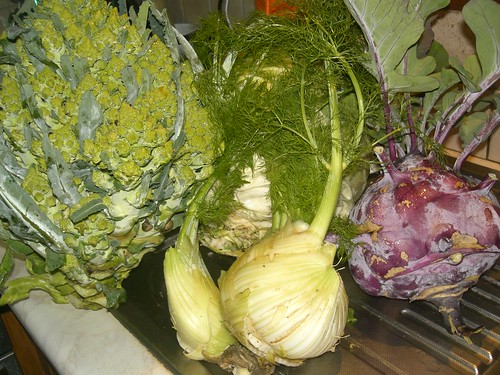
calabrese fennel kohlrabi

Calabrese, finnocchio, kohlrabi, all grown in Galatas, Hania.

Monday, 22 December 2008

Post-weekend story: Urban garden

(I originally published this post on my other blog - Organically Cooked - on the 5th of December, one day before Greece was plunged into chaos after the death of Alexis.)

There's a serious economic crisis reigning in Greece, invisibly infiltrating the town of hania, visible only the those who read between the lines. People want to work, but are either denied the right to do so, or can't find enough of it. The state has always made a show of their provision of free health care to their protegees, the privileged public servants of Greece. But it has recently been revealed that this free care was at the expense of private businesses and promises that the owners would be paid; the chemists' union has stopped providing drugs to state-insured citizens, and doctors have stopped treating state-insured patients for free. Boutiques and specialised stores are void of customers. The only businesses doing well in Greece are the banks - they're always full of people, people paying off their debts, people withdrawing cash, people taking out loans, people transferring their debts from one bank to another; in general, people needing money.

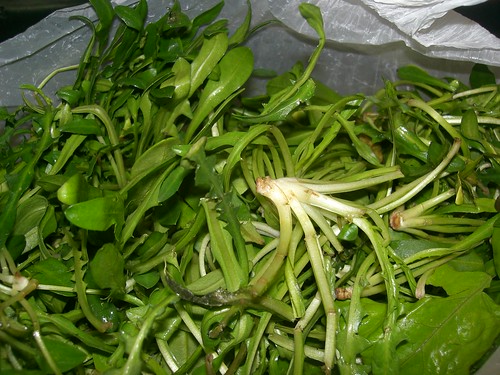
The economic crisis has hit food sales. In Hania, stamnagathi is a prized green, usually selling for at least 7 euro a kilo; in the heart of winter, I've paid more than 8 euro a kilo, which in some cases is more than the price of meat per kilo. Stamnagathi is a fortnightly staple in our house, alternating with other more conventional greens such as cabbage and brocolli. So you can imagine how thrilled I was to find it selling at less than 5 euro a kilo last week. At that price, I should have bought the whole crate and washed, boiled and frozen it to last me until the end of winter.

stamnagathi

As with any cheap product, I was worried about buying low quality: price is nearly always associated with quality, even if this supposition is only in the mind. I decided to ask the shopkeeper why the price of stamnagathi had dropped dramatically. The price of petrol has fallen dramatically, but here's what the shopkeeper had to say:

"This year, stamnagathi has had a slow start because it hasn't rained so much. There has been a sterady supply of it, but it hasn't had that lush green look it used to have at this time of year last year. (I had bought some at this time, and it was rather tasteless and dry.) Now that it's been raining more, it has started to grow more profusely. I was selling it last week at just under 7 euro a kilo, but it wasn't selling. Stamnagathi has always sold at constant levels right throughout the winter. I think it's got to do with the economic crisis. Now stamnagathi is being brought in to us sorted into two types (that's never happened before): the large thick glossy type which sells at a higher price, and the small thin type which sells at a lower price. It gives people a choice price-wise, but it's really the same thing."

This discussion made me feel very guilty about spending my hard-earned income on a bag of spinach, since the garden is full of nettles, and nettles really do taste like spinach in a spanakopita. I was too lazy to bother harvesting them.

nettles cabbage cauliflower broccoli

The economic crisis was made more obvious to me recently by an amazing discovery I made while getting some chores done in the town centre. I was to meet up with someone while I was there, and we arranged a meeting place. I was the first to arrive at the shopping mall - the only one in Hania - so I wandered around it until my friend arrived.

shopping centre hania chania
The shopping centre reminds me of other shopping precincts around the world, the kind I used to go to in New Zealand, where the shops were always crammed with colourful wares, while the street kids hung around on the benches in the middle of the squares, sniffing glue to while away the time; all that glitters is not gold.

The shopping complex on Boniali street in Hania was modelled around typical shopping malls in large cities, in the hope that it will attract an atmosphere of shoppers that come to view the place as an events arena. People could window shop, try out new things, have a bite to eat from one of the eateries, maybe even food-court style, and entertain their kids. One look at the mall now, and you will think that the economic crisis has had a serious impact in Hania; most of the shop windows are dusty and the units empty. The ones that are being used are divided into two categories: the street-facing units are used as shops selling consumer items (they are all being used), while the offices tucked away in the large marble corridors of the complex, invisible at street level, are being used as offices for private businesses such as engineering and graphics firms. There are many unused compartments, turning the wide corridors into unattractive alleyways that look unsafe. There is underground parking available, but it is expensive; the suers of the car park are usually people who run businesses in the shopping mall and its environs rather than shoppers.

The shopping centre has not been affected by the economic crisis; it was simply never a success. The local community does not do their shopping according to the laws of a shopping mall culture. People use stores referred to them by contacts, or on their own judgment; they love walking down the main shopping streets checking out the windows. If it isn't at street level, then it's invisible. Even food shopping is specialised: if it isn't general supplies which you can pick up from your one-stop shop, the supermarket, it's mizithra, xinohondro, and hand-made filo pastry, sold in stores that have a long established tradition of selling the same product in the same location. Why would anyone want to buy their mizithra from a specialty store located in a modern building with no history? The shops in the mall that opened up and shut down, one after the other, represented markets that were affected by recessions and booms in the economy, as well as seasonal differences, mainly knick-knack articles which made suitable Christmas gifts or interesting artistic additions to the household furnishings - when one could afford it.

Life in Hania does not centre around a shopping mall. Events in a small Mediteranean town have never centred on a commercial enterprise. People have their own private circle of friends; either that, or they organise a get-together with their families, entertaining in their own homes, or going out to cafes where they would be seen, as well as being able to people-watch themselves. This plush clean modern complex, comprised of three different buildings with offices located at the higher levels, became a lunar wasteground with a clinically clean white appearance. Its flower boxes, surrounded by benches for visitors' comfort, are void of colour, filled mainly with weeded earth, save a few sturdy yucca shrubs, planted at a time when there was some hope that the shopping centre would be more successful. But if someone cared to look more closely, they would also have found something else growing in the flower boxes, which would probably seem preposterous in another town:

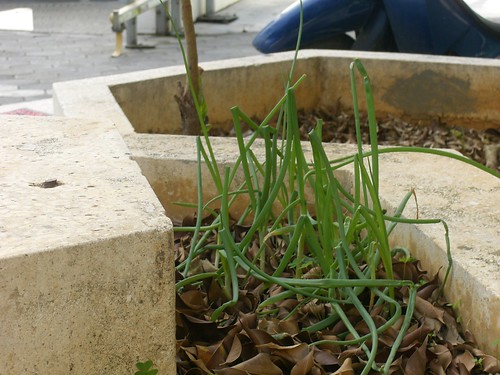
some spring onions, ...
shopping centre hania chania spring onion lower bed

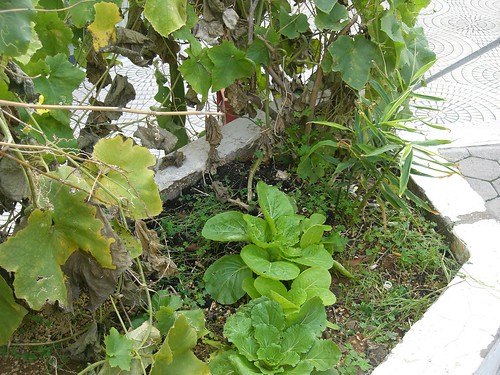
... a few lettuce plants with a climbing pumpkin creeper and grapevine in the background...
shopping centre hania chania lettuce flower bed

... and some coriander.
shopping centre hania chania coriander flower bed

Someone's using these useless flower boxes as their garden. Maybe it's one of the more organically-minded store owners in the mall, maybe it's someone who lives in one of the boxy little apartments in the inner-city, maybe it's someone who simply doesn't have a garden, but wants to eat fresh greens that they have planted themselves. Could it be someone who's feeling the economic pinch, trying to feed a family? It was the coriander that got me wondering: maybe it's an economic migrant that wants a taste of his (or her) homeland. Coriander is never sold at the fresh produce section of our supermarkets. Although I've started growing coriander at home, this herb is too pungent for my family's tastebuds; it's already starting to seed before I had the chance to use it.

Behind the facade of the big flash cars that don't fit onto our narrow roads, the flashy Christmas decorations in the shop windows and the expensive price tags in the high fashion boutiques, a cloud of insecurity hangs over Hania, a fair distance away from our senses so as to seem intangible.

(And the next evening, that cloud of insecurity burst into a violent thunderstorm, drenching us with riots, demonstrations and strikes.)

©All Rights Reserved/Organically cooked. No part of this blog may be reproduced and/or copied by any means without prior consent from Maria Verivaki.
Wednesday, 17 December 2008

Winter garden

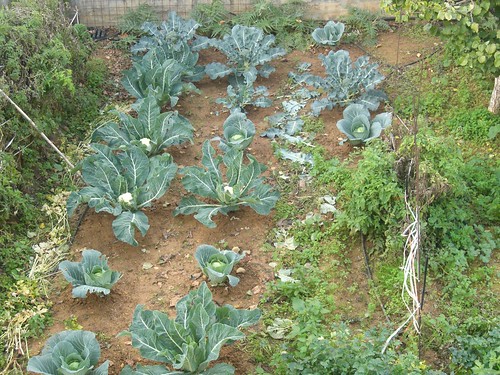
CIMG5869

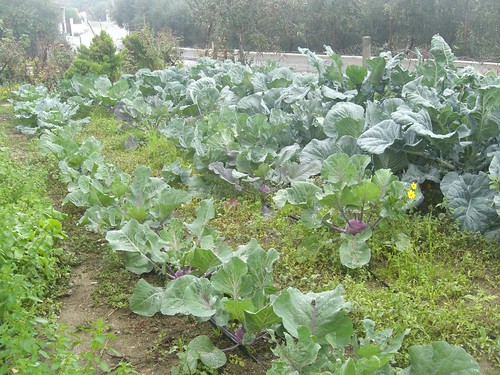
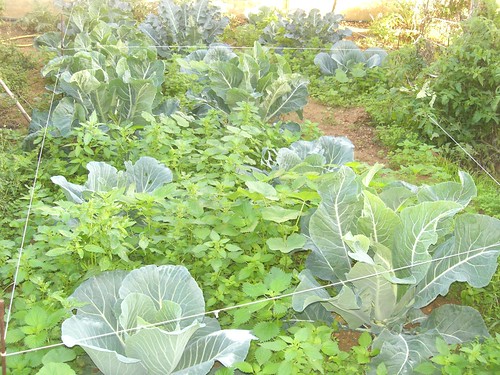
It's not all doom and gloom: our garden is looking rather prosperous.
We harvested our first broccoli last Sunday, and now the cauliflower is also ready.
But the cabbages still need some more growing time.

Wednesday, 10 December 2008

Olives in brine

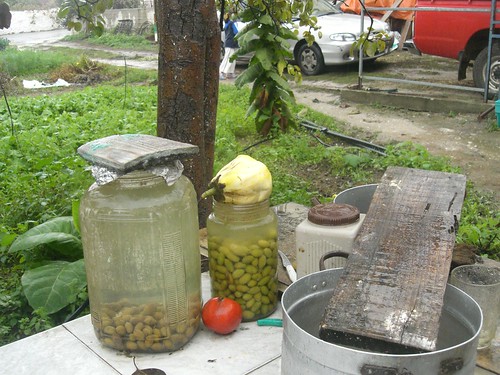
olives in brine

A village scene on a very wet day; olives in brine. The jars are missing their lids, so my uncles placed an aged (albino) eggplant on top of one and a piece of (rotting) wood on the other to keep away insects and dust.

The mayhem is continuing, now that there is no control anywhere. I don't have a licence to use my husband's hunting rifles, but I have the water pressure unit ready on hand to protect what I can.

Answers to yesterday's quiz:
The fashion store is operated by Chinese businesspeople - wherever we see red lanterns hanging outside a store all over Greece, this is a sign that cheap clothes are being sold here by Chinese people.
On the left-hand side is a TAVERNA, while the green door has a sign on it for the Greek Language Society; it is also the premises of a "philological preparatory school" which helps high school students in their exams.

Saturday, 6 December 2008

Aliens: guess what?

kohlrabi

This vegetable looks like an alien.
Do you know what it is?

Answer tomorrow.

Thursday, 4 December 2008

Vlita flower

vlita variety

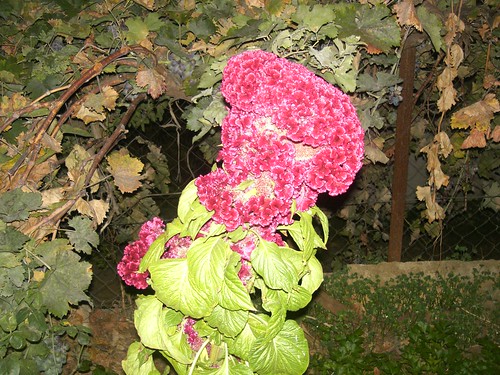
A flower related to vlita (amaranth), Kirtomado, Hania. This flower grows up to about a metre tall, unlike yesterday's pohutukawa, which grows up to twenty metres tall. Well, you didn't really believe it would grow hundreds of metres tall, did you?!

Thursday, 13 November 2008

Autumn hues

signs of autumn

Autumn colours are considered one of the most spectacular artists' palettes. In my town, however, the mesmerising autumn hues are not played out very well; most of our trees are evergreens. Most of the time, summer turns to autumn without a trace, since the weather is still quite warm.

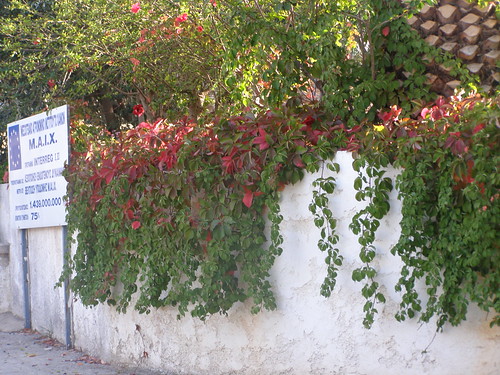
This is the only plant in the whole town - found in various places: my home, the town centre, most of the villages, and even my workplace, where the photo was taken - that remind us that winter is nearing.

For more spectacular shots of autumn, take a look here and here.

Sunday, 26 October 2008

Camera critters: I tort I tor a puddycat

Now you see me...

... now you don't.


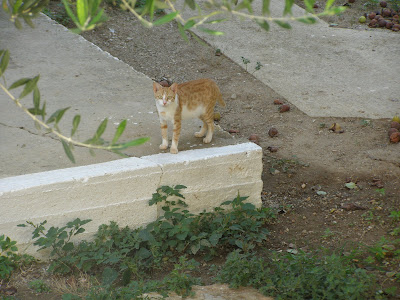
My neighbour's cat playing 'koukoutsa' (peekaboo).

Saturday, 25 October 2008

Autumn bounty


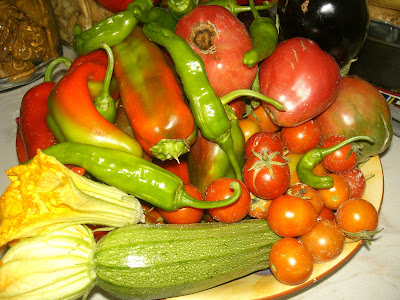
October harvest from our garden; the remains of summer.

Sunday, 24 August 2008

Camera critters: sea snails


These snails seem to be quite cosy stuck onto the rotting wooden post of an unkempt fence at Kalamaki Beach. The owner of the house says that they are edible. They are boiled and extracted out of the shell with a pin, then dipped into an oil-garlic-vinegar dip before they are eaten.

For a completely different perspective of snail meals, click here.

Thursday, 21 August 2008

I wish I had a garden...


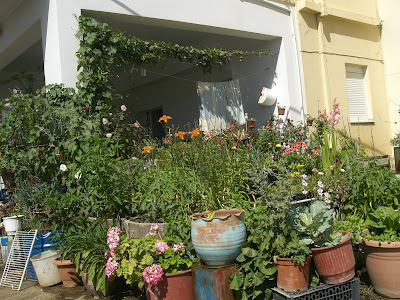
These pot plants were found beside the verandah of an apartment block built on an extremely noisy and dusty main road in an industrial zone, but the owner must be thankful that the flat does not face the street; despite this, the back yard of the verandah is located among a steel scrapyard, not the nicest of places to live, obviously.

The owner of the pot plants must have great affection for nature and living organisms. Maybe nature in its wild form is difficult to access for them, maybe they were born in a village, maybe they just love the colours of nature in their purest form. Whatever it is, I felt the owner's presence in this topsy turvy mix of living objects, imagining someone sitting outside in the cool evening breeze when the industrial complex has closed down after the day's business, nurturing the plants and enjoying their lot.

Monday, 4 August 2008

Odd shots Monday: forever locked


The town of Hania was once filled with stately homes, all porting heavy iron gates and doors, a sign of importance, a signal to keep clear, and that all intruders would be dealt with accordingly. Now, all that's left of this stately iron gate is the rust and the crumbling stonework. This gate looks as though it hasn't been opened up for a long time, by the state of the overrun garden in front of it.

It's not the only gate that seems to be in a perpetual state of being locked; quite a few other gates and doors on this central street are in the same state, reminding us of a glamorous prosperous past. I tried to find a door or gate as grand as this one in the same area (where there are many of these types of doors), that looked as though it was being used, but to no avail; most of the usable ones are not very photogenic. At least no one will be bothered by the recycling bin that has been placed in front of this old gate, as it doesn't look as if anyone will be passing through it on a regular basis.

Saturday, 2 August 2008

The park of peace and friendship

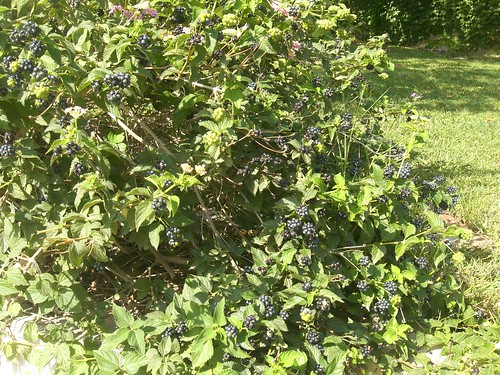
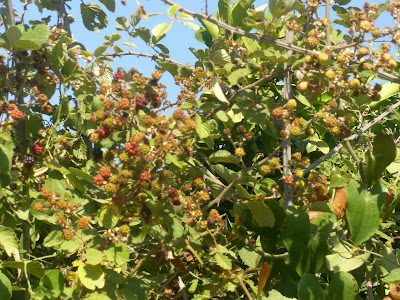
I love juicy blackberries, I'd eat the damn lot
if these were blackberries, but they are not.
They're inedible berries that turn green and black,
that pretty pink flower - it's quite cherubic.

CIMG4437

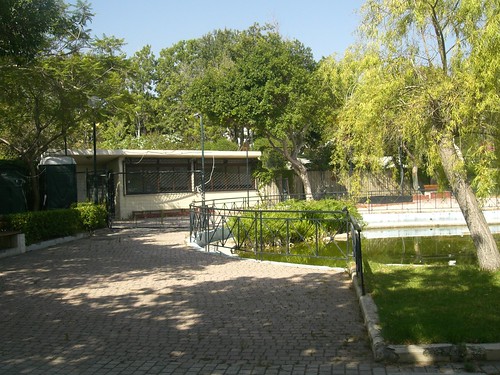
They're found in a park in my little town's centre
which no one has bothered to open for summer.
Why is it that our local council did not
lease out the canteen to refresh us when hot?

CIMG4431

Wait till you hear what the council has named it
EIRHNIS FILIAS - Park of Peace and Friendship.
It does seem quite peaceful in an eerie manner,
but where are the friends who can play in its theater?

It's boiling in Hania on a daily basis,
but no one seems interested in kids' happy faces;
when I sit with my children in this empty park
I wonder if it's safe to walk through in the dark.

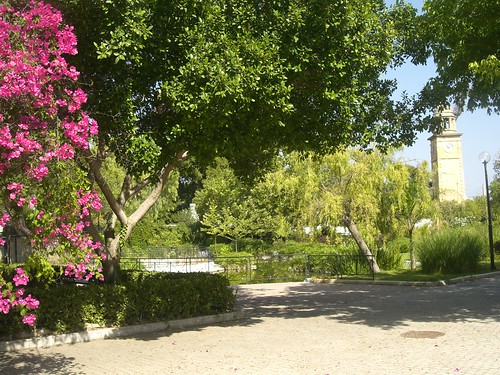
We could be out here in the late evening time
watching the clock tower calling out its chime
that it's not too late to go home, not quite yet,
that we can always wait at least till sunset.

CIMG4436

Maybe the council does not understand English
and I should have chosen some other language
to voice my opinion; maybe in Greek,
maybe that is what would make them all think.

Why did the council spend money to build this,
when all it does now is grow tired and listless?
There should be some children running up and down,
to light up the life of this little town.

Had it been owned by some private business
it would have been operating right until Christmas.
It's never too cold to sit out in the sun;
even in winter, Hania's weather's fun.

Instead of a canteen all busy and running
for townies who find it too far to go swimming,
we must contend with a locked up cafe
and turn on the A/C to cool off the day.


As for real blackberries, I know where they grow;
in fields in the village, they're used as hedgerows.
As a gourmet, I know when they're best.
Most people don't know them; they think they are pests.

©All Rights Reserved/Organically cooked. No part of this blog may be reproduced and/or copied by any means without prior consent from Maria Verivaki.
Thursday, 24 July 2008

Zucchini baseball

When you can no longer stand the look of zucchini on your dining room table or kitchen bench top, and the wholesaler offers you a low price on your orange production, there's always this solution.

(The courgette escaped our notice. It is perfect for animal feed, but not much else.)

Sunday, 20 July 2008

Camera critters: kids


Some people might call this kid 'cute'; others will think 'delicious'.

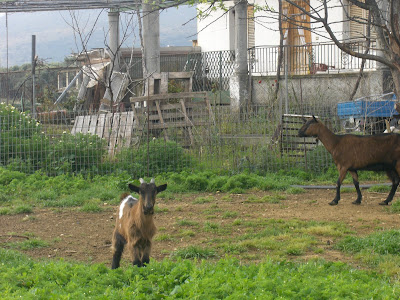
Goat and kid in Vamvakopoulo, Hania.

Sunday, 29 June 2008

Camera critters: Butterfly


Butterfly on a thyme bush: Fournes village, Hania.

Sunday, 22 June 2008

Camera critters: Grasshopper


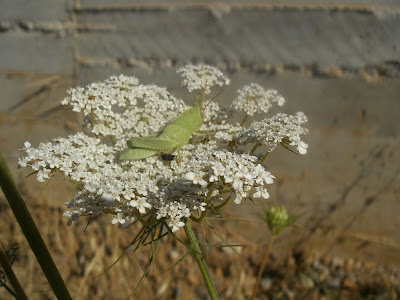
Grasshopper on Queen Anne's lace, Fournes village, Hania.

Tuesday, 17 June 2008

Artichokes

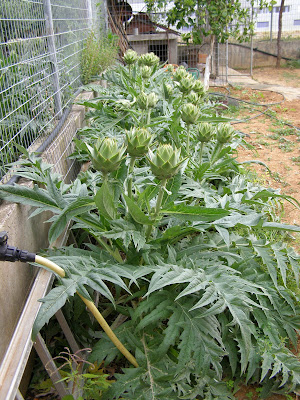
If you don't cut your artichokes at this stage...


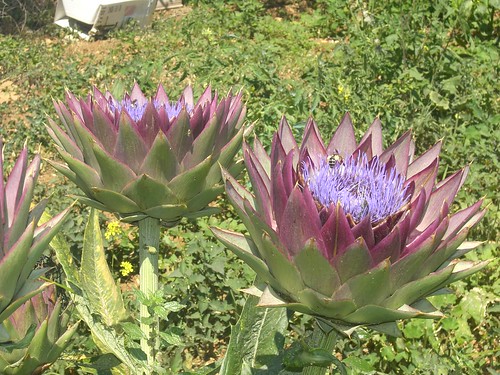
... this is what happens to them:

artichoke in flower

In the former, they are delicious; in the latter, they are beautiful.

Thursday, 12 June 2008

Forgotten garden


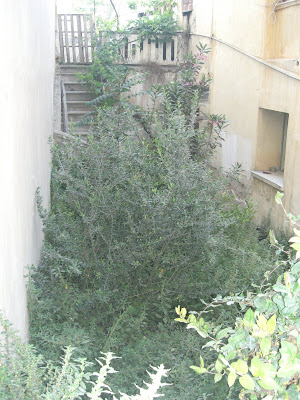
It's the kind of place no one would think of looking. Walking past it on the street, slightly sunken from the level of the road, it is barely worth turning one's eyes to, a mess of tangled pointless greenery, sandwiched between the two walls of the neighbouring houses. It must have been useful to someone in days gone by; the wooden ladder wouldn't have been built if the garden was never going to be used. Someone must have had high hopes for this patch of earth in past times. There's a grapevine plant growing unchecked at the top, while the whole patch is practically overtaken by a wild olive tree. The weeds are thriving, maintaining a no man's land of the site.

Friday, 23 May 2008

Skywatch Friday: Rainbow


It's Skwatch Friday again and today I can see the faint outline of a rainbow in mine.

As I climbed into the car in the driveway of our house, I caught sight of the rainbow. It had been fine and sunny all morning and in the afternoon it started to rain. Rain is always welcome in Hania, which is one of those 300-days-of-sunshine towns, but just lately, we've been having very mild weather. I don't know if climate change has had anything to do with this, but it's preferable to 30 degrees Celsius in the shade, which is the norm throughout the summer - from the beginning of June toll the end of September.