Showing posts with label rubbish. Show all posts

Friday, 5 December 2008

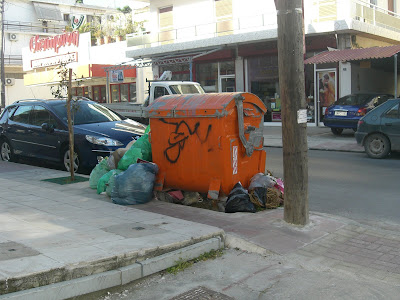
Other people's rubbish

rubbish

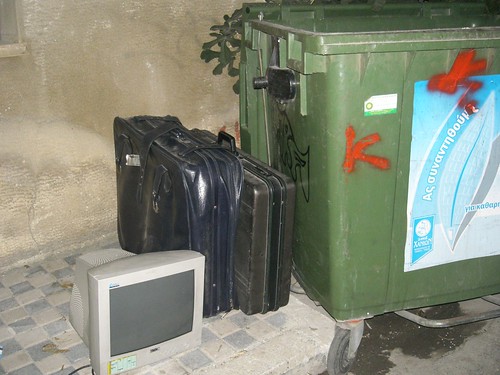
I would have liked to take these suitcases home with me - they reminded me of travelling in older times, when suitcases were made of leather and closed tight with straps. Now everyone travels with wheeled trolleys; life has changed.

Those big bulky monitors are also a thing of the past, too...

Saturday, 29 November 2008

Exhibition

Hania has one of the highest rates of road accident deaths in the country, which must make us the worst drivers in the whole of Europe, since Greece once again tops the lists in that respect.

car crash exhibition hania chania hospital

It's all very well to say that the roads are at fault, but since we know that, we should be more careful when we drive.

car crash exhibition hania chania hospital

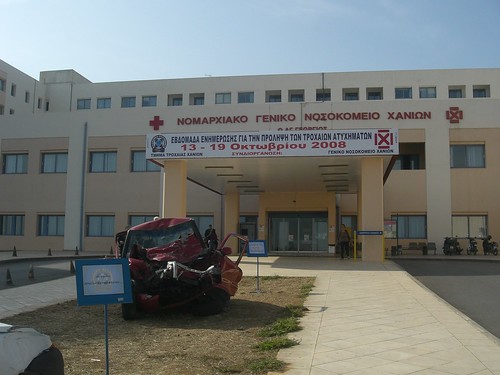
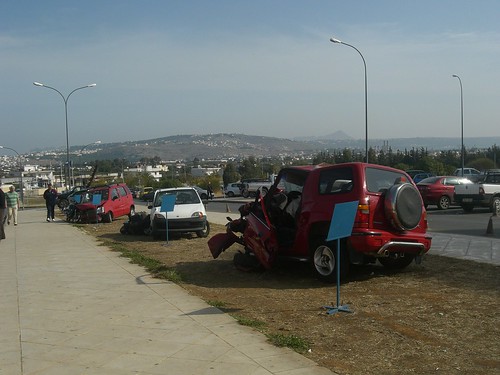
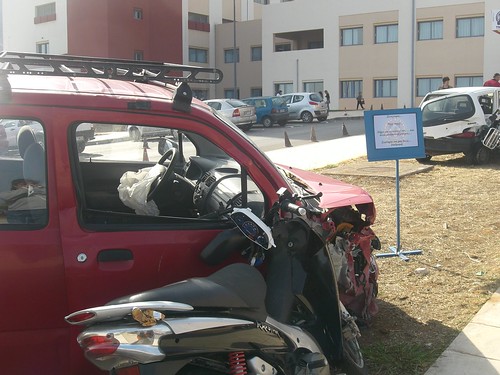
Recently, an exhibition was held outside the general hospital of Hania to highlight this fact. Cars involved in road fatalities were positioned centrally, at the entrance to the hospital, and each one had a sign saying how the accident happened, and why the driver was at fault.

car crash exhibition hania chania hospital

This one was caused by the driver of the car. The sign says:

"He was out all night...
He was drinking...
His co-driver was a few more bottles of beer...
He set out in a foggy journey..."

I don't know which driver(s) was killed, but that's not that the point.

Thursday, 4 September 2008

Stalos beach

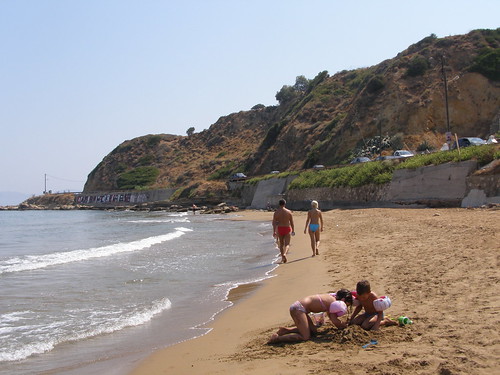
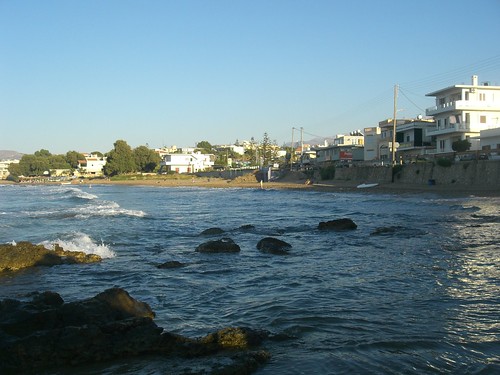
When you look at a photo of a beach that looks like this (blue sea below a blue sky, calm crystal waters, sunny skies, warm weather), the first thing you are probably going to think is "I wish I were there."

stalos beach hania chania

Yes, why not. Now put yourself in the barefoot camerawoman's feet (and bikini), and turn around to see what's on the other side:

stalos road hania chania

A main road, situated on a dangerous bend (this particular point on the road is also called 'the dangerous Stalos bend' by the locals), with a steady stream of traffic all heading to the same or similar places on the western coastal road out of the main town of Hania. There are also pipes for the water supply trailing down the hillside, and a shop that sells fireplaces and brick barbecues, which is sited in the hollow carved out of the hill to make way for commercial activities.

The scenery gets worse:

stalos road hania chania

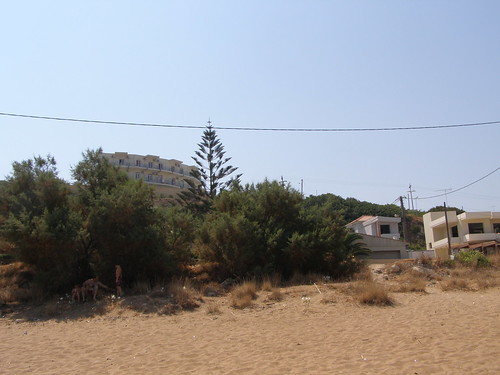
... a hilltop hotel with a grotesque unseemly design; nothing in its facade attracts clients, except perhaps the 'magnificent view of the beach' (imagine the climb up to it after your swim). It is exposed to the sun all day, hence the garish A/C boxes above each and every single French window. A few hastily constructed unfinished rooms (with an empty open-air restaurant below one) are strewn haphazardly across the face of the hill, a dirty grey garage shed, and a mound of rubbish under the trees.

The coastal roads did not even have a name for the beaches that were located on them before the advent of tourism. They were simply known as 'yialo', the seashore; the name of the village located above the beach was used to signify the part of the 'yialo' referred to. They were once considered the most desolate places to live, mainly because the land immediately before the beach was thought of as infertile, the salty soil incapable of nurturing anything edible on it. In fact, most of the uninhabited coast was sectioned off in plots and given by the state as a gift to the Asia Minor refugees who came to live in Greece after being expelled from the former Ottoman Empire (now Turkey). When I first came to Crete nearly two decades ago, I clearly remember sheep grazing on some fields in front of the sea, and there were also two brick-making factories located here. The land has now all been turned into hotels, shops, restaurants and other businesses catering to the tourist trade.
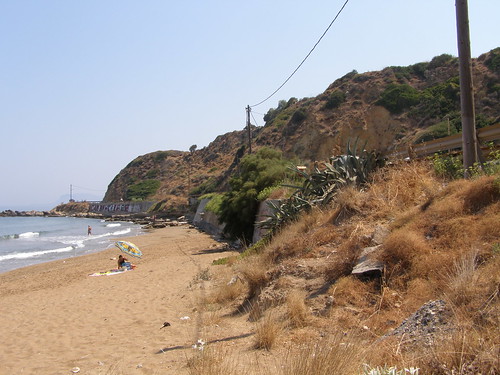
stalos road hania chania

You might wonder why we came out here as a family, when we have the choice of so many other places to go for a swim. It's actually quite close to where we live, and the waters are extremely clear. There are no beach umbrellas on this particular site (although there are a little way towards the left), but that should serve as a warning: the area is known for its dangerous riptides, pulling you back into the sea when there is a strong current, rather than pushing you out to the shore. About forty years ago, seven army cadets drowned here, and countless tourists' bodies have been washed ashore over the years. That's not including the road accidents that have caused fatal injuries. You can see a little white rusty iconostasis with a tiny cross between the tamarisk trees and the flax bushes, which is a sure sign that someone has died on this spot; when we left the beach, I noticed that fresh flowers had been laid in it, as well as on other points on the same side of the road, which means that the deceased's families are maintaining the sites where their loved ones left their last breath.

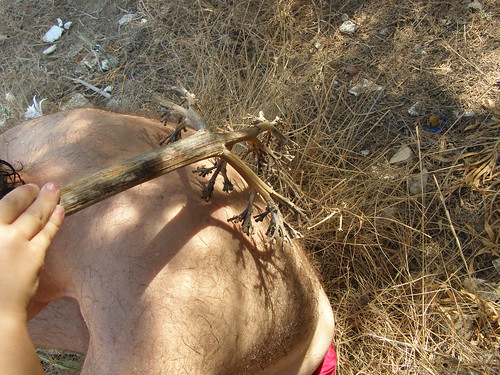
In amongst the horrors of the location, we found that we did enjoy our swim here. The water was cool, fresh and clean. I do recommend you come to Stalos beach too, but just be careful of your steps (and strokes). We also found some dried branches of the flax flower, which make a marvellous back-scratcher...

back scratcher flower stalos hania chania

as well as reindeer horns!
reindeer flower stalos hania chania

Saturday, 9 August 2008

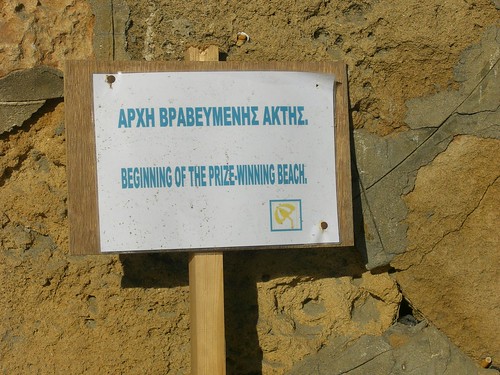
Award winning beach???

agious apostolous beach

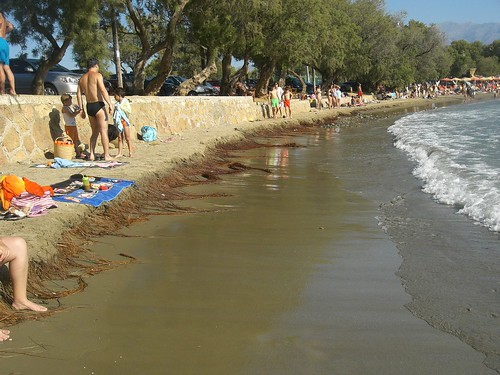
Agious Apostolous Beach hosts children's swimming lessons in the sea every summer. One would assume that it must be kept clean and family oriented. There is even a sign that attests to its award winning status as a beach.

agious apostolous beach

I don't think I'm exaggerating when I say the opposite is true. The sand has been washed away towards the wall, forming a ridge over the fallen branches - they were obviously never cleared away before the summer season started - of a variety of the tamarisk tree, known locally as 'almiriki', which is found all over the island, prospering in sandy areas.

kalamaki 2008

Beach umbrellas and deckchairs (you pay to rent them) line most of the area, which becomes very stony as it stretches out westwards (and changes its name to Kalamaki Beach), so that very few people actually come here any more (this was our favorite haunt last summer). The only parts of the beach which are cleared of washed-up debris (and this year, there has been more than the usual amount) are those where major hotel chains and restaurants are located, which is understandable.

The good thing about this beach, despite the state that it is now in, is that it's close to where I live, and I can enjoy the sea (and take interesting photos) whenever I want.

Monday, 4 August 2008

Odd shots Monday: forever locked


The town of Hania was once filled with stately homes, all porting heavy iron gates and doors, a sign of importance, a signal to keep clear, and that all intruders would be dealt with accordingly. Now, all that's left of this stately iron gate is the rust and the crumbling stonework. This gate looks as though it hasn't been opened up for a long time, by the state of the overrun garden in front of it.

It's not the only gate that seems to be in a perpetual state of being locked; quite a few other gates and doors on this central street are in the same state, reminding us of a glamorous prosperous past. I tried to find a door or gate as grand as this one in the same area (where there are many of these types of doors), that looked as though it was being used, but to no avail; most of the usable ones are not very photogenic. At least no one will be bothered by the recycling bin that has been placed in front of this old gate, as it doesn't look as if anyone will be passing through it on a regular basis.

Monday, 14 July 2008

Odd shots Monday: Horny goats


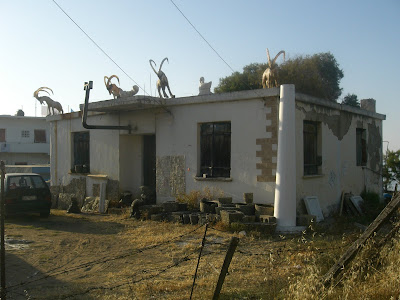
You might be wondering what these goats with kerata are doing up on the roof. George (the owner of the house) put them there. This way, he doesn't have to worry about their knocking over the furniture or ramming the car.

Here are some true stories about kerata (the Greek word for "horns"):

In last year's school Christmas pageant, my son had to dress up as a reindeer.
"I'd like some kerata, please," I asked the shop assistant at the toy shop.

A taxi-driver colleague of my husband's was approached in his taxi by a man who got into his car and showed him a gun. The driver asked "Do I know you?" The man answered: "I'm the kerata." He then asked the driver to stop screwing his wife, advice which the driver heeded.

Instead of saying 'fuck you', you could say 'ta kerata sou' as a term of abuse to someone instead. They'll understand why you mentioned reindeer horns.

Thursday, 12 June 2008

Forgotten garden


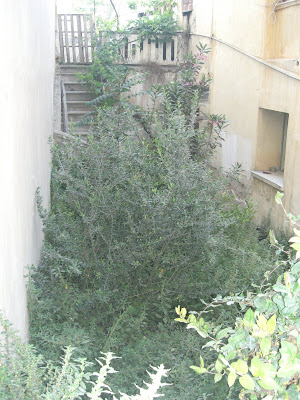
It's the kind of place no one would think of looking. Walking past it on the street, slightly sunken from the level of the road, it is barely worth turning one's eyes to, a mess of tangled pointless greenery, sandwiched between the two walls of the neighbouring houses. It must have been useful to someone in days gone by; the wooden ladder wouldn't have been built if the garden was never going to be used. Someone must have had high hopes for this patch of earth in past times. There's a grapevine plant growing unchecked at the top, while the whole patch is practically overtaken by a wild olive tree. The weeds are thriving, maintaining a no man's land of the site.

Sunday, 8 June 2008

Pig on the run


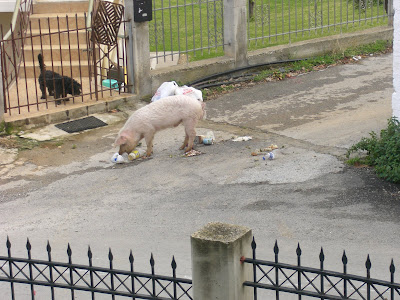
One morning, I opened the balcony door to air the children's room, and was confronted with this sight: the pig had escaped from his owner's field - maybe it got tired of living in a pig sty - and roamed the streets of the village suburb where I live. But not for long; the owner found it and got it tethered up again.

My neighbour had (once again) left her rubbish outside her front gate; her dog sat behind his side of the fence, watching the pig greedily devouring what would have been his dinner. So the pig had a meal out, and from what I nosily observed from my house, it really enjoyed itself.

I don't think the pig has survived to tell its sorry tale, so I'm doing it the honours.

Wednesday, 28 May 2008

ABC Wednesday: Street sweeper

street sweeper
It's ABC Wednesday again, and S is for street sweeper.

I admire the patience of this immigrant to my town, taking on the job of sweeping the main street right in front of the Agora clean for the benefit of the locals and tourists alike. He didn't bat an eyelid when he saw me photographing him; he just proudly carried on with his work. Notice how he's tied a few blue bin liners behind him; he's just doing his job.

Tuesday, 27 May 2008

Splash of colour


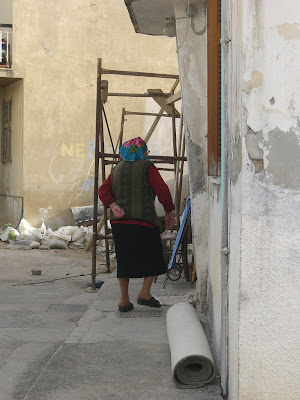
This woman's headscarf adds a splash of colour in an otherwise dreary dull inner-city neighbourhood which is undergoing renovation, judging from the smooth stucco walls of one of the buildings. But even that has managed to acquire graffiti.

I suppose the woman's Russian - maybe from Georgia or the Ukraine. A local Greek woman her age would never wear such a colourful scarf; hers would be plain black.

Thursday, 22 May 2008

Rubbish collectors

rubbish collection
I like to see people working in public on the streets of my town. They're just doing their job, in full view of all the passersby. Where would be without these rubbish collectors who migrated from goodness where to collect Greek people's rubbish?

Tuesday, 18 March 2008

General strike


Greece is experiencing one of the worst cases of social unrest in a long time. Various pensions schemes are going to be unified under a single national security system, and this has upset many people (but not me in particular). The sight of uncollected rubbish is becoming more and more common these days, as are the locked banks, empty ATMs and a go-slow policy in government offices. A trip into town these days is a smelly experience. And did you know that it's illegal to strike on Mondays and Fridays in Greece? That would be like a three-day weekend, wouldn't it?