Showing posts with label people. Show all posts

Wednesday, 24 December 2008

Little old lady

little old lady in black at iconostasis

While I was weeding the garden, I heard a woman talking on the street. Our street is not exactly the kind you stroll around in; it has no footpath and our house is situated on a dangerous bend. I paid no attention until I realised that the voice was that of a woman who I knew.

She's about a hundred years old, walks with her back bent, and her walking frame is never far away from her. She lives down the road from our house. Every Saturday without fail, come rain or shine, she insists on coming to the iconostasis right across the road from our house and lighting an oil-burning lamp.

Today there was one problem: she lost her way. She's a little blind - aren't all old people?

I decided to help her.

"Come, Kiria Marika, the iconostasis is to your right."

""Who are you?" she asked me while she was in the middle of the road, so that the next car to come speeding up the hill would send her (and myself) flying into the air to another world.

"I'm Maria, now walk to the right."

"Are you new here?"

"Kiria Marika, WALK to the RIGHT!" Where was this woman's daughter, I was asking myself, knowing full well that her daughter could be in the house, and still not notice her mother sneaking out to light the lamp at the iconostasis.

"Are you the cleaning lady? Which house are you cleaning today?"

"Kiria Marika, I'm MARIA from THIS HOUSE!" At this stage, I was getting ready to call for reinforcements.

"Your name's Maria? Do you live here?"

"Kiria Marika, you're now at the iconostasis!" I put her hands on the roof just under the cross. Kiria Marika started making the sign of the cross, praising the lord for getting her to the iconostasis in one piece.

"Oh, it's you, Maria, from the house across the road. I think I almost lost my way, the sun was so bright and I couldn't see where I was going."

You're telling me...

Saturday, 20 December 2008

Street market

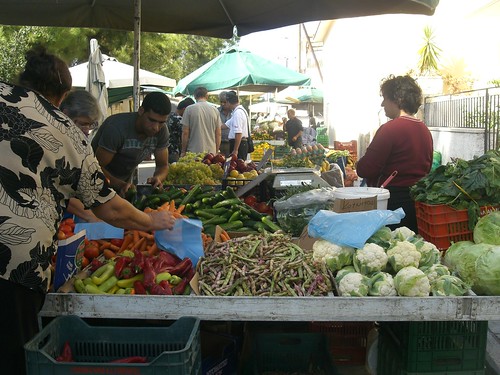
laiki street market

Fresh produce stall at one of the daily street markets in Hania.

This photo was taken six weeks ago, so the peppers may now be hothouse varieties.

Sunday, 30 November 2008

Cheese and honey

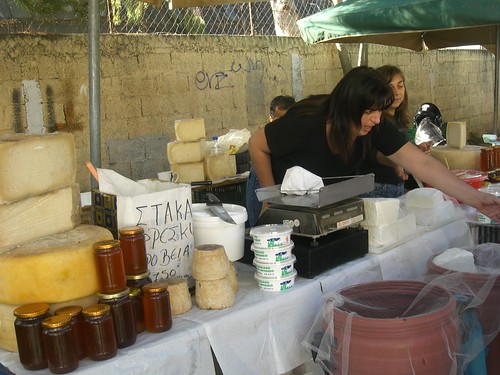
laiki street market hania chania

Locally produced cheeses and honey at a farmers' stall at the daily street market in Hania.

The practices of old-time producers often reflect the use of the products: Soft curd cheese (mizithra), hard yellow cheese (graviera) and honey are often used in combination in local food products, for example, kalitsounia.

Wednesday, 12 November 2008

Street stall


Would you consider buying clothes from this stall?

First of all, it's a Wednesday afternoon, when the town centre is closed in Hania (as it always is, along with Mondays; an old-fashioned custom, probably imported from France), so it's very quiet in the area at 5pm.

Secondly, the stall is across the road from the town's gymnasium, so his only customers will be parents ferrying their children from one activity to another, no passing trade, just drivers. In the one hour that I hung around the area, I didn't notice a single customer, just some people he knew (friends or relative), who stopped by his stall and spoke to him.

Finally, he's a gypsy - oops, I'm sorry, that doesn't count. Or does it? I think he's set up a trading site to cover illegal activities.

Tuesday, 21 October 2008

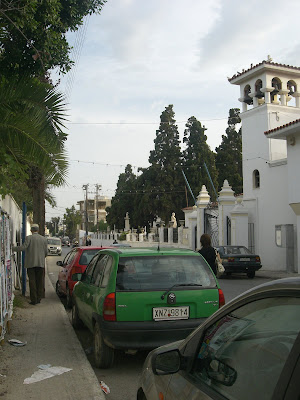
Old man at St Luke's


Agios Loukas (St Luke) church houses the town's inner city cemetery. It is located on a street that approaches the town from the west. But that's not why I took the photo. I wanted to talk to you about the old man walking on the pavement. He leaves his house somewhere further down the road, and taps his way up the corner of the road just a few more steps ahead of him. Then he turns back down the same road he came up on, and walks back home. He does this two times a day, every day.

Whenever I walk along this road, I feel very happy to see him. He uses familiar landmarks that he has mapped out in his mind, like the lamp posts, electricity poles, the texture of the walls and gates that he passes, among other things. I got to know him a long time ago when I noticed he was tapping his stick on a car that had been parked on the footpath.

"Do you need any help?" I asked him.

"Oh, no, thanks, I'm fine," he answered. "It's just this car that's been parked here for a long time, and it's blocking my access to the rest of the road."

"Would you like me to help you maneuver your way round it?" I asked helpfully.

"No, thanks, no, I don't walk anywhere else except this stretch of road if it's clear of cars. I'm completely blind," he told me.

I'm still seeing him take his daily walk here, and I think that's a good sign. It means he hasn't moved home to St Luke's yet.

Saturday, 18 October 2008

Street people


On a recent afternoon walk into town, I bumped into a lot of PPP's: people with personal problems.

A man was walking along the road mumbling incoherently to no one in particular. He was carrying a beer bottle, and everyone who approached him made a dash to cross the street.

A woman was being dragged into a toy store by a mentally handicapped teenage boy who was taller and stronger than her. She was promising him that they would come back later once they had finished the job they had originally set out for.

Two women wearing very high heels were walking very slowly side-by-side, arms linked, on a very narrow road in the middle of town, discussing what they would like to buy - it had to be new - for the wedding they were invited to on the forthcoming weekend. They probably couldn't hear me walking behind them because their chatter, combined with the sounds from their heels clonking hard on the pavement, was much louder than my soft sole sneakers, so I had to wait till the road widened slightly to get away from them. They were so lucky not to be on a time limit of one hour to walk from one side of town to the other and back again in order to pick up their children from their clubs.

And that was life on a Tuesday afternoon some time last month in the town of Hania.

Thursday, 4 September 2008

Stalos beach

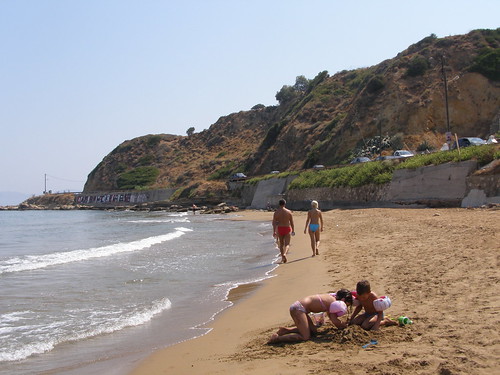
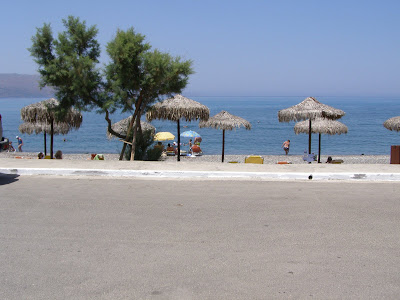
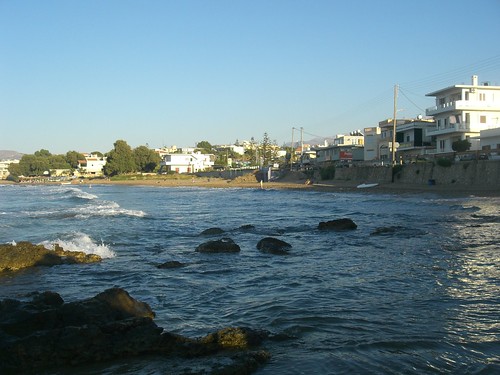
When you look at a photo of a beach that looks like this (blue sea below a blue sky, calm crystal waters, sunny skies, warm weather), the first thing you are probably going to think is "I wish I were there."

stalos beach hania chania

Yes, why not. Now put yourself in the barefoot camerawoman's feet (and bikini), and turn around to see what's on the other side:

stalos road hania chania

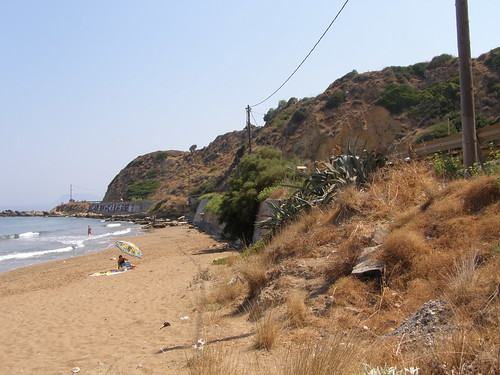
A main road, situated on a dangerous bend (this particular point on the road is also called 'the dangerous Stalos bend' by the locals), with a steady stream of traffic all heading to the same or similar places on the western coastal road out of the main town of Hania. There are also pipes for the water supply trailing down the hillside, and a shop that sells fireplaces and brick barbecues, which is sited in the hollow carved out of the hill to make way for commercial activities.

The scenery gets worse:

stalos road hania chania

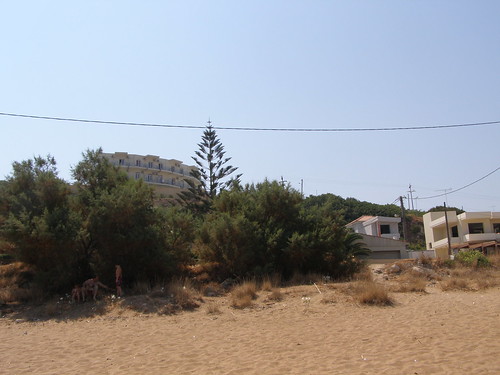
... a hilltop hotel with a grotesque unseemly design; nothing in its facade attracts clients, except perhaps the 'magnificent view of the beach' (imagine the climb up to it after your swim). It is exposed to the sun all day, hence the garish A/C boxes above each and every single French window. A few hastily constructed unfinished rooms (with an empty open-air restaurant below one) are strewn haphazardly across the face of the hill, a dirty grey garage shed, and a mound of rubbish under the trees.

The coastal roads did not even have a name for the beaches that were located on them before the advent of tourism. They were simply known as 'yialo', the seashore; the name of the village located above the beach was used to signify the part of the 'yialo' referred to. They were once considered the most desolate places to live, mainly because the land immediately before the beach was thought of as infertile, the salty soil incapable of nurturing anything edible on it. In fact, most of the uninhabited coast was sectioned off in plots and given by the state as a gift to the Asia Minor refugees who came to live in Greece after being expelled from the former Ottoman Empire (now Turkey). When I first came to Crete nearly two decades ago, I clearly remember sheep grazing on some fields in front of the sea, and there were also two brick-making factories located here. The land has now all been turned into hotels, shops, restaurants and other businesses catering to the tourist trade.

stalos road hania chania

You might wonder why we came out here as a family, when we have the choice of so many other places to go for a swim. It's actually quite close to where we live, and the waters are extremely clear. There are no beach umbrellas on this particular site (although there are a little way towards the left), but that should serve as a warning: the area is known for its dangerous riptides, pulling you back into the sea when there is a strong current, rather than pushing you out to the shore. About forty years ago, seven army cadets drowned here, and countless tourists' bodies have been washed ashore over the years. That's not including the road accidents that have caused fatal injuries. You can see a little white rusty iconostasis with a tiny cross between the tamarisk trees and the flax bushes, which is a sure sign that someone has died on this spot; when we left the beach, I noticed that fresh flowers had been laid in it, as well as on other points on the same side of the road, which means that the deceased's families are maintaining the sites where their loved ones left their last breath.

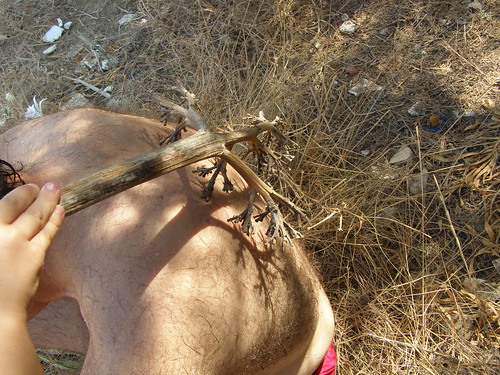
In amongst the horrors of the location, we found that we did enjoy our swim here. The water was cool, fresh and clean. I do recommend you come to Stalos beach too, but just be careful of your steps (and strokes). We also found some dried branches of the flax flower, which make a marvellous back-scratcher...

back scratcher flower stalos hania chania

as well as reindeer horns!

reindeer flower stalos hania chania

Tuesday, 19 August 2008

Outdoor fun park

My children were invited to a children's birthday party held at an outdoor fun park. They played in a balloon adventure park for nearly four hours without getting bored once. The parents enjoyed their margaritas in the cool evening breeze, as well as some pastry desserts and the leftovers of the children's pizza dinner.

outdoor fun park hania chania

The fun park is located half a kilometre from the beach, about two kilometres from where I live. It is located at the centre of tourist activity: there is a huge INKA supermarket across the road, and the area is surrounded by hotels, tavernas and shops catering for the tourist trade. During the day, the outdoor area doesn't operate due to the harsh sun. The balloons are pumped up after 6pm, when people start leaving the beach. People kept arriving at the fun park all hours of the evening, which was a very warm one (we were at the start of a heatwave).

As a family outing, it isn't cheap; children pay an entrance fee of 5 euro, with an orange juice included, but there's also the cost of food and drinks for the rest of the family. Then there are other attractions which are not included in the entrance fee (not pictured): each go-cart costs 1 euro per ride, and there are many other similar rides to choose from. As a children's function venue, however, it is very cost-effective: others do the work for you, and you don't have to clean up afterwards.

outdoor fun park hania chania

Despite living a stone's throw away from this amusement centre, which also houses a bowling alley on its roof and pinball machines indoors, I had never been there before. It has a desolate look as you pass it on the main road during the day. It is also greatly reminiscent of the plastic world we live in, with its artificial lights and well-kept lawns, despite the electricity and water shortages we face throughout the summer.

Nevertheless, I had a great time sitting in the cool evening breeze while the children amused themselves independently. Even my airy house with its top-floor balcony could not compete with this place. We got home just before midnight, having thoroughly enjoyed ourselves.

Sunday, 17 August 2008

Nameday

August the 15th is the day Greeks celebrate the third most important religious feast in the Greek Orthodox calendar. Easter takes precedence as the most important feast, followed by Christmas (ever wondered why Christmas in Greece is so dull?), followed by the Dormition (Assumption to the Catholics) of the Virgin Mary. A 14-day-long fasting period, along exactly the same guidelines as the Great Lent, precedes the feast day. Although it is a national holiday, it does not seem like one, mainly because it falls in the middle of the summer, just when everyone seems to be on holiday anyway: just like Christmas time in my Antipodes homeland.

Mary, Maria, Panagiota (the One above the Saints, but presumably below God) all celebrate their nameday today, along with Mario and Panagioti. Namedays, believe it or not, are more important than birthdays. Despite the fact that many people are happy to celebrate both their name and birthday, it's the nameday that won't ever be forgotten by friends and relatives. It's also the one that evokes pleasant feelings, which is what makes Greeks the envy of the non-Greeks on such auspicious occasions:

Woman announcing her nameday: "It's my nameday today!" "Oh, really? What's your name?"
Woman announcing her birthday: "It's my birthday today!" "Oh, really? How old are you?"

And for those of you - Greeks and non-Greeks alike - who have a name which is not recognised in the religious calendar of the Greek Orthodox church (my mother's, and even my son's, don't feature in it), don't worry: there's always All-Saints Day.

So here I am, on my nameday, expecting a dozen guests to be fed and watered. In Crete, namedays are celebrated without inviting people to them. Friends and relatives will either phone to wish the celebrant χρόνια πολλά, which loosely translates as: "may you have many years of life to come", which is OK if you're not, say, 84 years old, otherwise it might sound like a curse.

Here are the choices most people select from to celebrate their nameday:
1. Have a big sit-down meal at home. This means lots of cooking and cleaning. This kind of revelry is reserved for Papa Bear: his nameday falls in the autumn, when cooking up a feast is a good way of heating up the house on a cool evening and entertaining guests indoors is the norm.
2. Have guests over at home, but serve only finger food and sweets, kind of like a buffet. I love the idea but would prefer it if someone else would make the finger food and cakes. It still means cleaning up before and after the event.
3. Go out for either a sit-down meal or finger food and sweets. This works well if you know who is coming to your nameday, because it's one of those parties which custom dictates you do not invite people to; in other words, you must make the effort to let people know where you will be instead, because you won't be at home where they may expect to find you.
4. Invite certain people to go out with you on your nameday, but not your regular well-wishers. Too elitist for us; simply not our style.

caretta hania chania

We decided to go out to a place we knew well and could hope on finding a free table. It's best to book a table if you want good food on this day, being the holiday that it is, otherwise, you have to contend with restaurants, tavernas and other food establishments that may offer a lower standard of food and service. As I have a strong opinion about where you will find very good tasty well-cooked food in Hania (only in a private house), the place I chose was selected purely on the grounds of location: it was right next to the beach, the waves could be heard crashing on the sand, and there was a small playground for the younger members of the party to amuse themselves within view of the parents. I was simply lucky that the food also turned out to be good.

seafood kalitsouniacaretta hania chania

Caretta Caretta has nothing to do with turtles: the name simply has a good gimmicky sound to it. We've been going to this seaside taverna for a long time now. It's located on the west coast of Hania, in a village called Agia Marina (Saint Marina). The village borders two other seaside villages which play host to the the classiest nightlife zones in Hania at this time of year: Stalos to the east, and Platanias to the west. This is where everyone comes if they want to boogie the
summer night away. Neither Stalos, Ayia Marina nor Platanias have specific borders, melding into each other in the way that neighbourhoods tend to do when they start sprawling. Once the poorest areas in the district, they are now the wealthiest. Up until the early 1950's (ie pre-mass tourism), the seaside soil was considered infertile, and lay barren-looking. It was the kind of land that refugees were gifted by the state, because it was deemed useless. Some clever person had the idea that they could build basic rooms to meet the low standards of the backpacking beach-sleeping mosquito-bitten grubby tourists at the time, and since then, Greece has been treated as a cheap holiday destination, an opinion which suddenly changed this year with the dollar crisis, or should I say the euro crisis, since our Northern European tourists are particularly feeling the sting of an expensive currency.

sea urchin

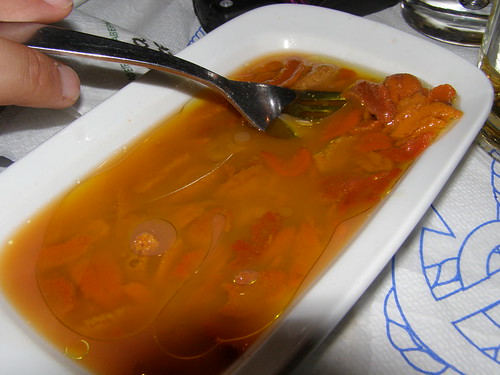
Every year, Caretta Caretta shows signs of improvement rather than stagnating. It offers the full range of Greek cuisine, along with internationally known pasta dishes (like carbonara) which are safe choices for the poor tourists who do not know how to ask for good Greek food by name. Along with this standard menu, it also offers some surprises, some of which we chose for my special day: grilled filleted sardines, seafood kalitsounia (better get the chef police onto them for the misuse of Greek culinary terminology), crab stuffed with a cheese filling and our all-time favorite delicacy, the most expensive meze of all, sea urchins, which are dressed with the ubiquitous olive oil and lemon juice and enjoyed as a dip with sourdough bread: a very acquired taste, but a special one nonetheless. We also ordered a seafood salad, some dakos, a plate of fried whitebait, some tasty octopus in vinegar dressing, some fried calamari a few plates of fried potatoes - they were that good. Total cost: 135 euro, for a party of 12.

©All Rights Reserved/Organically cooked. No part of this blog may be reproduced and/or copied by any means without prior consent from Maria Verivaki.

Friday, 15 August 2008

SkyWatch Friday: sea or sky?


Where does the sea stop being sea and start being sky?
Where does the sky stop being sky and start being sea?

Tavronitis beach, North-West coast of Hania, Crete.

Wednesday, 13 August 2008

ABC Wednesday: D for Deckchairs

D is also for deckchair.

In my town, they're all over the beach in the summer.

tavronitis beach hania chania

You can't miss them when you come to Crete on holiday.

Monday, 11 August 2008

Odd shots Monday: the train station


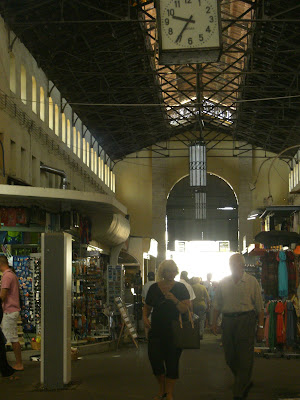
You may be wondering what's so odd about this shot: it looks like a normal train station, doesn't it? Just when you least expected it, Hania has its own Kings Cross.

Weary travellers holding their bags, a ticket vending machine, boutique-style stores for that last minute shopping before you board your train, the ticking clock reminding you that the train is due to depart, out-dated decor from art deco times...

(But it's not a train station; it's the Agora in Hania.)

Saturday, 9 August 2008

Award winning beach???

agious apostolous beach

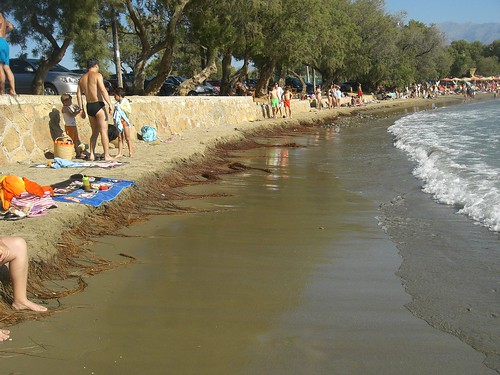
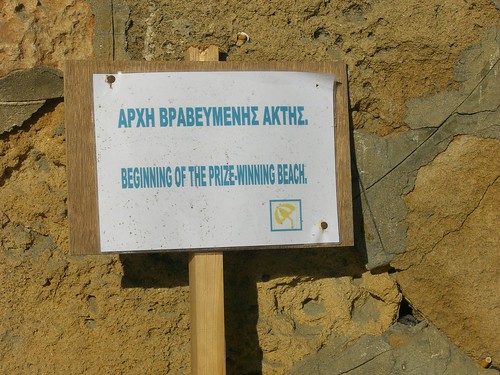
Agious Apostolous Beach hosts children's swimming lessons in the sea every summer. One would assume that it must be kept clean and family oriented. There is even a sign that attests to its award winning status as a beach.

agious apostolous beach

I don't think I'm exaggerating when I say the opposite is true. The sand has been washed away towards the wall, forming a ridge over the fallen branches - they were obviously never cleared away before the summer season started - of a variety of the tamarisk tree, known locally as 'almiriki', which is found all over the island, prospering in sandy areas.

kalamaki 2008

Beach umbrellas and deckchairs (you pay to rent them) line most of the area, which becomes very stony as it stretches out westwards (and changes its name to Kalamaki Beach), so that very few people actually come here any more (this was our favorite haunt last summer). The only parts of the beach which are cleared of washed-up debris (and this year, there has been more than the usual amount) are those where major hotel chains and restaurants are located, which is understandable.

The good thing about this beach, despite the state that it is now in, is that it's close to where I live, and I can enjoy the sea (and take interesting photos) whenever I want.

Wednesday, 6 August 2008

ABC Wednesday: C for Carriage


It's ABC Wednesday again, and C is for cart or carriage, in the lovely town of Hania which is usually written as Chania.

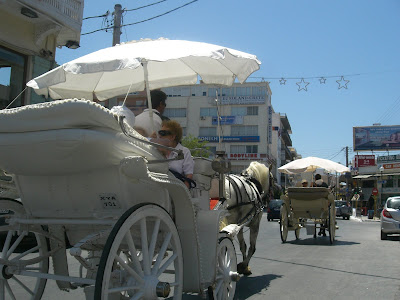
Everyone loves going for a ride in one of these old-fashioned carriages. These ones are heading towards the old harbour; as relics of older times, they suit the mood of the lovely port lined with the many little cafe bars. They are used mainly by tourists (at 20 euro for a short ride, the price is a bit steep), and they are also hired for weddings. The town is too small and the roads are too narrow for open-top tourist buses, but these are prettier and will stay in your memory for much longer.

If you're wondering what the Christmas lights are doing in the picture (another 'C' word) on a warm summer's day, don't worry: we don't light them until Christmas time; it's just easier to leave them hanging there rather than taking them down and putting them up every year...

Although the name of the town of Hania is most often written with a 'C' ('Chania'), the 'C' is never pronounced. To pronounce the name of the city correctly when you see it written as 'Chania', pretend it's not there, and say 'Hania' instead. That's why I call my blog 'One day in Hania'.

Tuesday, 5 August 2008

A night on the town

The beach is one of my favorite places to play in, pretending to be a pirate hiding treasure or looking out for other pirates who want to ransack my deserted island. But I don't really care about swimming. Mum says she doesn't want us to miss out on learning to swim like she did, but I think I take after her; it doesn't look like I'll be learning to swim very quickly either. Some people are just not made for water. I hate it when water seeps up my nose. So you can imagine how glad I was when a couple of days ago the weather was so windy that the beach pool was bulging with frothy waves and the lessons were cancelled.

agious apostolous waves beach hania chania

After school broke up for the summer, we've never stayed at home in the afternoon since those swimming lessons started. We were at a loose end that day when it was too cold to go swimming. The sun was shining, but the wind was tipping the chairs over on the balcony and we couldn't sit outside. The house hadn't cooled down enough to sit outdoors.

"What shall we do instead?" she asked us. She's always taken a democratic view in our leisure choices, but always seems to get us to do things she wants us to do anyway. Christine wanted to go horse-riding: 'it's too late in the afternoon"; I wanted to go to the water slide park: 'if it's windy here, they're going through a hurricane".

"How about a trip into Hania to see your favorite paediatrician?" she suggested. That's where she wanted to go, so we agreed with her, otherwise, she might not have taken us anywhere. We knew we were up for our last vaccination, and we wanted to get it over and done with too. I only felt a little sting in the beginning but after that, I didn't feel anything. Christine tried to run away at one point; I wonder what she's going to do when she gets her tuberculosis vaccination at school next year.

"Isn't it too windy to go to Hania, too?" I asked. Dad always checks the weather before we go out.
"Wear a jacket," she replied. But no one else was wearing one, so I didn't take one either. She'd make me carry it if I ended up taking it off in town. But when we left the doctor's, the wind was still quite strong. "I'm cold," Christine said, hugging her arms, but she was laughing.

"I love this weather," Mum said. She never wears a jacket, but never complains about the weather. I suppose it felt better than the feeling you get when the sun is too bright and it's burning down on you. As we walked towards the town, I noticed I didn't sweat. I was beginning to see why Mum liked this weather. My body felt much lighter than it did during the day, and I didn't have that sticky feeling on my skin.

"Now that we're in Hania, would you like to have something to eat in town?" I knew she'd take us out for the meal of our choice. That's what I like about Mum: she knows we don't want to eat at a sit-down taverna which serves all those meals she makes at home. Neither does she, in any case. We chose Goody's because with each happy meal they give you a toy.

plateia 1866 hania chania

Mum ordered our happy meals: a hamburger, some chips and a soft drink. "Aren't you having anything for yourself, Mum?" I asked her. "I wish you'd eat everything so that I didn't have to eat your leftovers." We never eat it all. Mum hates throwing away food, so she never orders anything for herself. I got a Ninja turtle figurine in my meal, while Christine got a bracelet with pink light-up hearts.

When we left Goody's, it was already dark, and there was a lot of traffic on the road. I've never seen so many cars on the road before; where were they going with all their lights lit up?

outside goodys at hania chania

"Where are they all going, Mum?" we asked.
"Out for fun," she replied.
"Where?"
"Anywhere, wherever there's something to do."
"Can we go where they're going, too?"
"You're already there," she replied.
Sometimes she likes to be secretive and get us to work out the answer. She says it helps us to become cleverer. I think she just likes to tire us out.

halydon st going to old port hania chania

Summertime. The tourists in their rental cars. The Athenians in their jeeps. The locals jostling for space among the foreigners. Walkers get to their destination faster than drivers. We were standing opposite the taxi stand.
"Shall we check whether Dad's there?" she asked us.
"There he goes!" Christine shouted.
"That's a TOYOTA," I told her. "The SKODA's behind it," I pointed out.
"Is that Dad's taxi?" Christine asked me.
"No," Mum cut in. "Did you notice the licence plate?"
We didn't know it in the first place, so Mum told us to remember to look at it the next time the taxi was parked in the garage.
"Do you know it, Mum?"
"Of course; that's how I recognise Dad's taxis from the others."
She's right again. All the SKODA's looked the same to us too, except that some had more scratches than others.

There was music coming from the park next to the taxi rank. People who looked very different from us were wearing feathers in their long black hair, singing and dancing. We thought they were Indians. Mum told us they were from South America. We watched them perform some songs and dnces, then Mum gave us money to throw into their collection box. "Time to go," she told us, which was a pity, because we were quite comfortable sitting on the ground with all the other people who also looked very different from us - they had blonde hair, pale faces and very red skin from sitting in the sun too long.

plateia 1866 south americans hania chania

We walked on to the corner. Now the road was crowded with people and lights from the shops.
"Where are we going, Mum?" Silly question, she wasn't going to tell us. But I thought I recognised the street. Could this be...? I still wasn't sure which road it was. Suitcases. Swimsuits. People. Towels. Glasses. So many people. Cats. Glass cats in all colours. Could this be a toy shop?

glass cats halydon st hania chania

"Shall we go inside and have a look, Mum?"
"Don't touch anything!" is all she said, diverting us to the opposite side of the street.
Gold. Silver. Pretty rings. Hats. Horses. Carriages. More people.
"Can we ride on one of those one day?"

horses halydon st hania chania

Mum smiled at us. I knew what she was thinking: we don't need to take a horse and carriage, because we have a car and a taxi. That's why we don't use public transport, either. But I'd like to ride on a bus one day. I asked Mum if we could take a bus into town one day. She told me that even if we did catch a bus from the main road into town, we'd have to walk up the hill when we returned home. I agreed with her that it wouldn't be a good idea to take the bus. Who wants to walk up the hill under the hot sun breaking out in sweat?

fountain lighthouse hania chania

Sweets. Bottles. People wearing shorts and sandals. They looked like they had just come from the beach. Chairs. Music. People sitting at cafes. People walking. A fountain!
"What's behind the fountain?" Mum asked us.
What was behind the fountain? There were too many people to see anything distinctive. A light. The lighthouse. The lighthouse!
"O faros!" Christine and I shouted out the answer together. We knew that's what Mum wanted us to say. We were at the old port.

old mosque port hania chania

"Are we going to sit down?" Everyone else seemed to be sitting down or looking for a seat.
"Let's take a walk ...," Mum insisted, while we moaned.
"... and then we'll have---"
"ICE CREAM!" Christine and I shouted together.

Photobucket

So we walked around the harbour a little while to make Mum happy until we got tired and Mum thought we were going to fall into in the water. We turned back up Halydon St and she bought us our ice-cream. We were very tired by the end of the night, but the whole adventure had been a wonderful staycation. I wish we could take a bus back to the car. Or at least see Dad at the taxi stand so he could drive us back.

©All Rights Reserved/Organically cooked. No part of this blog may be reproduced and/or copied by any means without prior consent from Maria Verivaki.

Thursday, 31 July 2008

The seaside taverna

Eating out in Hania can be a bit of a bore. Once the tourist season is over, half the eateries in the province close down, and there is virtually nothing available around the coastal areas. Hania in the winter reminds me of the great New Zealand closedown, just after Christmas Eve, when all the shops, museums, galleries, restaurants, TAB’s, libraries, and anything else public simply shut down, assuming that all people go away for their summer holidays, without a thought given for those who didn’t go on holiday, and had to stay in a dead city during the summer. (Now, nothing is closed after Christmas; in fact, it’s almost become a 24-hour culture). But once the tourist season hits town (end of March till end of October), all the restaurants in the province open up for their share of the foreign tourists' cash, tourism being our main export 'crop' in Hania.
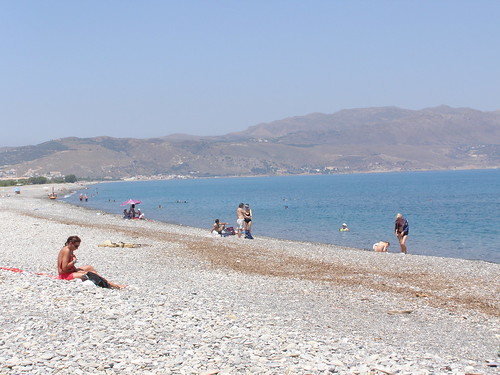
tavronitis beach hania chania

But there’s another reason why I personally dislike going out for a meal in Hania, whether it’s winter or summer; all the restaurants in the province have the same menu. They serve exactly the same food,
as I'm sure most tourists will attest to when asked what they thought of the food in Hania. There is no taste sensation going on here; it's the same food being served up, with only the slightest of variations, depending on the cook, and maybe the quality of the ingredients used. And that’s not all; the same food is served up that any Haniotissa wife and mother would cook on a regular basis for her family; yemista, stifado, horta, kalitsounia, gigandes, you name it. Or maybe I lie; to date, I have never seen fasolada on the menu, and once when I did see fakes on the menu, it wasn’t actually available. We do have one or two Chinese restaurants in the town, but the menu tends to be very pricey, if the set takeaway menu price is anything to go by (30 euro for two people). But that’s about it.

Of course, there are places that serve well-cooked meals; maybe not so interesting, but at least they are very tasty. You just have to know where to go. One of the places you shouldn't go for that kins of meal is a taverna in a tourist area. Beachside tavernas are always a risky choice. You simply never know what you're up against: a restaurant that takes great pride in the food it serves to the here-today-gone-tomorrows, or one that sees this as a good reason not to go to too much bother in the first place. In the shoes of the customer, how do you choose a good place to eat on a sweltering hot day by the beach in an area slightly off the beaten track on a Greek island? After a swim under the brillliant yellow sun in the diamond-encrusted Mediterranean sea, you will probably be hungry, or will get hungry very quickly when the smells of lunchtime grills working in over-drive waft past your nose, whether you're a tourist or a local.

My family's once-a-month outings landed us at Periyiali in Tavronitis with some friends from Athens who were visiting relatives in the area; we decided to go out and meet them in their territory. Living mainly in the big Greek smog, they were pretty much tourists themselves, so it didn't surprise us that they chose the closest, flashiest eaterie near the beach, the one with an impressive round beach bar featuring an array of alcoholic beverages, the one with loud pop music blaring from the speakers, the one where the menu was dictated by the clientele: everyone had just come off the beach, and was bound to head straight back onto a deckchair once they had had their meals. The Northern Europeans were already looking like boiled shrimps. In the summer, there is an endless choice of places to go, but dining by the beach means you have to put up with tourist menus. Even the best diners in the whole town suffer under the pressure of serving well-cooked meals as quickly as the seats are vacated. If you want a high-quality meal in the middle of the summer in Greece, find a friend's house. Don't expect to find a gourmet meal in a summer resort town where package tourists have been flying in at the rate of 40-50 direct flights a day from Northern Europe.
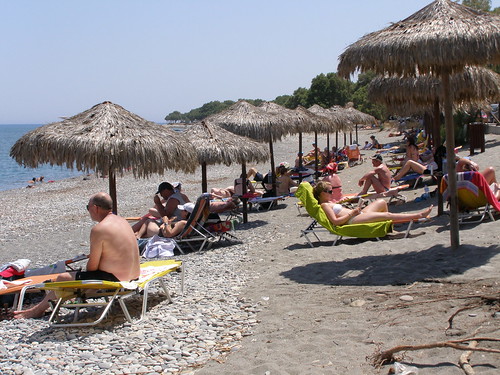
tavronitis beach hania chania

"We come here all the time," they told us, "the owner's a friend of the family." Another thing to avoid when you go to a taverna; no matter how bad the service or the food is, the owner will still be a friend of the family.

"Let's order," said our friends, without even looking at the menu card. This is not unusual; Greeks usually ask to be told the menu by the waiter, which also hints at an aspect of the Greek psyche that may need some explanation: the Greek people have an oratory culture - they are better listeners rather than good readers. Mobile phones have helped advance their talents in this respect; emails simply never caught on. This is why I've lost touch with most of my Greek friends; most of them give me their landline or mobile phone number. They have no idea about computer telecommunication, or what Skype is. Even if they own a computer, they aren't usually connected to the internet. Go ahead, google it: only a third of the Greek population uses the internet; to shock your pants off, here's another interesting bit of trivia: Greek internet users form just over 1% of the users of the internet in the whole of Europe. Of the 27 countries in the EU, Greece ranks in the 14th place for internet usage, well below Romania, who only just entered the EU recently. This angers me, but maybe I should just leave behind some of my New Zealand baggage; paying a shrink to find out why I feel like this is a waste of money, as I already know why. Ηas one not heard of the phrase 'γνώση σε αυτόν' (gnosi se auton)?

I suggested we see the menu cards anyway. There was a wide variety of meals of available, everything that one would expect to see on a Greek menu, organised in the typical way that Greeks organise their menus: appetisers, salad, grills, pizzas, pasta, and traditional Creto-Greco food, which consisted of all the meals we normally cook in our own home in the summer - boureki, moussaka, pastitsio, yemista, fasolakia. There was nothing unexpected or out of the ordinary. I wonder how they would approach a slight menu change: instead of pizza, they could add a vegetarian ladenia; instead of saganaki cheese, how about bouyiourdi?

We sat at a table close to the road next to the beach. The view was wonderfully peaceful, beautiful. It's a pity the tavern had half the windows closed; the outdoor space surrounded the bar which had a lot of business from the foreign tourists filling their beer guts. As soon as we took our seats, along comes a very polite waitress with the bottled water (which we didn't ask for). Why they didn't bring us tap water is a mystery to me - were they really thinking about the money they would make from selling a bottle of water? Bread is only to be bought to the table when it's asked for (new governmental rules since last year), but that came too. I could see that our taverna meal was going to end up costing us more than the most expensive restaurant in the province.

Both families had children with them. Choosing restaurant meals for the children gets easier as they get older. They have their standard favorites: fried squid (kalamari), pizza, chips and salad (or salad oil for dunking for those not keen on greens). We also have our own set favorites when eating at beach tavernas and other suspect eateries: bifteki burgers. You really can't go wrong here, since the plate usually contains some salad and fries on the side. Our friends had completely different ideas about what to order:

tavronitis beach hania chania

"What are you having, Maria?" asked my holidaying friend.
"Oh, I'll have the leftovers from my kids' choices?"
"You're not having a main meal?!?" she exclaims.
"No, they've ordered more than enough for all of us." My husband had also ordered a serving of stuffed bifteki, and with the hors d'oeuvres that were bound to be ordered with our Athenian tourist visitors, we would be feeling stuffed before the mains even come.
"Calamari, chips and pizza? They're just appetisers! What are they having for mains?"
"That's their main meal."
"Well, you order a main then." Sometimes, Greeks are 'too much'.
"They won't eat everything."
"Oh, why not? My kids can eat two plates each." And they certain ly looked as though they could: as primary-school children with their pregnant stomachs and tree stumps for legs, they walked around on their flattened hobbit-like feet like teletubbies.
I stayed firm. "I'm not having a main."

She shrugged and left it at that. Along comes the waiter. "Ready to order?" My friend asked me to give my family's order first. My son called out 'calamari' while my daughter called out 'pizza'. I asked for a serving of stuffed bifteki and a separate order of fries.

"Hey, how many servings of fries d'you want? I can't listen to everyone's order separately," boomed the pot-bellied waiter, who might have been having a hard day, but that was not my problem. I let the others do the talking; they were expert at taverna ordering:

"Let's have three fries, make that four, one with staka, three tzatziki - is that too many? OK, make it two tzatziki - one large combination salad with some dakos, another stuffed bifteki for you, one shrimp saganaki for me, one paeedakia (lamb chops) for my daughter and one grilled octopus in wine sauce for my son (?!?), and let's see, is that enough?" Speak to Greek taverna owners and they will tell you that there are no better customers than Greeks, because they order a lot of food, whether they eat it or not; they leave money for the time they spend at the table, not like the tourists who order two plates and a salad to be shared among four people over a period of two hours.

"May I suggest the mixed fried vegetables (courgettes, aubergines and mushrooms) to go with the tzatziki?" asked the now happy smiling friendly waiter, who could see we were over-ordering, especially since he didn't bother telling us that the biftekia, octopus and paeedakia each came with their own serving of fries.

"Great," my cheery friend agreed. "And a couple of cold beers with that, thanks. Could you just make sure that the paeedakia have a bone, you know, I want them to look like little pork chops with the bone, you know?" She brought her hands up to her face, joined together the thumbs and forefingers, and pulled her hands across in the shape of a rib-bone smile. "It's for a child," she added, with a knowing look on her smiling face. Her daughter must be a very fussy eater.

"Could we have a couple of Cokes, too?" I added.

"Aren't you having any beer, Maria? Why don't you order one bottle of Coke at a time so they bring it to you cold?"

"They're for the children." I never drink alcohol when we go out, because I always end up doing the driving, as if I'm being punished for demanding a no-cooking day. And the children never have fizzy drinks at home. Today is treat day; anything is permissible.

"Your children drink Coke? Oh, wow, our children never drink soda or pop drinks. They only drink water."

There's a time and a place for everything. I had kept my mouth shut long enough. That was enough to get me started. "Why are they so fat then?" I asked innocently with a bewildered look on my face. "And how on earth did they require 1000 euro worth of dental treatment each?" The conversation topic took a 180-degree turn after that: the price of petrol is crippling their use of the SUV in Athens, air-conditioning is a way of life if you live in an apartment, you need more than 100 euro in your pocket each time you go to the supermarket, all topics of unknown quantity to us rural dwellers living off a garden surrounding a detached house all within short distance of our local big smoke, Hania.

Some of the plates we ordered started drifting onto our table. Some dishes came on time (chips and kalamari), others needed a little longer (paeedakia and biftekia), while some never came at all (pizza). The salad had far too much dill, and the salad ingredients did not blend well. We were treated to sugary watermelon and tasteless cherries at the end of the meal. Total cost: 102 euro, for what was basically grilled and fast food (pizza not included).

tavronitis beach hania chania

At least the beach at Tavronitis did not fail to disappoint: it was perfect for swimming - crystal clear water in the shade of the blue in the Greek flag, a pebbly beach with little sand and plenty of shade. Mind you, it isn't shallow: after about two metres in from the shore, the water becomes too deep for children who are used to wading around Kalamaki Beach for a good twenty metres. Next time we're in the Tavronitis area, we'll stick to Anemomilos, just down the road from Periyiali, the no-nonsense place which makes no pretentious claims to what it offers: fast food at decent prices.

©All Rights Reserved/Organically cooked. No part of this blog may be reproduced and/or copied by any means without prior consent from Maria Verivaki.

Wednesday, 23 July 2008

ABC Wednesday: A for Asylum


Another round of ABC Wednesday has started, and this week, it's being hosted on its very own website, ABC Wednesday, created by Denise and her team.
This week's letter is - of course - A, and the word is asylum.

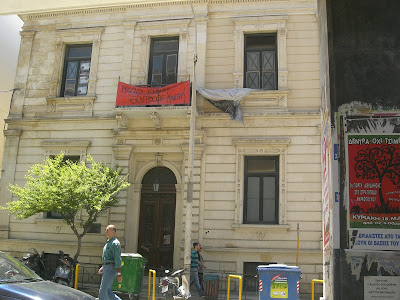
This is one of the old buildings that reminds the residents of Hania of its former more glorious period, the years between the world wars, even though it now looks like a dumpster. The plaque on the building simply states the owner's name and that he donated it to the University of Crete. He must have been an important person in the community. People become important in Greece usually because they are connected with money or politics. To build a house like this one means the former owner was wealthy and/or possibly involved in politics (the two still go hand-in-hand in Greece).

Riches don't always bring happiness, and this is probably the reason why the former owner of the house passed it on to the state in his will. The state had no money to spare (as usual) to maintain it by repairing what needed to be fixed, so the house was left to stagnate in a state of ruin. The University of Crete was expanding and took over the building, as was the original owner's wishes.

There's only one catch with university properties. University areas are protected by asylum: the police can't enter them under any circumstances, according to an archaic Greek law created no doubt for the benefit of the advancement of science and knowledge. This is why not a single university building in the whole country has remained unscathed by attacks from hooligans, vandals, drug dealers, squatters and all other kinds of vagrants. The building in question has been occupied by student activists for the last two years, its present use probably not envisioned by the former owner.

This building is found on the main shopping road in Hania, diagonally across from the Agora, which coincidentally also begins with 'A'.

Tuesday, 22 July 2008

Swimming pool with natural wave movement


My children take swimming lessons in the sea. Today was a particularly choppy day, and the pool was overcome many times with waves. Lessons continue in this weather - the children are taught to jump or ride the waves, and there are lots of laughs and shouts as they do this.

Saturday, 19 July 2008

Elafonisi

Every year, we visit our friend Aleko in his summer house in a small village close to one of the most impressive nature spots on the south-western coast of Hania, Elafonisi, which also sports probably the most aesthetically alluring beach in the region of Hania: crystal clear water, whose rippling ground-level waves roll onto coral-pink sand, tucked away in a remote area of the province which was once extremely difficult to access. The wind always blows hard here, making the water icy cold, even in the middle of summer; maybe it's done on purpose, to keep too much development away from the area, on which point of course it has succeeded.

Κάθε χρόνο, επισκεφθόμαστε τον φίλο μας τον Αλέκο στη θερινή κατοικία του σε ένα μικρό χωριό κοντά σε ένα από τα πιο εντυπωσιακά σημεία της νοτιο-δυτικής ακτής Χανίων, το Ελαφονήσι, το οποίο επίσης έχει μία από τις πιο ελκυστικές παραλίες των σε όλη την περιοχή. Κρυστάλλινα νερά, μικρά κύματα που σπάνε στην κοραλλιογενείς-ροζ άμμο, όλα βρίσκονται σε απομακρυσμένη περιοχή της επαρχίας η οποία κάποτε ήταν εξαιρετικά δύσκολη η πρόσβαση. Ο άνεμος πάντα σκληρά φυσάει εδώ, το νερό παγωμένο, ακόμη και στη μέση του καλοκαιριού! Ίσως αυτό έγινε επίτηδες, για να κρατηθεί πάρα πολύ μακριά από την παγκόσμια ανάπτυξη της περιοχής, στο οποίο σημείο βεβαίως έχει πετύχει.

P7130084

To get to Aleko's house, we drive off the main highway onto very narrow country roads, passing a few sleepy villages, like Topolia, which is famous for the freshness of its water. It is located on a rise, so that the melting snow from the mountains surrounding it passes the area before it gets to the town of Hania itself. We sat under a walnut tree in the central square and cooled ourselves off with some of that refreshing water, with which people fill up plastic containers and take home with them (it's legal).

Ο δρόμος στου Αλέκου το σπίτι μας πηγαίνει από τον κεντρικό αυτοκινητόδρομο σε πολύ στενούς δρόμους, περνώντας μερικά γραφικά χωριουδάκια, όπως τα Τοπόλια, διάσημα για το νερό του χωριού. Το χιονι λιώνει από τα βουνά που περιβάλλουν την περιοχή και περνάει από εδώ πριν να διοχετευθεί στη ίδια η πόλη των Χανίων. Καθόμαστε κάτω από μια καρυδιά στην κεντρική πλατεία και δροσιζόμαστε με το νεράκι, με το οποίο οι άνθρωποι γεμίζουν πλαστικά δοχεία και τα παίρνουν στο σπίτι τους (είναι νομιμο).

walnut tree topolia hania chania

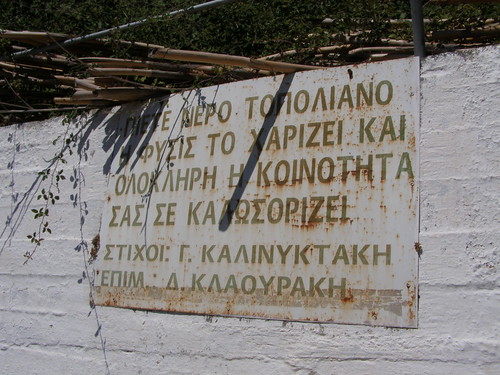
The plaque at the square reads as a mantinada, a form of Cretan poetry:
Drink water from Topoliana,
which Nature freely gives,
the whole of our community
welcomes you to our village.

Μια μαντινάδα έιναι γραμμένη σε μια πινακίδα:
Π
ιέτε νερό Τοπολιανό η φύσις το χαρίζει
και ολόκληρη η κοινότητα σας σε καλωσορίζει.

P7130005

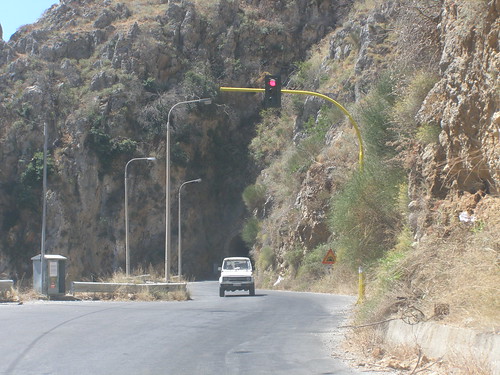
From this point on, the road narrows to a single lane, as it passes through the Gorge of Topolia (not the famous Samaria Gorge, but a narrow chasm nevertheless. A tunnel was built through the mountain. The traffic lights indicate which direction of the traffic has the right of way: only one car fits its width.

Από αυτό το σημείο και μετά, ο δρόμος στενεύει σε μια μονή λωρίδα κυκλοφορίας, καθώς περνά μέσα από το Φαράγγι των Τοπολίων (όχι το περίφημο Φαράγγι της Σαμαριάς, αλλά παρ 'όλα αυτά, ένα στενό χάσμα). Η σήραγγα κατασκευάστηκε μέσα στο βουνό. Τα φανάρια δείχνουν την κατεύθυνση της κυκλοφορίας και ποιος έχει το δικαίωμα να περάσει: μόνο ένα αυτοκίνητο χςράει στο πλάτος της.

tunnel before ayia sophia cave hania chania

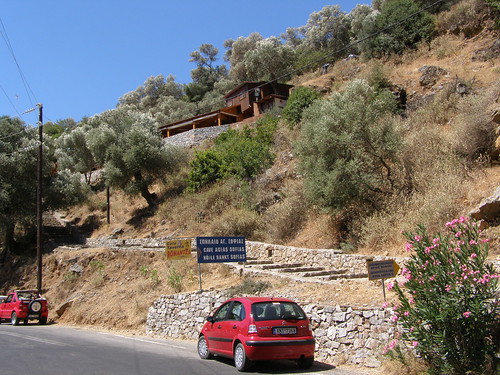
The tunnel leads directly to a hillside containing a cave of archaeological importance, turned into a shrine dedicated to St Sophia. Church services, even wedding ceremonies and baptisms, are held here, especially when the family concerned has been ''promised' to the saint (another meaning of dedicated: 'ταμένος').

H σήραγγα οδηγεί απευθείας στην πλαγιά ενός λόφου που περιέχει μια σπηλιά αρχαιολογικής σημασίας, οι οποία είναι αφιερωμένη στην Αγία Σοφία. Στην εκκλησία αυτή γίνονται γαμήλιες τελετές, ακόμη και βαφτίσια για τις οικογένειες που είναι ταμένες στην Άγια.

ayia sophia cave hania chania

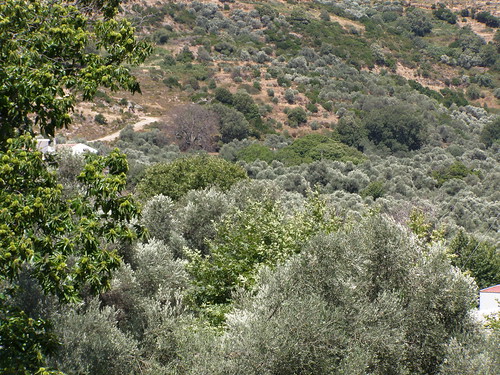
The road then passes through the village of Elos, which gets its name from 'swamp'. It used to be a breeding ground for malaria, but is now one of the most verdant villages in Hania, home to the oldest vineyard in Crete, and an environmentally important eco-system with native flora and fauna. Water runs freely in this area, the tall trees and dense foliage being living proof of this.

Ο δρόμος στη συνέχεια περνά από το χωριό Έλος, το οποίο ήταν γόνιμο έδαφος για την ελονοσία, αλλά τώρα είναι ένα από τα πιο πράσινα χωριά στα Χανιά, σπίτι του αρχαιότερου αμπέλιου στην Κρήτη, με ένα περιβαλλοντικά σημαντικό οικολογικό σύστημα με αυτόχθονα είδη χλωρίδας και πανίδας. Το νερό τρέχει ελεύθερα, ζωντανή απόδειξη τα ψηλά δένδρα και πυκνό φύλλωμα.

elos valley hania chania

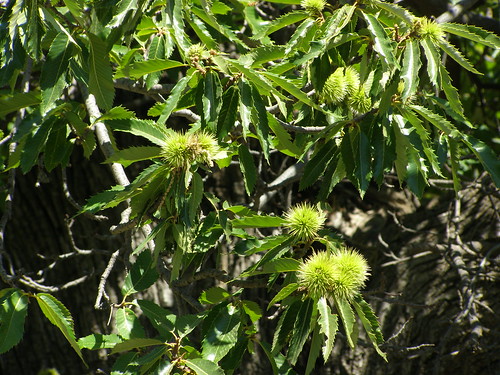
The region also has one of the biggest chestnuts plantations in all of Greece.

Η περιοχή έχει επίσης μια από τις μεγαλύτερες φυτείες κάστανα σε όλη την Ελλάδα.

P7130023

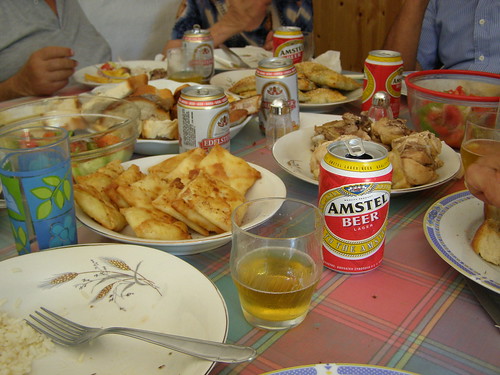
Whenever we visit him at his house, he and his wife always make us feel very welcome: traditional Cretan festive fare is the norm - kalitsounia with mizithra, kalitsounia with vlita, summer salad, boiled chicken with pilafi, pork steaks and potato chips, all followed by a juicy watermelon. he was only sorry that we oculdn't sit outside because the wind was roaring upwards of 7 on the Beaufort scale today (the plastic chairs were flying off the verandah).

Κάθε φορά που τον επισκεφθόμαστε στο σπίτι του, ο Αλέκος και η σύζυγός του πάντα μας κάνουν να αισθανόμαστε πολύ ευπρόσδεκτοι: η κρητική κουζίνα είναι ο κανόνας – καλιτσούνια με μιζιθρα, καλιτσούνια με βλήτα, καλοκαιρινές σαλάτες, κοτόπουλο βραστό μα πιλάφι, χοιρινές μπριζόλες και πατάτες τηγανιτές, και ένα ζουμερό καρπούζι. Σήμερα μας ζητούσαν συγγνώμη που δεν μπορούσαμε να κάτσουμε έξω γιατί ο άνεμος τα έπαιρνε όλα.

P7130060

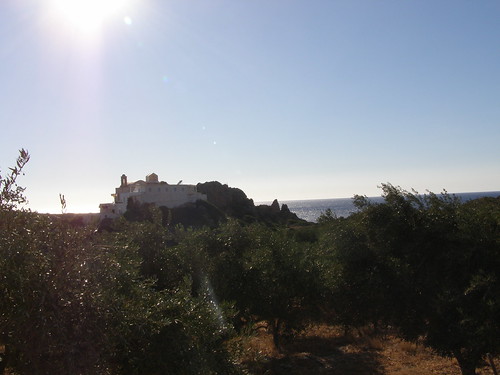
On the way to Elafonisi from Aleko's house, the road takes you past the monastery of Hrisoskalitissa (meaning 'the Virgin of the golden steps') built on the rocks above the roughest coast of the western shoreline of Hania; it stands like a sparkling gem, glistening under the glorious sun. There is a port close by to Hrisoskalitissa monastery; the area once played host to a large customs office, due to the area's inaccessibility to Hania. These times are now long gone, with the coming of extensive road networks.

Στο δρόμο προς το Ελαφονήσι από το σπίτι του του Αλέκου, ο δρόμος περνάει από το μοναστήρι της Χρυσοσκαλίτισσας, χτισμένο πάνω στα βράχια σε ένα άγριο σημείο της δυτικής ακτής των Χανίων. Είναι σαν στολίδι αφρώδη, γυαλίζει υπό τον ένδοξο ήλιο. Υπάρχει ένα λιμάνι κοντά στη μονή, παλιά σημαντικό λιμάνι με τελωνείο, λόγω της ελλειψης πρόσβασης στα Χανιά. Αυτές οι εποχές έχουν περάσει με τον ερχομό του εκτεταμένο οδικού δίκτυου.

P7130068

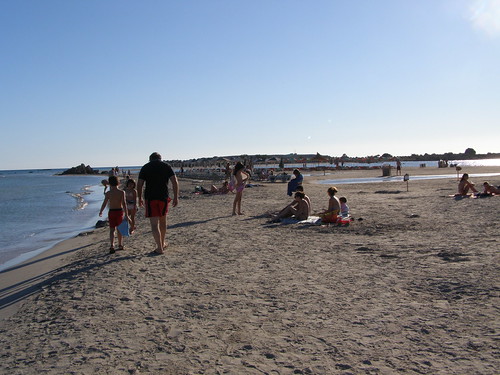
The sandy dirt road leading to the beach has been widened since the first time I came to Elafonisi, but nature is still in its rawest form here. The hills rise high and dry above Elafonisi, while the coast is bordered by low dense shrubs resulting from the high winds which do not allow trees to gain any height. The trees have taken the shape of an upside down witches broom, being swept to one side as the wind blows hard against them. The water is shallow for a long way out, and you can walk all the way to an islet in the middle of the sea, from which the area takes its name, the 'nisi' in 'ealfonisi' means 'island', while 'elafo' comes from the word 'elafi', meaning 'deer': I didn't see any!

Ο αμμώδης χωματόδρομος που οδηγεί στην παραλία έχει διευρυνθεί, αλλά βρίσκεται ακόμη σε αγρια μορφή εδώ. Τα βουνά πάνω από το Ελαφονήσι φαινοντε ολόξερα, ενώ η ακτή συνορεύεται με χαμηλούς πυκνούς θάμνους. Οι ισχυροί άνεμοι δεν επιτρέπουν τα δέντρα να κερδίσουν ύψος. Τα δέντρα έχουν λάβει το σχ΄μα που τους αναγκάζει ο άνεμος να πάρει. Τα νερα είναι ρηχά, και μπορείτε να περπατήσετε όλο το δρόμο στο νησάκι στη μέση της θάλασσας, από το οποίο η περιοχή πήρε το όνομά της, μ’ονο που δεν είδαμε κανένα ελάφι!

elafonisi hania chania

Life in the main centers of Crete do not have that air of island life that many of the smaller islands in the Aegean Sea do: fantastic beaches, seaside cafes, peace and quiet. Like many other south-west coastal towns of Crete, Elafonisi reminds you that Crete is in fact an island, even if you do have to drive a long way out to prove it. The waters are clear and clean, like sparkling crystal. They are shallow but you may find them too icy for your liking - but that's only in the beginning. Once you dip your whole body into the water, you warm up in no time at all. But on the coastal stretches of Elafonisi, you need to lie down like a starfish to immerse your whole body in the water because it is so shallow. The children literally ran to the island from the main shoreline, the water reaching at the most up to their tummies.

Η ζωή στα κύρια κέντρα της Κρήτης δεν έχει τον αέρα του νησιού, όπως τα νησιά του Αιγαίου: φανταστικές παραλίες, παραθαλάσσια καφενεία, ησυχία. Όπως πολλές άλλες νοτιο-δυτικες παράκτιες πόλεις της Κρήτης, το Ελαφονήσι σας υπενθυμίζει ότι η Κρήτη είναι στην πραγματικότητα ένα νησί, ακόμη και αν πρέπει να οδηγείσετε μια μακρινή απόσταση για να το καταλάβετε. Τα νερά είναι καθαρά, κρυστάλλινα και αφρώδη. Είναι ρηχά, αλλά παγωμένα - αλλά αυτό είναι μόνο στην αρχή.


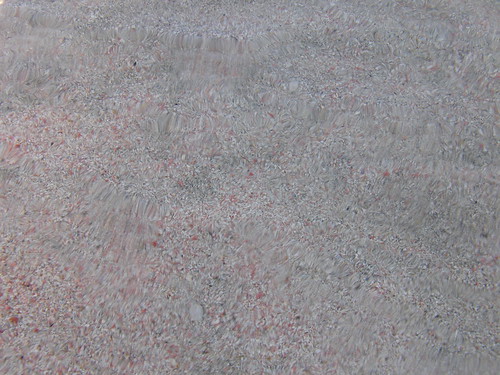
It's not just the depth of the water that will amaze you: the coral pink gravel that forms part of the sand is not seen on other coasts around the island. It all adds to its unique character, along with the flora found on the island itself...

Δεν είναι μόνο το βάθος του νερού που θα σας μαγέψει: το κοραλλιογενείς ροζ χαλίκι το οποίο αποτελεί μέρος της άμμου δεν θα το δείτε άλλού. Προσθέτει στον μοναδικό χαρακτήρα της περιοχής, μαζί με τη χλωρίδα που βρίσκεται στο νησί ...

pink sand elafonisi hania chania

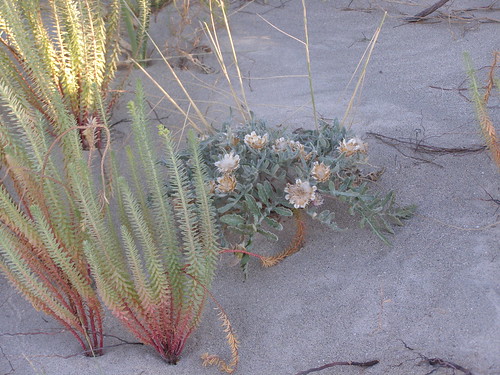
... which plays host to a wide variety of prickly cactus-like flowers that grow in the sand without irrigation.

... υποδοχής μιας ευρείας ποικιλίας κάκτωειδών, όπως και τα λουλούδια που αναπτύσσονται στην άμμο χωρίς άρδευση.

fauna of elafonisi hania chania

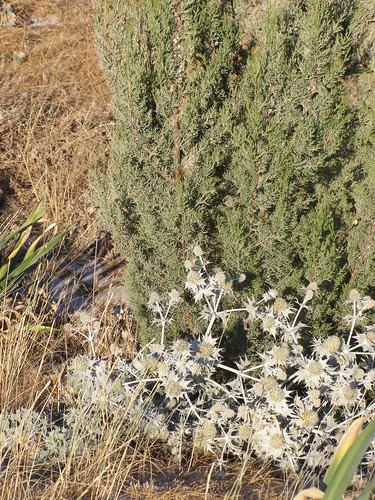
Even cypress trees grow without any help.

Ακόμη και κυπαρίσσια μεγαλώσουν χωρίς καμία βοήθεια

fauna of elafonisi hania chania

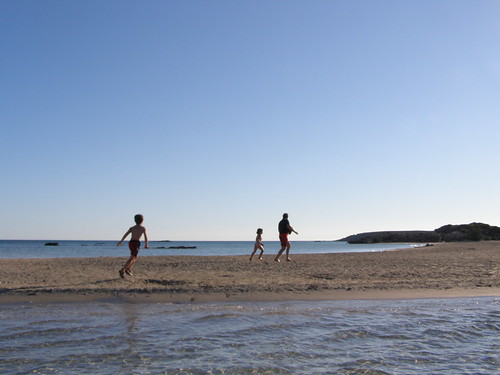
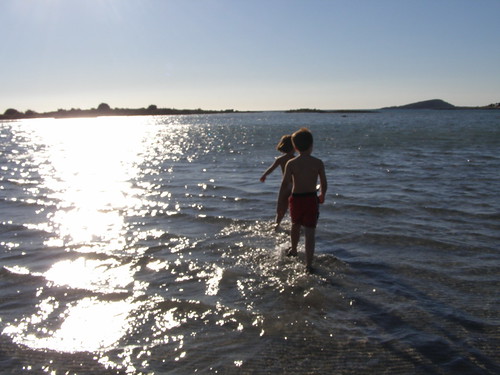
It's always a joy to run wild in these waters.

Είναι πάντα χαρά να τρέχεις μέσα σε αυτά τα νερά.

elafonisi hania chania

And we love going back to this little paradise every summer.

©All Rights Reserved/Organically cooked. No part of this blog may be reproduced and/or copied by any means without prior consent from Maria Verivaki.