Showing posts with label curio. Show all posts

Saturday, 25 April 2009

Twelve o'clock

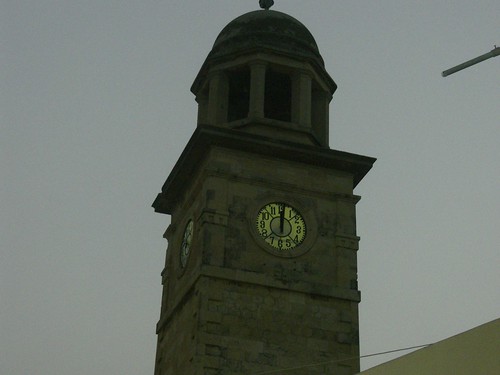
This clock is found at the municipal gardens in the centre, across the road from the twon stadium; it is a meeting point for all the locals.

municipal gardens clock hania chania

"Where shall we meet up?"
"How about by the clock?"

Hopefully, no one was looking at the time it said on the day this photo was taken, because it was neither midday nor midnight.

Monday, 9 February 2009

Red rain

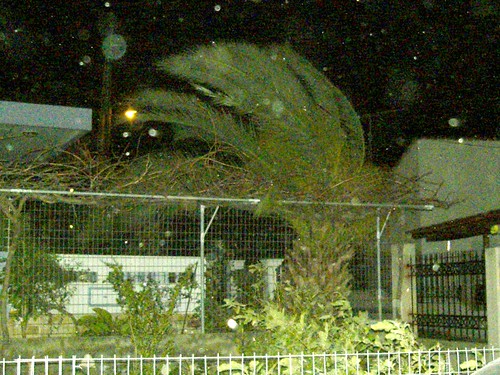
A few days ago, a big windstorm raged all night. Strangely enough, it was very warm wind, not from the Arctic, but from Africa. It was so strong that the ferry boat didn't leave that night, and I lost a bath mat that I had left on the washing line to dry off. I tried to take a photo of the swaying trees, but this was the best I could come up with in the late night.

palm tree in storm

While everyone was trying to sleep with the sound of the wind seeming like it was blowing roofs off the houses it started to rain. The aftermath of the combination of warm strong wind and rain is red rain.

the aftermath of the storm

The phenomenon is due to dust clouds gathering in the African desert, rising and being pushed north (Crete is above Libya). If it rains during that period, the dust settles wherever it lands, and stays there until you clean it; unlike ordinary dust, it sticks to the surface it lands on. If you were unlucky enough to have washing on the line to dry, that too will become red and you'll have to wash it again. In any case, you have to wipe down the washing line, because your clean washing will get red streaks on it.

the aftermath of the storm

This storm occurred a few days ago in Hania. When this happens, you can see most people outside their house as soon as the rain stops, cleaning the red sand from the Sahara Desert off their walls, yards and cars.

And that's life in the Mediterranean right now - we had another bout of it yesterday, this time during the day. As I don't want to get muddy just by standing on my verandah (it actually sticks on your clothes), I've uploaded these photos from the last bout of red rain.

Saturday, 7 February 2009

Naryile

naryile

Ever seen one of these in action?
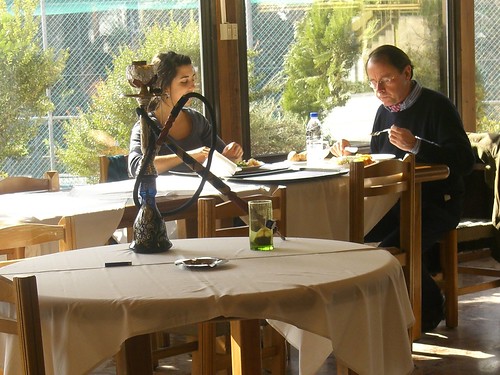
Apparently, it's very popular on campus in the evenings, or just before studying for exams...

Tuesday, 6 January 2009

Crooked house

omalos hania chania

This house is found at the Omalos plateau, near the entrance of the Samaria Gorge. Would anyone like to hazard a guess as to how it got into this state?

The answer will be posted later in the week (along with more photos).

Saturday, 27 December 2008

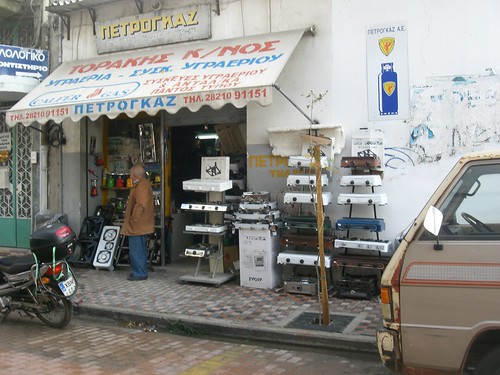
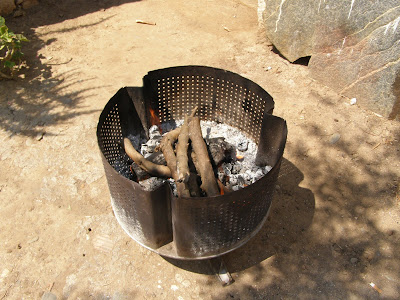
Gas cookers

gas burners hania chania
Mobile gas cookers

Gas cookers were once the main form of cooking element in villages. Although Crete is not connected to gas via pipes, it is still standard practice to use a gas cooker (for reasons of economy) connected to a gas bottle. Once the bottle empties (you will notice the flame not burning brightly, or the bottle is simply empty and gas won't light up), you take it to your nearest gas station (it could be a petrol station) to fill it up, or phone someone to come and replace it for you (if you're not very mobile).

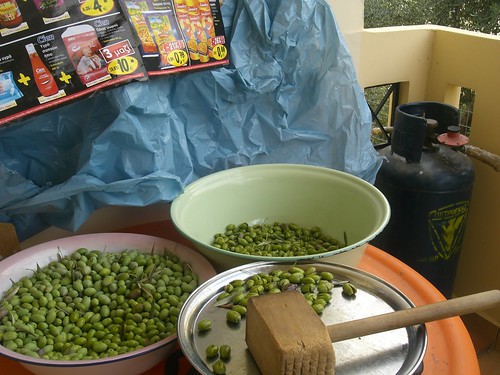
curing green olives for brine
The gas bottle sits in a corner of our balcony. It's connected to the kitchen via a small hole in the wall.

These mobile gas elements are still used by a lot of people such as economic migrants, people on very low wages, owners of country houses in remote villages and others who can't afford the money or the space for a whole cooker. This shop must be doing good business in these difficult times when gas is cheaper as a fuel and the cost of living is rising.

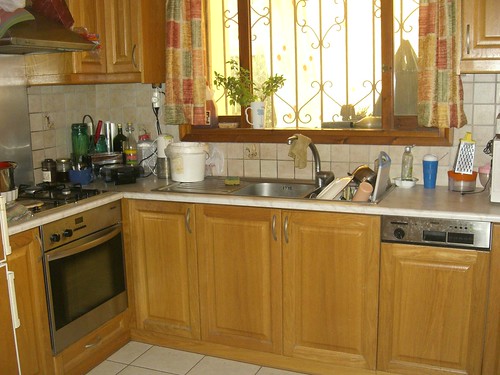
kitchen
Notice the electric elements next to the gas elements, all of which are fitted into the kitchen unit

We use gas for most of our cooking needs, but, as part of the trend in modern house construction and design, the elements are fixed in the kitchen wall unit, rather than being a separate item, as these gas cookers are. I love my gas cooker; chips always fry better on a gas cooker than an electric cooker. The big bonus is that when we have a power cut, I can still cook or warm something up.

Wednesday, 24 December 2008

Little old lady

little old lady in black at iconostasis

While I was weeding the garden, I heard a woman talking on the street. Our street is not exactly the kind you stroll around in; it has no footpath and our house is situated on a dangerous bend. I paid no attention until I realised that the voice was that of a woman who I knew.

She's about a hundred years old, walks with her back bent, and her walking frame is never far away from her. She lives down the road from our house. Every Saturday without fail, come rain or shine, she insists on coming to the iconostasis right across the road from our house and lighting an oil-burning lamp.

Today there was one problem: she lost her way. She's a little blind - aren't all old people?

I decided to help her.

"Come, Kiria Marika, the iconostasis is to your right."

""Who are you?" she asked me while she was in the middle of the road, so that the next car to come speeding up the hill would send her (and myself) flying into the air to another world.

"I'm Maria, now walk to the right."

"Are you new here?"

"Kiria Marika, WALK to the RIGHT!" Where was this woman's daughter, I was asking myself, knowing full well that her daughter could be in the house, and still not notice her mother sneaking out to light the lamp at the iconostasis.

"Are you the cleaning lady? Which house are you cleaning today?"

"Kiria Marika, I'm MARIA from THIS HOUSE!" At this stage, I was getting ready to call for reinforcements.

"Your name's Maria? Do you live here?"

"Kiria Marika, you're now at the iconostasis!" I put her hands on the roof just under the cross. Kiria Marika started making the sign of the cross, praising the lord for getting her to the iconostasis in one piece.

"Oh, it's you, Maria, from the house across the road. I think I almost lost my way, the sun was so bright and I couldn't see where I was going."

You're telling me...

Monday, 22 December 2008

Post-weekend story: Urban garden

(I originally published this post on my other blog - Organically Cooked - on the 5th of December, one day before Greece was plunged into chaos after the death of Alexis.)

There's a serious economic crisis reigning in Greece, invisibly infiltrating the town of hania, visible only the those who read between the lines. People want to work, but are either denied the right to do so, or can't find enough of it. The state has always made a show of their provision of free health care to their protegees, the privileged public servants of Greece. But it has recently been revealed that this free care was at the expense of private businesses and promises that the owners would be paid; the chemists' union has stopped providing drugs to state-insured citizens, and doctors have stopped treating state-insured patients for free. Boutiques and specialised stores are void of customers. The only businesses doing well in Greece are the banks - they're always full of people, people paying off their debts, people withdrawing cash, people taking out loans, people transferring their debts from one bank to another; in general, people needing money.

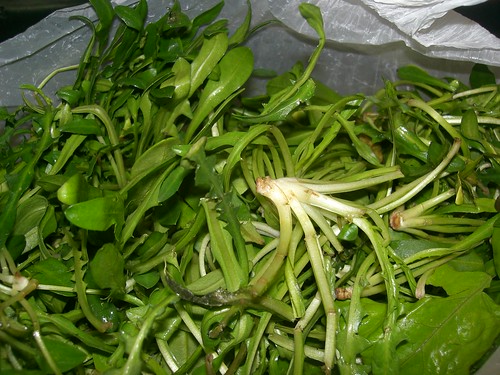
The economic crisis has hit food sales. In Hania, stamnagathi is a prized green, usually selling for at least 7 euro a kilo; in the heart of winter, I've paid more than 8 euro a kilo, which in some cases is more than the price of meat per kilo. Stamnagathi is a fortnightly staple in our house, alternating with other more conventional greens such as cabbage and brocolli. So you can imagine how thrilled I was to find it selling at less than 5 euro a kilo last week. At that price, I should have bought the whole crate and washed, boiled and frozen it to last me until the end of winter.

stamnagathi

As with any cheap product, I was worried about buying low quality: price is nearly always associated with quality, even if this supposition is only in the mind. I decided to ask the shopkeeper why the price of stamnagathi had dropped dramatically. The price of petrol has fallen dramatically, but here's what the shopkeeper had to say:

"This year, stamnagathi has had a slow start because it hasn't rained so much. There has been a sterady supply of it, but it hasn't had that lush green look it used to have at this time of year last year. (I had bought some at this time, and it was rather tasteless and dry.) Now that it's been raining more, it has started to grow more profusely. I was selling it last week at just under 7 euro a kilo, but it wasn't selling. Stamnagathi has always sold at constant levels right throughout the winter. I think it's got to do with the economic crisis. Now stamnagathi is being brought in to us sorted into two types (that's never happened before): the large thick glossy type which sells at a higher price, and the small thin type which sells at a lower price. It gives people a choice price-wise, but it's really the same thing."

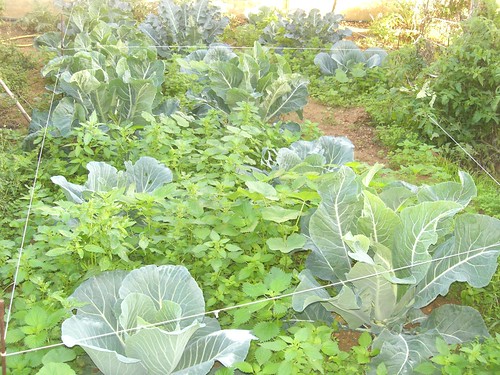
This discussion made me feel very guilty about spending my hard-earned income on a bag of spinach, since the garden is full of nettles, and nettles really do taste like spinach in a spanakopita. I was too lazy to bother harvesting them.

nettles cabbage cauliflower broccoli

The economic crisis was made more obvious to me recently by an amazing discovery I made while getting some chores done in the town centre. I was to meet up with someone while I was there, and we arranged a meeting place. I was the first to arrive at the shopping mall - the only one in Hania - so I wandered around it until my friend arrived.

shopping centre hania chania
The shopping centre reminds me of other shopping precincts around the world, the kind I used to go to in New Zealand, where the shops were always crammed with colourful wares, while the street kids hung around on the benches in the middle of the squares, sniffing glue to while away the time; all that glitters is not gold.

The shopping complex on Boniali street in Hania was modelled around typical shopping malls in large cities, in the hope that it will attract an atmosphere of shoppers that come to view the place as an events arena. People could window shop, try out new things, have a bite to eat from one of the eateries, maybe even food-court style, and entertain their kids. One look at the mall now, and you will think that the economic crisis has had a serious impact in Hania; most of the shop windows are dusty and the units empty. The ones that are being used are divided into two categories: the street-facing units are used as shops selling consumer items (they are all being used), while the offices tucked away in the large marble corridors of the complex, invisible at street level, are being used as offices for private businesses such as engineering and graphics firms. There are many unused compartments, turning the wide corridors into unattractive alleyways that look unsafe. There is underground parking available, but it is expensive; the suers of the car park are usually people who run businesses in the shopping mall and its environs rather than shoppers.

The shopping centre has not been affected by the economic crisis; it was simply never a success. The local community does not do their shopping according to the laws of a shopping mall culture. People use stores referred to them by contacts, or on their own judgment; they love walking down the main shopping streets checking out the windows. If it isn't at street level, then it's invisible. Even food shopping is specialised: if it isn't general supplies which you can pick up from your one-stop shop, the supermarket, it's mizithra, xinohondro, and hand-made filo pastry, sold in stores that have a long established tradition of selling the same product in the same location. Why would anyone want to buy their mizithra from a specialty store located in a modern building with no history? The shops in the mall that opened up and shut down, one after the other, represented markets that were affected by recessions and booms in the economy, as well as seasonal differences, mainly knick-knack articles which made suitable Christmas gifts or interesting artistic additions to the household furnishings - when one could afford it.

Life in Hania does not centre around a shopping mall. Events in a small Mediteranean town have never centred on a commercial enterprise. People have their own private circle of friends; either that, or they organise a get-together with their families, entertaining in their own homes, or going out to cafes where they would be seen, as well as being able to people-watch themselves. This plush clean modern complex, comprised of three different buildings with offices located at the higher levels, became a lunar wasteground with a clinically clean white appearance. Its flower boxes, surrounded by benches for visitors' comfort, are void of colour, filled mainly with weeded earth, save a few sturdy yucca shrubs, planted at a time when there was some hope that the shopping centre would be more successful. But if someone cared to look more closely, they would also have found something else growing in the flower boxes, which would probably seem preposterous in another town:

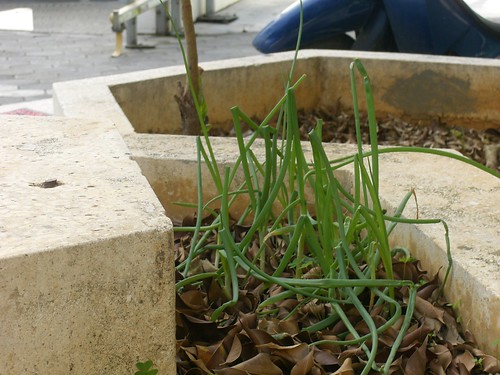
some spring onions, ...
shopping centre hania chania spring onion lower bed

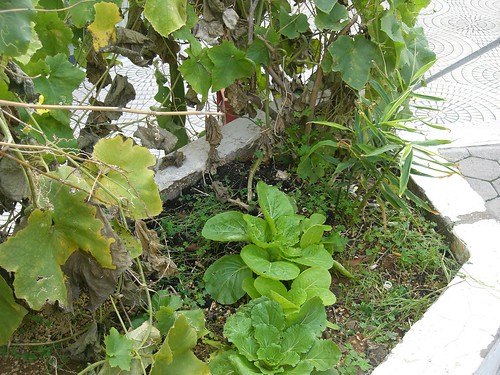
... a few lettuce plants with a climbing pumpkin creeper and grapevine in the background...
shopping centre hania chania lettuce flower bed

... and some coriander.
shopping centre hania chania coriander flower bed

Someone's using these useless flower boxes as their garden. Maybe it's one of the more organically-minded store owners in the mall, maybe it's someone who lives in one of the boxy little apartments in the inner-city, maybe it's someone who simply doesn't have a garden, but wants to eat fresh greens that they have planted themselves. Could it be someone who's feeling the economic pinch, trying to feed a family? It was the coriander that got me wondering: maybe it's an economic migrant that wants a taste of his (or her) homeland. Coriander is never sold at the fresh produce section of our supermarkets. Although I've started growing coriander at home, this herb is too pungent for my family's tastebuds; it's already starting to seed before I had the chance to use it.

Behind the facade of the big flash cars that don't fit onto our narrow roads, the flashy Christmas decorations in the shop windows and the expensive price tags in the high fashion boutiques, a cloud of insecurity hangs over Hania, a fair distance away from our senses so as to seem intangible.

(And the next evening, that cloud of insecurity burst into a violent thunderstorm, drenching us with riots, demonstrations and strikes.)

©All Rights Reserved/Organically cooked. No part of this blog may be reproduced and/or copied by any means without prior consent from Maria Verivaki.
Wednesday, 5 November 2008

Village ingenuity


Recycling at its best.
What is being recycled, and what is its new life?
Answer tomorrow.

Saturday, 1 November 2008

Caper bushes


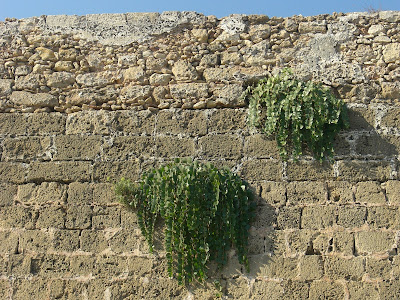
Caper bushes growing in the original wall of the old town of Hania, near the Naval Museum.

Friday, 31 October 2008

The Naval Museum of Hania


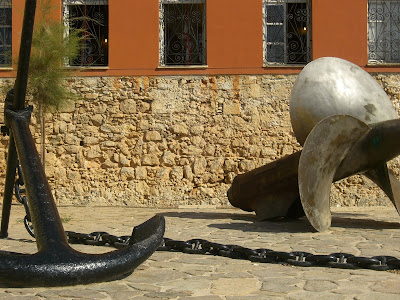
An anchor and a propeller, displayed outside the Naval Museum of Hania, at the Old Port.

Thursday, 30 October 2008

Entrance to the old town


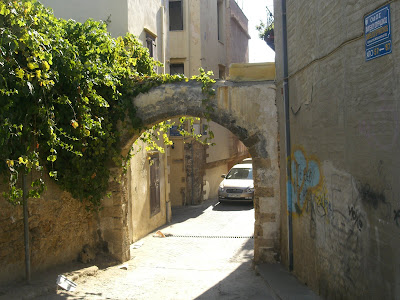
The only surviving gate, one of four, leading into the old walled town of Hania. This one is found in the area of Topanas (the old Jewish quarter), and remains attached to a part of the original wall on the western side.

Wednesday, 6 August 2008

ABC Wednesday: C for Carriage


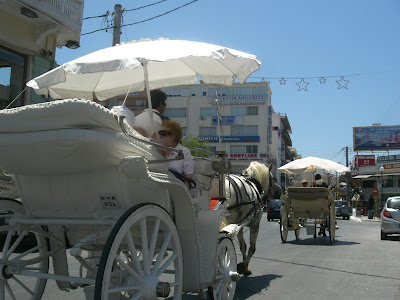
It's ABC Wednesday again, and C is for cart or carriage, in the lovely town of Hania which is usually written as Chania.

Everyone loves going for a ride in one of these old-fashioned carriages. These ones are heading towards the old harbour; as relics of older times, they suit the mood of the lovely port lined with the many little cafe bars. They are used mainly by tourists (at 20 euro for a short ride, the price is a bit steep), and they are also hired for weddings. The town is too small and the roads are too narrow for open-top tourist buses, but these are prettier and will stay in your memory for much longer.

If you're wondering what the Christmas lights are doing in the picture (another 'C' word) on a warm summer's day, don't worry: we don't light them until Christmas time; it's just easier to leave them hanging there rather than taking them down and putting them up every year...

Although the name of the town of Hania is most often written with a 'C' ('Chania'), the 'C' is never pronounced. To pronounce the name of the city correctly when you see it written as 'Chania', pretend it's not there, and say 'Hania' instead. That's why I call my blog 'One day in Hania'.

Monday, 28 July 2008

Odd shots Monday: bottles


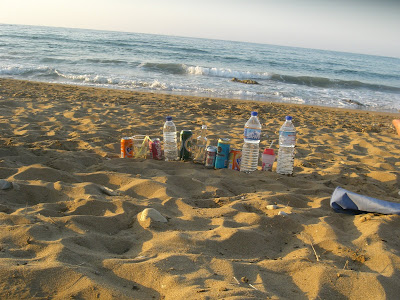
We go to the beach every day in the afternoon, never before 5.30pm. It's still hot, but Mum says it's not so hot that your skin will burn if you're under the sun. That's why she doesn't bother slapping sunscreen oil on our skin. Even though we're there every day, we're hardly brown, which just goes to show you can protect yourself from the sun if you want.

At this time the deck chairs are usually empty, as this is tea time for most of the Northern Europeans who come to visit out town. They've been here all morning, drinking and sunbathing, turning beetroot, as Mum says. The litter bins on the beach are filled with all types of bottles, probably bought from the numerous cafes and beach bars behind us. We fished them out of the bin, filled them with sea water and lined them up for you to see. They made better toys than spades and castle pails.

Monday, 14 July 2008

Odd shots Monday: Horny goats


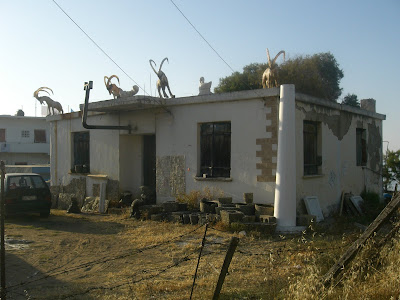
You might be wondering what these goats with kerata are doing up on the roof. George (the owner of the house) put them there. This way, he doesn't have to worry about their knocking over the furniture or ramming the car.

Here are some true stories about kerata (the Greek word for "horns"):

In last year's school Christmas pageant, my son had to dress up as a reindeer.
"I'd like some kerata, please," I asked the shop assistant at the toy shop.

A taxi-driver colleague of my husband's was approached in his taxi by a man who got into his car and showed him a gun. The driver asked "Do I know you?" The man answered: "I'm the kerata." He then asked the driver to stop screwing his wife, advice which the driver heeded.

Instead of saying 'fuck you', you could say 'ta kerata sou' as a term of abuse to someone instead. They'll understand why you mentioned reindeer horns.

Thursday, 10 July 2008

The well of the Turk


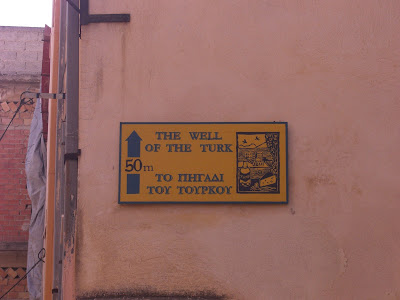
What do you think you will find if you walk 50m up the road to the well of the Turk? This sign is found in Splantzia, on one of the high walled narrow buildings in the maze of streets that was once the Arabian-Turkish area of Hania.

Wednesday, 2 July 2008

ABC Wednesday: Xylophone

It's ABC Wednesday again and X is for xylophone, which stands for 'xylo' (say KSEELO) meaning wood and 'phone' meaning sound.


Press the play button to hear the music of the xylophone (which happens to be made of metal tubes, and not wood), located at the children's public library of Hania, in the municipal gardens.

Saturday, 28 June 2008

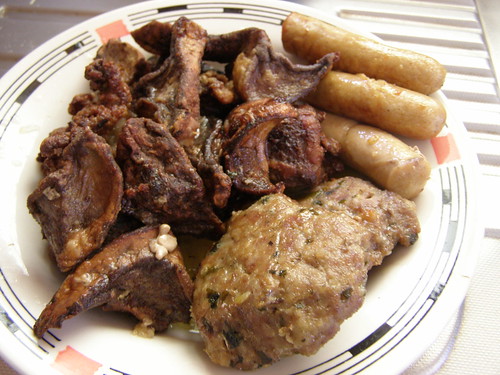
Offal

P6050006
It's a load of old waffle
that awful is OFFAL.
It may not look good
to treat it as food.

But once you have cut it
and floured it and fried it,
believe me, there's nothing
that tastes quite just like it.

Maybe it's hiding
in that little SAUSAGE
you ate as of late
in your wholemeal bread sandwich.

So next time you're buying
a small spring-born lamb,
you might think of eating
what you thought was spam.

It's liver and kidney
and sweetbreads and heart,
the kind of things chucked
in a steak-kidney tart.

Let it all cook until it is crunchy;
just think of it then as a squidgy BIFTEKI.
And when it's all done, it needs very little:
some lemon juice, salt and horta to fill you!

©All Rights Reserved/Organically cooked. No part of this blog may be reproduced and/or copied by any means without prior consent from Maria Verivaki.

Monday, 23 June 2008

Odd shots Monday: the baobab tree


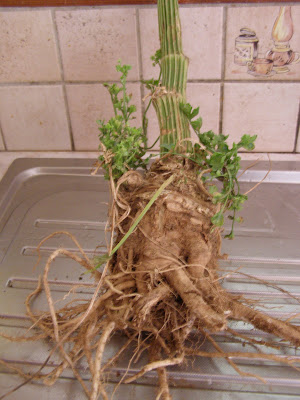
Antoine St-Exupery's The Little Prince was afraid of baobab trees growing out of control on his planet. He knew they had to be trimmed regularly, otherwise they would choke the atmosphere, and there wouldn't be enough oxygen for his own survival. I found one in my garden the other day. It looked grotesque, with its straggly roots and thick torso, like a witch in disguise, infested with black rot. The leaves that were coming out of the trunk were gasping for air (so I cut them off and used them in a bean soup).

Does anyone want to hazard a guess as to what this actually is?

Wednesday, 18 June 2008

ABC Wednesday: Vauxhall Victor vintage vehicle

vauxhall triumph
It's ABC Wednesday again, and V is for Vauxhall Victor.

This one in particular doesn't seem to have moved in a long long time. Although the car's not roadworthy, it obviously means something special to the owner, as he (I doubt it's a woman) is keeping it parked in his driveway, and doesn't seem to want to part with it. It is clearly an FB model which means it dates back to at least 1964 - that car is over 40 years old.

I think my father's first car - from what I can remember - was a Vauxhall.

Sunday, 8 June 2008

Pig on the run


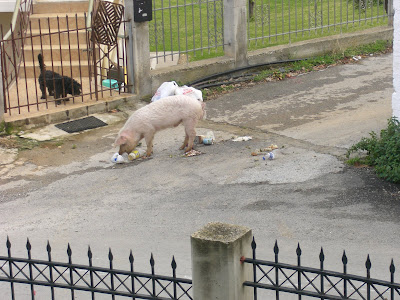
One morning, I opened the balcony door to air the children's room, and was confronted with this sight: the pig had escaped from his owner's field - maybe it got tired of living in a pig sty - and roamed the streets of the village suburb where I live. But not for long; the owner found it and got it tethered up again.

My neighbour had (once again) left her rubbish outside her front gate; her dog sat behind his side of the fence, watching the pig greedily devouring what would have been his dinner. So the pig had a meal out, and from what I nosily observed from my house, it really enjoyed itself.

I don't think the pig has survived to tell its sorry tale, so I'm doing it the honours.