(This post is based on a short story which was originally written 25 years ago, published in the Evening Post, the former evening newspaper of Wellington, New Zealand, and awarded a prize of 20 dollars. Part one of this story was posted on 9 July 2080 in Organically Cooked.)
When I came to Greece on holiday in 1974 with my parents, I thought I was coming to a place where everyone lived by the sea under the sun wearing smiling faces. I didn't expect to experience the feelings aroused by war and sending away soldiers to fight for their country. After three and a half months, our holiday had finally come to an end: our return tickets to New Zealand stated 21 July 1974 as the departure date.
On the eve of our departure, we woke up on a hot summer's day in Pireaus. It was a local holiday in the neighbourhood, as the district church was celebrating its patron saint, the Prophet Elias. Our bags were packed and ready for our departure the next day. Peace and quiet is expected on holidays, and the neighbourhood was silent. My father's sister told us to get ready to go to church. She was about to prepare a picnic to eat near a park in the churchyard. At this moment, there was a knock on the door; it was her sister-in-law.
Barbara had a scared look on her face. My aunt was used to it; Barbara had always been the worrying type. "Seen a ghost, again, Barbara?"
Barbara's hollowed eyes were overcome with tears. "Haven't you heard?"
"Heard what?" snapped my aunt. Now she was worried.
"There's a war on; haven't you heard?"
We turned on the radio. Every single radio station we tuned in to was playing the same pre-recorded message: "... state of war..., ... emergency... γενική επιστράτευση (mobilisation of military forces into combat)..." Now my aunt was worried.
On 20 July, 1974, Turkey invaded Northern Cyprus (which it has been occupying illegally for the last 34 years; its status in the region is still not recognised globally) and the Greek airports closed down to all international flights. Overnight, from holidaymakers, we had officially become overstayers.
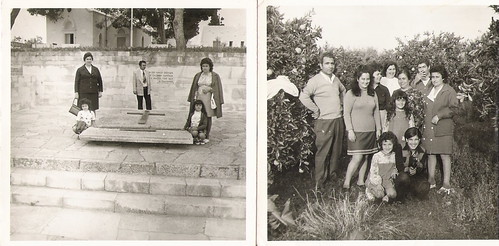
(the tombs of the famous Venizelos family, heads of state, Hania; orange groves in the village; 1974)
All men aged under 40 were called up for compulsory enlistment. My father was 39 years old at the time. As a Greek citizen, he had to do his duty. The state asked for the enlistment of all men who, upon completion of their military training, had received a coloured certificate when they were dismissed. Those given a white certificate were excused from service at this time. Dad couldn't remember what colour his certificate was, but he knew where he kept his military documents: in the inside pocket of an old blazer he had travelled to New Zealand with, which was hanging in the wardrobe of our home in Wellington. After a few phone calls from neighbours' houses - we begged them to take our dollars, phone calls were not cheap back then - we managed to track down my aunt who had a key to our house. She found the certificate (and the house broken into), and called us immediately from our home, to tell us it was white. We told her not to expect us at the airport. When will you be coming back? she asked us. We don't know, my mother replied. Take the girls and go home, my father told my mother. I'm not leaving without you, my mother cried. He didn't really want to go back anyway.
At the tender age of eight, to me, war signified guns, Nazis and starving naked children, all of which bore no resemblance to the war that was unfolding in Greece. People wouldn't come out of their houses, the streets were empty, not a sound to be heard - music had practically become banned overnight (most of it had been censored in any case, under the military junta regime). Everyone had the radio turned on to hear all the news reports. People would walk around their houses, in their yards, with long faces; if they had to go somewhere - cars crossed the roads only occasionally - they would walk hurriedly, as if they feared a bogeyman. Whenever they came across a religious icon, they solemnly made the sign of the cross and whispered a prayer. My sister and I, once regarded as the 'Greek tourist foreigners', the centre of attention, were now noticed.
Our father was not drafted; other children's fathers and brothers were not so lucky, making them grow up so quickly. Children my age would be talking about the war situation in as serious a tone as their parents', fearing that they may have to face up to losing an important member of the family, and in Greek families, all the men were like electricity pylons, heading and directing everyone else.
The days of the war period passed slowly. We stayed at home, with the radio on all day, tuned into a news station, waiting for any updates to the situation. The report we had been hoping for came quite suddenly. We were at Barbara's house. Her husband had also escaped military service, and her son was under 18, the age required to be drafted. They were a happier family than most others in the neighbourhood. The radio had been playing soft music, when suddenly it was cut off, and the standardised melody signalling the news report came on.
This time, there was more than the usual commotion when the scheduled news reports were broadcast. "Ta nea, ta nea!" This was a signal for everyone, especially children, to shut up.
And then we heard the news report. It consisted of three words, because the rest - if there were any - were drowned by the whole neighbourhood's cries of joy: "Ο πόλεμος τελείωσε." (The war is over.)
Shouts, screams, laughter, hugs and kisses filled the streets. The grown-ups put on music, the children let off firecrackers. This all began to happen in less than a minute, which just goes to show, everybody - literally - was listening to the radio, and probably the same station. I can still remember the first question I asked my aunt: "Does this mean we're going back to New Zealand?" Everyone laughed. "So you want to go back now?" she asked me, with tears in her eyes. Despite the end to my war, the conflict still continues in different form in Cyprus.
My parents were eager to leave as soon as possible in case more hostilities broke out. No one cried on the day of our departure, except for one hysterical aunt who cried at any emotional event, whether happy or sad. They all asked us not to forget them, and to come back again some time, not to visit, but to stay for good. I do not recall the return journey to New Zealand. We had no time to call anyone back home to tell them we were coming. When we finally touched down at Wellington Airport, we picked up our suitcases and took a taxi home. There was no one to welcome us back.

(school photo, Clyde Quay School, Wellington, New Zealand, 1978)
It was late in the afternoon when we arrived in Mt Victoria. My sister and I had the same thing on our minds: to walk down Armour Avenue to our aunt's house and announce our arrival. We could see the light on in her house. Telephones were not that widespread in the mid-70s, no matter which part of the world you lived in. I remember seeing my four-year-old cousin; he had grown taller in the four months we had been away. And it didn't take long for our neighbours to find out about our return: Mt Victoria was still very much a Greek suburb of Wellington in the mid-70s; in 1978, seven of the 12 school leavers at Clyde Quay School were of Greek origin. They started crowding into my aunt's tiny house, to hear us tell them all about out adventures in the land they left, but yearned to go back to.
©All Rights Reserved/Organically cooked. No part of this blog may be reproduced and/or copied by any means without prior consent from Maria Verivaki.

Incredible post, like the days it describes.
ReplyDelete"...I thought I was coming to a place where everyone lived by the sea under the sun wearing smiling faces."
This is still the image most people i have come across have for Greece :-)
"At the tender age of eight, to me, war signified guns, Nazis and starving naked children, all of which bore no resemblance to the war that was unfolding in Greece."
Although a term not used when people talk about dictatorship (κούφια η ώρα που τ' ακούει ;-) ), i have come to the conclusion that it is essentially a cold "civil war" (Cold as in the "common" Cold War :-) ) because the society gets equally polarised into groups for and against the situation.
That was a most illuminating post.
ReplyDeletePS it was warmer here today and overcoats were not need but even for us summer is still cool.
What can I say for this great post? I am really touched recalling that horrible period of our recent history. As a Greek Cypriot refugee from the North part of Nicosia, who was forced to leave his house, by the Turkish invators, I want to deeply thank you for sharing this story. REMEMBER CYPRUS!
ReplyDeletehi! i wanted to thank you for this post. i didn't know much about the war. all i know is that my parents have pictures of themselves at the protests in washington, dc at the time. i was four years old. my family is from thessaloniki, and my dad talks lovingly of crete. he went when he was young, and for years, it has been our goal to go finally see it for ourselves. we hope to go next summer. thank you for showing us life there.
ReplyDeleteWhat a post! So much history, and RECENT in a way. It seems you are just slightly younger than me, and I cannot imagine such a thing happening when I was 8 or 9. War to me was Vietnam, not Nazis, but it was only on television for someone my age.
ReplyDeleteThis is what I call a living piece of History.
ReplyDeleteI was amazed reading this post; as a former journalist and a History lover.
If I'm allowed I will only be in holidays from 4th to 31th August but until then I'm almost drowned in work so I really think it's more honest to start my "blogholidays" right now because I won´t have the time friends around blog world need and deserve.
Please take care and enjoy each little bit of life.
Love the post! It has been a crazy weekend. But I am back. Have a great day!
ReplyDelete